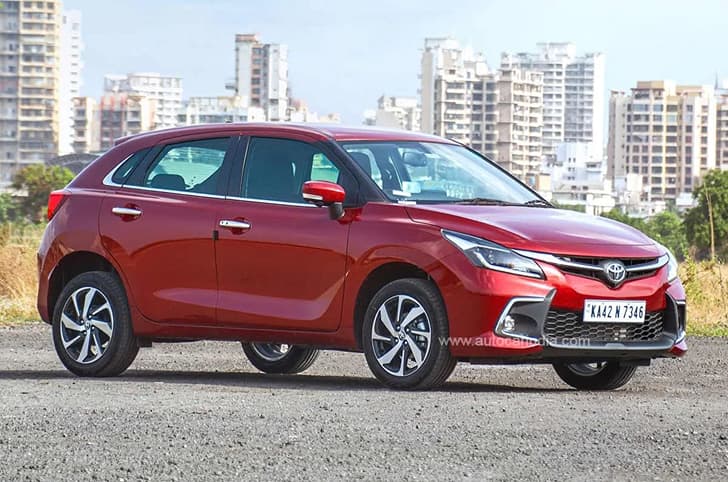

The 2026 Toyota Glanza facelift (launching October 14) gets a new 3-cylinder engine, Level 2 ADAS, and ventilated seats, directly rivalling the 2026 Maruti Baleno facelift from which it shares its platform and powertrain.
The 2026 Toyota Glanza facelift is a mid-cycle update launching on October 14, 2026, with an expected ex-showroom starting price of approximately Rs 6.75 lakh — a step up from the outgoing model's Rs 6.73 lakh entry point. The headline changes are a new 1.2-litre three-cylinder petrol engine, Level 2 ADAS, and a revised front fascia that brings it visually in line with the 2026 Maruti Suzuki Baleno facelift, which launched roughly a month earlier in September 2026.
Because the Glanza and Baleno share the same Heartect platform, powertrain, and most of their feature architecture, the facelift is best understood as Toyota's version of the same engineering update — with some interior and exterior differentiation to justify the Toyota badge premium.
Quick Comparison: 2026 Toyota Glanza Facelift vs 2026 Maruti Baleno Facelift vs Hyundai i20
| Specification | 2026 Toyota Glanza Facelift | 2026 Maruti Baleno Facelift | Hyundai i20 |
|---|---|---|---|
| Launch / On-sale | October 14, 2026 | September 2026 | On sale (current gen) |
| Starting price (ex-showroom) | ~Rs 6.75 lakh (expected) | Rs 5.99 lakh | Rs 5.99 lakh |
| Engine | 1.2L 3-cyl Z-series petrol | 1.2L 3-cyl Z-series petrol | 1.2L 4-cyl petrol |
| Power / Torque | 83hp / 112Nm | 83hp / 112Nm | 88hp / 115Nm |
| Gearbox options | 5-speed MT, 5-speed AMT | 5-speed MT, 5-speed AMT | 5-speed MT, CVT |
| CNG variant | Expected (70hp / 102Nm) | Yes (70hp / 102Nm) | No |
| ARAI fuel efficiency (petrol) | To be declared (current: 22.35–22.94 kpl) | To be declared | Up to ~20 km/l (ARAI, manufacturer claim) |
| Level 2 ADAS | Yes (expected) | Yes | No (current gen) |
| Ventilated front seats | Yes (top trims, expected) | Yes (segment-first claim) | No |
| Wheelbase | 2,520 mm | 2,520 mm | 2,580 mm |
| Length | ~3,990 mm | 3,990 mm | 3,995 mm |
| Bharat NCAP rating | TBD | 4-star | Not tested (current gen) |
| Key weakness | Premium over Baleno for near-identical hardware; Toyota-specific differentiation is cosmetic | 83hp is down from the old 90hp four-cylinder; AMT only (no CVT) | No ADAS, no CNG, narrower dealer network vs Maruti |
Sources: Autocar India – Glanza facelift specs, Times of India – Baleno vs i20 comparison
What exactly is the 2026 Toyota Glanza facelift, and why does it matter?
The Toyota Glanza is a badge-engineered derivative of the Maruti Suzuki Baleno, sold through Toyota's Nexa-equivalent network in India under a cross-badging arrangement between Toyota and Suzuki. Every significant mechanical change to the Baleno eventually flows into the Glanza, typically with a lag of a few weeks to a couple of months.
This facelift matters for two reasons. First, it introduces a genuinely new engine architecture — the shift from a four-cylinder to a three-cylinder unit is not a minor tweak; it changes the car's character. Second, it brings Level 2 ADAS to the premium hatchback segment for the first time, a feature previously reserved for SUVs priced well above Rs 10 lakh. The Baleno facelift launched in September 2026 with claims of segment-first Level 2 ADAS and ventilated front seats, and the Glanza facelift is set to carry those same credentials from October 14.
For buyers deciding between the two, the hardware is nearly identical. The choice comes down to Toyota's after-sales reputation, residual value expectations, and whether the cosmetic differentiation justifies the expected price premium.
What does the 2026 Glanza facelift look like on the outside?
Toyota has released an official teaser ahead of the October 14 launch, and the front fascia is the primary canvas for change. The Toyota logo has migrated from the grille to the leading edge of the bonnet — a design move that aligns with Toyota's global identity refresh.
The teaser reveals a shiny garnish strip that extends downward into a revised bumper, rectangular fog lamps replacing the circular units of the outgoing model, and a hexagonal pattern for the air intake. An ADAS sensor module is expected to be mounted at the front, similar to the placement on the updated Baleno — a functional addition rather than purely decorative.
New exterior colour options are anticipated, though Toyota has not confirmed the palette ahead of launch. The side profile and rear are expected to carry over largely unchanged from the pre-facelift model, maintaining the familiar five-door hatchback silhouette with a 2,520 mm wheelbase and approximately 3,990 mm overall length.
The Hyundai i20 is 30 mm wider and has a 60 mm longer wheelbase than the Glanza/Baleno pair, which translates to a marginally more spacious rear cabin. The Glanza's dimensions remain unchanged with this facelift, so that gap persists.
How has the interior changed in the 2026 Glanza facelift?
The cabin layout is expected to stay largely familiar. The layered dashboard, physical switchgear, and dash-top infotainment screen of the pre-facelift model are all expected to carry over, consistent with how Toyota has handled previous Glanza updates — evolutionary rather than revolutionary.
The meaningful interior additions tie to the new feature set. Additional steering wheel buttons for ADAS controls are expected, and Toyota may introduce new interior colour themes to visually distinguish the Glanza cabin from the Baleno's — a small but commercially important detail for buyers who walk into both showrooms.
The 9-inch touchscreen infotainment system with wireless Android Auto and Apple CarPlay, automatic climate control, and connected-car technology are all expected to carry over from the current model. The head-up display and 360-degree camera, which are already available on higher trims of the outgoing Glanza, should be retained.
What new features does the 2026 Glanza facelift bring?
The feature additions mirror what the 2026 Maruti Baleno facelift introduced, which makes sense given the shared architecture. On top trims, buyers can expect:
Ventilated front seats — the Baleno facelift claimed this as a segment-first, and the Glanza is expected to follow suit on equivalent variants.
Cooled wireless charging pad — an upgrade over the standard wireless charger on the outgoing model, adding active cooling to prevent phone overheating during charging.
Upgraded audio system — the Baleno facelift pairs its 9-inch screen with a six-speaker Clarion system; the Glanza is expected to offer comparable audio hardware.
Level 2 ADAS — this is the headline safety addition. The suite is expected to include adaptive cruise control with automatic emergency braking, lane-keep assist, and high-beam assist. A tyre pressure monitoring system (TPMS) is also expected to be added.
Carried-over safety features include six airbags (standard across the range on the Baleno facelift — the Glanza is expected to match this), ABS with EBD, electronic stability control, hill-hold assist, ISOFIX child-seat mounts, and a 360-degree camera on top trims.
The Hyundai i20 does not currently offer Level 2 ADAS in its lineup, giving the Glanza/Baleno pair a meaningful safety technology advantage in the segment. The i20 does offer a 10.25-inch touchscreen (larger than the Glanza's 9-inch unit) and a single-pane sunroof — features the Glanza does not offer.
For buyers who prioritise safety tech, the Glanza facelift's ADAS package is a genuine differentiator. For those who want a sunroof or a larger screen, the i20 still holds an edge. If you're comparing hatchbacks with six airbags across the segment, our guide to best hatchbacks with 6 airbags under Rs 10 lakh covers the full space.
What engine powers the 2026 Toyota Glanza facelift?
This is the most consequential change in the facelift. The outgoing Glanza uses Maruti's 1.2-litre four-cylinder K-series petrol engine, which produces 90hp and 113Nm. The 2026 facelift is expected to replace this with Maruti's newer 1.2-litre three-cylinder Z-series unit, the same engine introduced in the 2026 Baleno facelift.
In the Baleno, this three-cylinder unit produces 83hp at 5,700 rpm and 112Nm at 4,500 rpm — a reduction of 7hp and 1Nm compared to the outgoing four-cylinder. On paper, that sounds like a step backward. In practice, three-cylinder engines of this generation are typically tuned for lower-rpm torque delivery and improved fuel efficiency, which is the trade-off Maruti has made explicitly.
The current Glanza's ARAI-claimed fuel efficiency sits between 22.35 km/l and 22.94 km/l depending on variant. The Z-series engine in the Baleno facelift is tuned for further efficiency improvement over this figure, though official ARAI numbers for the Glanza facelift are yet to be declared. These are manufacturer-claimed ARAI figures; real-world fuel economy in city driving conditions typically runs 15–20% lower.
Gearbox options remain unchanged: a 5-speed manual transmission and a 5-speed AMT (automated manual transmission). There is no CVT option — a gap that the Hyundai i20 fills with its IVT (Intelligent Variable Transmission) automatic. For buyers who prefer a smoother automatic experience, the Glanza's AMT, while practical, does not match the refinement of a CVT or torque-converter automatic.
CNG variants are expected to continue in the facelift lineup. The Baleno facelift's CNG variants produce 70hp and 102Nm, and the Glanza CNG facelift is expected to offer comparable output figures. CNG availability is a meaningful advantage over the Hyundai i20, which does not offer a factory-fitted CNG option.
How does the Glanza facelift's engine compare to the Baleno facelift's — are they identical?
For practical purposes, yes. Both cars are expected to use the same 1,197cc three-cylinder Z-series naturally aspirated petrol engine producing 83hp and 112Nm, paired with the same 5-speed manual or 5-speed AMT gearbox options. The Autocar India specifications page for the Glanza facelift confirms the 1,197cc displacement, three-cylinder configuration, and front-mounted engine layout.
Toyota may apply minor calibration differences — as it has done with previous Glanza iterations — but no significant powertrain divergence is expected. The CNG tuning, if carried over, would also mirror the Baleno's 70hp/102Nm CNG output.
The key question for buyers is whether the Toyota badge, dealer experience, and stronger resale value justify the price premium over the Baleno. Historically, the Glanza has commanded a Rs 20,000–50,000 premium over equivalent Baleno variants, and the facelift is unlikely to change that dynamic.
What is the expected price of the 2026 Toyota Glanza facelift, and how does it compare to rivals?
The outgoing Glanza is priced between Rs 6.73 lakh and Rs 9.99 lakh (ex-showroom), and the facelift is expected to be priced higher given the feature additions and engine upgrade. Autocar India's expected price range for the facelift is Rs 6.75 lakh to Rs 7.65 lakh (ex-showroom) at the time of writing, though official prices will be confirmed on October 14, 2026.
For context:
- 2026 Maruti Baleno facelift: Rs 5.99 lakh to Rs 9.99 lakh (ex-showroom), with AMT variants between Rs 7.50 lakh and Rs 9.99 lakh, and CNG variants at Rs 7.92 lakh (Delta) and Rs 8.92 lakh (Zeta)
- Hyundai i20: Rs 5.99 lakh to Rs 9.35 lakh (manual, ex-showroom), Rs 8.81 lakh to Rs 10.63 lakh (IVT automatic, ex-showroom)
- Tata Altroz: Competes in the same segment, though it uses a different platform and does not share the Baleno's powertrain
The Glanza facelift's on-road prices in major cities, based on Autocar India's estimates, range from approximately Rs 7.60 lakh (Gurgaon) to Rs 8.00 lakh (Hyderabad) for the base MT variant, and up to Rs 8.99 lakh (Chennai) for the AMT variant. These are estimated on-road figures inclusive of registration and insurance; ex-showroom prices will be the official reference point.
The straightforward weakness here is clear: if you're buying on value, the Baleno facelift offers near-identical hardware at a lower starting price. The Glanza makes sense if Toyota's service network, warranty terms, or resale value in your city tip the equation in its favour.
How does the 2026 Glanza facelift's ADAS system work, and is Level 2 meaningful in India?
Level 2 ADAS is defined as a driver assistance system that can simultaneously control both steering and acceleration/braking, but requires the driver to remain attentive and in control at all times. It is not autonomous driving. The driver must keep hands on the wheel and eyes on the road; the system assists rather than replaces human judgment.
The expected ADAS suite on the 2026 Glanza facelift — mirroring the Baleno facelift's package — includes:
- Adaptive cruise control (ACC): Maintains a set speed and automatically adjusts to the speed of the vehicle ahead
- Automatic emergency braking (AEB): Detects imminent collisions and applies brakes if the driver does not respond
- Lane-keep assist (LKA): Detects lane markings and provides steering input to keep the car centred
- High-beam assist: Automatically switches between high and low beams based on oncoming traffic
In Indian driving conditions — mixed-quality road markings, unpredictable traffic patterns, two-wheelers cutting across lanes — Level 2 ADAS works best on highways and well-marked expressways. In dense urban traffic, adaptive cruise control and lane-keep assist are less consistently useful, though AEB remains valuable in any environment.
Both the Glanza and Baleno facelifts bringing this technology to the sub-Rs 10 lakh segment is significant. Previously, ADAS was largely confined to SUVs above Rs 10–12 lakh. If you're researching the broader ADAS space in affordable cars, our roundup of top 10 most affordable ICE cars with ADAS provides useful context.
Should you buy the 2026 Toyota Glanza facelift or wait for the Maruti Baleno facelift?
This is the central buying decision for most shoppers in this segment, and it deserves a direct answer.
Buy the Glanza facelift if:
- Toyota's service network is stronger or more convenient in your city
- You expect better resale value from the Toyota badge (historically true in many markets)
- You want the same hardware with a different visual identity and stronger brand perception among buyers if you plan to resell
- Toyota's warranty terms or service packages suit your ownership profile better
Buy the Baleno facelift if:
- Price is the primary consideration — the Baleno starts lower and offers more variant choices
- You want access to Maruti's larger service network (Maruti has the widest dealer and service footprint in India)
- The AMT or CNG variants you want are available at a lower price point on the Baleno
- You're comfortable with the Maruti Nexa experience
Consider the Hyundai i20 if:
- You prefer a CVT automatic over an AMT
- A sunroof matters to you (the i20 offers one; the Glanza/Baleno do not)
- You want a larger 10.25-inch infotainment screen
- You're willing to trade ADAS and ventilated seats for those features
The Tata Altroz is also worth considering if you prioritise a 5-star Bharat NCAP safety rating and a more distinctive design, though it uses a different engine and does not offer CNG or ADAS at this price point.
For buyers focused on safety ratings across the hatchback segment, our guide to best hatchbacks with 6 airbags under Rs 15 lakh covers the full competitive set.
What are the key weaknesses of the 2026 Toyota Glanza facelift?
No buying guide is complete without an honest assessment of the downsides, and the Glanza facelift has several worth acknowledging.
Power reduction: The new three-cylinder Z-series engine produces 83hp versus the outgoing four-cylinder's 90hp. That 7hp deficit is noticeable in highway overtaking scenarios and on steep gradients. The trade-off is fuel efficiency, but buyers who do a lot of highway driving may feel the difference.
No CVT option: The AMT gearbox is functional but not as smooth as a CVT or torque-converter automatic. Competitors like the Hyundai i20 offer a CVT, which is a meaningfully better experience in stop-and-go traffic.
No sunroof: Neither the Glanza nor the Baleno offers a sunroof in any variant, which is an increasingly common expectation in the premium hatchback segment. The i20 offers one.
Premium over Baleno for near-identical hardware: The Toyota badge commands a price premium, but the underlying engineering is the same. Buyers who research carefully will know they're paying more for brand differentiation rather than a different product.
Three-cylinder refinement: Three-cylinder engines, even well-engineered ones, tend to produce more vibration and noise at idle and low revs compared to four-cylinder units. This is a character trait of the engine architecture, not a defect, but it represents a step down in refinement from the outgoing K-series four-cylinder.
Bharat NCAP rating pending: The outgoing Glanza does not have a Bharat NCAP rating. The 2026 Baleno facelift received a four-star rating, and the Glanza facelift is expected to be tested eventually given the shared structure, but no rating is confirmed for the facelift at launch.
What is the verdict on the 2026 Toyota Glanza facelift?
The 2026 Toyota Glanza facelift is a well-timed update that brings the car's feature set and powertrain in line with the 2026 Maruti Baleno facelift — its platform twin and closest competitor. The addition of Level 2 ADAS and ventilated front seats to a sub-Rs 10 lakh hatchback is genuinely meaningful, and the new three-cylinder engine, while less powerful than its predecessor, is tuned for better fuel efficiency.
The case for the Glanza over the Baleno rests on Toyota's brand equity, service reputation, and resale value — factors that vary by city and ownership profile. The case against it is equally clear: you're paying a premium for hardware that is, in most measurable ways, identical to what the Baleno offers at a lower price.
For buyers who have already decided on this platform and are choosing between the two badges, the Glanza is a rational choice if Toyota's after-sales network is strong in your area. For buyers who are undecided between this segment and the compact SUV space, the premium hatchback's strengths — fuel efficiency, urban maneuverability, and now ADAS — make a compelling case at this price point.
Official prices and variant details will be confirmed on October 14, 2026. Watch this space for a post-launch price breakdown and variant-by-variant buying recommendation.
Sources
- What to expect from 2026 Toyota Glanza facelift ahead of launch | Autocar India
- Toyota Glanza facelift Specifications – Engine, Dimensions & Features | Autocar India
- 2026 Toyota Glanza facelift: What to expect ahead of launch | Times of India
- Maruti Baleno facelift vs Hyundai i20: Price, specs, features compared | Times of India
- Toyota Glanza – Official Toyota India Page
- Top 10 most affordable ICE cars with ADAS | Autocar India
- Best Hatchbacks With 6 Airbags Under Rs 10 Lakh in India (2026) | AutoindexIndia
- Best Hatchbacks With 6 Airbags Under Rs 15 Lakh in India (2026) | AutoindexIndia