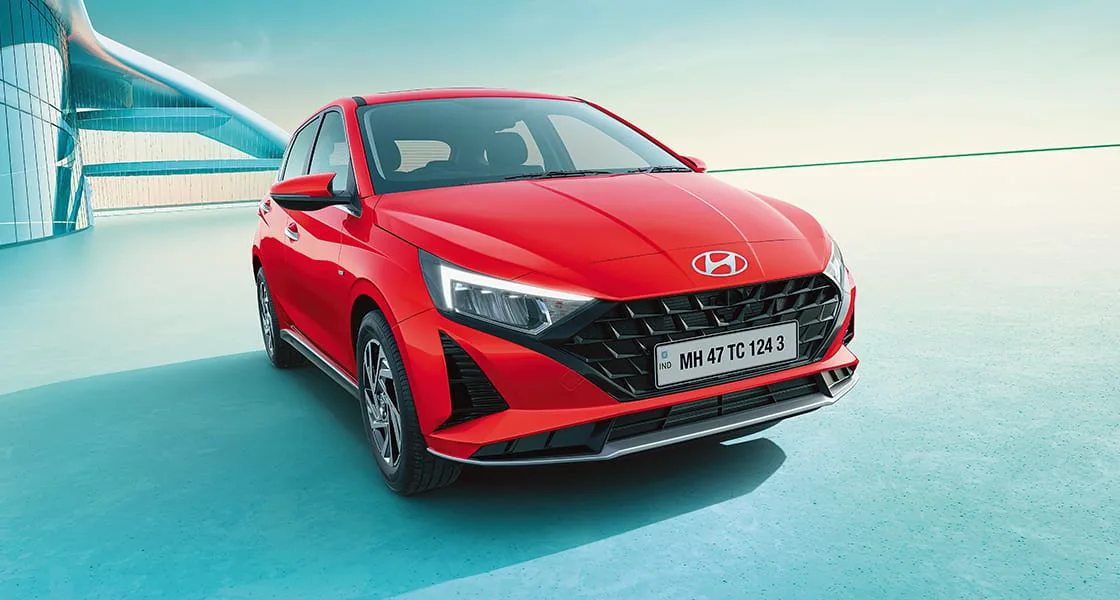
The Hyundai i20 sets the feature benchmark in the premium hatchback segment with six standard airbags, a segment-first 10.25-inch touchscreen, and ARAI-claimed mileage of up to 20.35 km/l — all starting under ₹6 lakh.
Key specs
| Fuel type | Petrol |
|---|---|
| Mileage (claimed) | 20.35 km/l (Petrol MT, ARAI claimed); 19.65 km/l (Petrol IVT, ARAI claimed) |
| Real-world mileage | Owners report 17–20 km/l on highways in real-world conditions (Autocar India user reviews, August 2026); independent instrumented test figures for the 1.2 MT are not yet published by Autocar India for the current model year. |
| Engine | 1.2 L Kappa, 1,197 cc, naturally aspirated |
| Power & torque | 82–87 bhp |
| Transmission | 5-speed Manual (MT); Intelligent Variable Transmission (IVT) |
| Drivetrain | FWD |
| Seating | 5 |
| Boot space | 311 litres |
| Ground clearance | 170 mm |
The Hyundai i20 is India's benchmark premium hatchback, priced from ₹5.99 lakh to ₹10.63 lakh (ex-showroom), and claims an ARAI-certified mileage of up to 20.35 km/l on the 5-speed manual — one of the strongest efficiency figures in its class. Powered exclusively by a 1.2-litre Kappa naturally aspirated petrol engine, it is available across nine variants spanning manual and Intelligent Variable Transmission (IVT) automatic options, making it one of the most comprehensively specced hatchbacks in the segment. The i20 also has a sportier sibling, the i20 N Line (profiled separately on evindexindia.com's ICE counterpart site), which uses a 1.0-litre turbo-petrol engine — that version is not covered here.
At 3,995 mm long and 1,775 mm wide on a 2,580 mm wheelbase, the i20 punches above its size with a 311-litre boot, a 10.25-inch HD touchscreen (claimed best-in-segment), a Bose 7-speaker audio system, a voice-enabled electric sunroof, and a built-in dashcam on top trims. Six airbags are standard across every variant, along with ESC, HAC, and VSM — a safety baseline that rivals often reserve for mid-range trims. The Knight editions add blacked-out R16 diamond-cut alloys with red brake calipers and all-black interiors for buyers who want a more aggressive look.
The i20 competes directly with the Maruti Suzuki Baleno, Toyota Glanza, and Tata Altroz in the premium hatchback space. Its combination of feature richness, a refined cabin, and a wide variant ladder — from the no-frills ₹5.99 lakh Era to the fully loaded ₹10.63 lakh Asta(O) Knight IVT Dual Tone — gives it broad appeal across first-time buyers and upgrade seekers alike.
Engines, mileage, and running cost
The Hyundai i20's sole engine for the standard range is the 1.2-litre Kappa four-cylinder petrol, displacing 1,197 cc and producing 82–87 bhp with 114.7 Nm of torque. Two gearbox choices are on offer: a 5-speed manual and Hyundai's Intelligent Variable Transmission (IVT), which is a belt-driven CVT tuned for smooth, stepless acceleration rather than sporty response. There is no CNG or diesel option in the current line-up.
ARAI-certified mileage stands at 20.35 km/l for the manual and 19.65 km/l for the IVT — both competitive figures for a 1.2-litre petrol hatchback. With a 37-litre fuel tank, the theoretical range on a full tank is approximately 750 km on the manual. Real-world owners report 17–20 km/l on highways, with city figures typically settling around 13–15 km/l depending on traffic conditions. Running costs are low: at ₹105/litre petrol, a 10,000 km/year driver on the manual spends roughly ₹51,000 annually on fuel.
The Sportz IVT variant (₹8.81 lakh) is the entry point for the automatic, making it accessible for urban buyers who want a stress-free commute without stretching to the Asta tier. The IVT's rubber-band feel at full throttle is a known trade-off, but in stop-and-go traffic it is genuinely relaxing.
Performance and drive
The 1.2 Kappa is a naturally aspirated unit, so outright performance is modest — 0–100 km/h takes around 13–14 seconds in the manual. It is not a car for enthusiasts chasing acceleration, but the engine is smooth and refined, with minimal NVH at highway cruise speeds. The 5-speed manual has a light clutch and short throws that make city driving easy, though a sixth gear would be welcome on long highway runs.
The suspension setup — MacPherson struts up front and a coupled torsion beam at the rear — is tuned for comfort over outright handling. Body roll is present in corners but well-controlled, and the ride quality over broken urban roads is composed. Ground clearance of 170 mm is adequate for most Indian road conditions, though deep potholes at speed can catch the underside. The electric power steering is light and precise, suiting the i20's city-focused character.
Drive modes (Normal and Sport) are available on the Sportz(O) Knight IVT only, sharpening throttle response in Sport mode. The Idle Stop & Go (ISG) system on the Asta(O) MT and Asta(O) Knight cuts the engine at red lights to save fuel, though some owners find it slightly intrusive in heavy traffic.
Cabin, space, and tech
Inside, the i20 punches well above its price point. The dashboard is clean and modern, with a 10.25-inch HD touchscreen on Asta(O) and Asta(O) Knight variants — claimed to be the largest in the segment. Wireless Apple CarPlay and Android Auto are available from the Magna variant upward. The Bose 7-speaker audio system, fitted from Sportz(O) onward, is genuinely impressive for a hatchback and a clear differentiator over rivals.
Top variants get a wireless charger, a built-in dashcam, Hyundai Bluelink connected car tech with OTA map updates (twice a year, up to 16 updates over eight years), and ambient lighting — blue on Asta(O) and dual blue/amber on the Knight editions. The voice-enabled electric sunroof on Asta(O) and Asta(O) Knight adds an airy feel to the cabin. Rear seat space is adequate for two adults, though three abreast is a squeeze on longer journeys. Boot space of 311 litres is class-competitive and practical for weekend luggage.
The Knight editions stand out with all-black interiors, brass-coloured inserts, sporty metal pedals, and R16 diamond-cut black alloy wheels with red brake calipers — a distinctive look that commands a modest premium over the equivalent standard variant.
Safety and ADAS
The i20 makes a strong safety case by fitting six airbags (driver, passenger, side, and curtain) as standard across every single variant — including the base Era. This is a genuine segment differentiator; most rivals offer six airbags only on mid or top trims. ABS with EBD, Electronic Stability Control (ESC), Hill-start Assist Control (HAC), and Vehicle Stability Management (VSM) are also standard across the range.
Additional safety features include rear parking sensors (all variants), impact-sensing auto door unlock, speed-sensing auto door lock, seat belt pretensioners for driver and passenger, ISOFIX child seat anchors, and a Smart Pedal system. Higher variants add a rear camera with dynamic guidelines (Sportz(O) and above), a Driver Rear View Monitor (Sportz and above), Emergency Stop Signal (Sportz and above), and Bluelink SOS/RSA buttons on Asta(O) and Asta(O) Knight. The i20 has received a 3-star Global NCAP safety rating. There is no Level 2 ADAS suite (no autonomous emergency braking or lane-keep assist) on the standard i20 — buyers wanting ADAS should consider the i20 N Line or a compact SUV.
Variants and pricing
The i20 is available in 15 configurations across nine trim levels. Ex-showroom prices (as of September 2026) range from ₹5.99 lakh for the Era to ₹10.63 lakh for the Asta(O) Knight IVT Dual Tone. Key stepping stones: the Magna MT at ₹7.00 lakh adds Apple CarPlay/Android Auto; the Sportz MT at ₹7.75 lakh brings LED DRLs, cruise control, and smart entry; the Sportz(O) MT at ₹8.34 lakh adds a sunroof and rear camera; and the Asta(O) IVT at ₹10.39 lakh tops out the non-Knight automatic range with the 10.25-inch screen, wireless charger, dashcam, and Bluelink.
The Knight editions (Sportz(O) Knight MT at ₹8.43 lakh and Asta(O) Knight IVT at ₹10.48 lakh, with a Dual Tone at ₹10.63 lakh) add the blacked-out styling package for a modest ₹9,000–₹15,000 premium over the equivalent standard variant — reasonable value for the visual upgrade.
How it compares
Against the Maruti Suzuki Baleno (₹5.99–₹9.17 lakh), the i20 is pricier at the top but offers more features — six standard airbags vs Baleno's two on base, a larger touchscreen, and a Bose audio system. The Toyota Glanza shares the Baleno's platform and is similarly priced. The Tata Altroz offers a diesel option and a 5-star Global NCAP rating, making it the safety leader, but its infotainment and feature set lag behind the i20 at equivalent price points.
The i20's 10.25-inch screen, Bose audio, built-in dashcam, and six standard airbags are hard to match in the segment. Its weakness is the absence of a turbo-petrol in the standard range (that's the N Line's territory) and no ADAS suite, which compact SUVs like the Hyundai Venue or Kia Sonet offer at similar prices.
Who should buy it
The Hyundai i20 is the right choice for urban buyers who want a feature-rich, refined hatchback with strong safety credentials and a wide variant ladder. The Sportz MT at ₹7.75 lakh is the sweet spot for value — it brings LED lighting, cruise control, and smart entry without the sunroof premium. The Asta(O) IVT is the pick for automatic buyers who want the full tech package including the large screen, wireless charger, and Bluelink.
Buyers who prioritise outright performance, ADAS, or higher ground clearance for rough roads should look at the i20 N Line or a compact SUV instead. But for those who spend most of their time in city traffic and want a premium cabin experience under ₹11 lakh, the i20 remains the segment benchmark.
Safety & ADAS
| NCAP rating | 3-star (Global NCAP) |
|---|---|
| Airbags | 6 airbags standard on all variants — driver, passenger, side (front), and curtain airbags |
| ADAS level | No Level 2 ADAS; cruise control on Sportz and above; rear camera with dynamic guidelines on Sportz(O) and above; TPMS on Magna Executive and above |
| Notes | ESC, HAC, VSM, ABS with EBD, Smart Pedal, impact-sensing auto door unlock, speed-sensing auto door lock, ISOFIX, seat belt pretensioners, and Emergency Stop Signal all standard or fitted from Sportz. Bluelink SOS/RSA on Asta(O) and Asta(O) Knight. |
Verdict
Best for: Urban buyers seeking a feature-rich, refined premium hatchback with strong safety credentials and a wide variant choice under ₹11 lakh
What we like
- Six airbags standard on every variant — including the ₹5.99 lakh base Era, a genuine segment first
- 10.25-inch HD touchscreen claimed best-in-segment, paired with Bose 7-speaker audio on upper trims
- ARAI-claimed mileage of 20.35 km/l (MT) is among the best in the premium hatchback class
- Wide variant ladder (15 configurations) from ₹5.99 lakh to ₹10.63 lakh covers almost every budget
- Knight editions deliver a distinctive blacked-out look for only ₹9,000–₹15,000 over the standard equivalent
What to know
- No ADAS suite (no AEB, lane-keep assist, or blind-spot monitoring) — compact SUVs at similar prices offer Level 2 ADAS
- 1.2 NA petrol only in the standard range — no turbo-petrol, diesel, or CNG option
- 3-star Global NCAP rating is below the 5-star scores of rivals like the Tata Altroz
- IVT automatic has a rubber-band feel under hard acceleration, limiting driver engagement
Variants
| Variant | Price | Mileage | Notable |
|---|---|---|---|
| Era Petrol MT | ₹5.99 Lakh | 20.35 km/l (ARAI claimed) | 6 airbags, ESC, VSM, rear parking sensors standard |
| Magna Executive MT | ₹6.75 Lakh | 20.35 km/l (ARAI claimed) | Auto headlamps, power windows, foldable key |
| Magna MT | ₹7 Lakh | 20.35 km/l (ARAI claimed) | Wireless Apple CarPlay & Android Auto |
| Sportz MT | ₹7.75 Lakh | 20.35 km/l (ARAI claimed) | LED DRLs, cruise control, smart entry with push-button start |
| Sportz(O) MT | ₹8.34 Lakh | 20.35 km/l (ARAI claimed) | Smart electric sunroof, rear camera with dynamic guidelines, Z-shaped LED tail lamps |
| Sportz(O) Knight MT | ₹8.43 Lakh | 20.35 km/l (ARAI claimed) | Black alloy wheels, red brake calipers, all-black interior with brass inserts |
| Asta MT | ₹8.66 Lakh | 20.35 km/l (ARAI claimed) | Bose 7-speaker audio, wireless charger |
| Sportz IVT | ₹8.81 Lakh | 19.65 km/l (ARAI claimed) | Entry-level automatic; LED DRLs, cruise control |
| Asta(O) MT | ₹9.20 Lakh | 20.35 km/l (ARAI claimed) | 10.25-inch HD touchscreen, Bluelink, voice-enabled sunroof, ISG |
| Sportz(O) IVT | ₹9.26 Lakh | 19.65 km/l (ARAI claimed) | Sunroof + automatic combination |
| Asta(O) MT Dual Tone | ₹9.35 Lakh | 20.35 km/l (ARAI claimed) | Dual-tone exterior on top MT spec |
| Asta(O) IVT | ₹10.39 Lakh | 19.65 km/l (ARAI claimed) | Full tech pack: 10.25-inch screen, Bluelink, dashcam, wireless charger, voice sunroof |
| Asta(O) Knight IVT | ₹10.48 Lakh | 19.65 km/l (ARAI claimed) | Knight styling + full tech pack; drive modes (Normal/Sport) |
| Asta(O) IVT Dual Tone | ₹10.54 Lakh | 19.65 km/l (ARAI claimed) | Dual-tone exterior on top IVT spec |
| Asta(O) Knight IVT Dual Tone | ₹10.63 Lakh | 19.65 km/l (ARAI claimed) | Top-of-range; Knight styling, dual tone, full feature set |
Key features
- 10.25-inch HD touchscreen infotainment with navigation — claimed best-in-segment (Asta(O) and above)
- Six airbags (driver, passenger, side, curtain) standard across all variants including base Era
- Bose 7-speaker premium audio system (Sportz(O) and above)
- Voice-enabled smart electric sunroof (Asta(O) and Asta(O) Knight)
- Hyundai Bluelink connected car tech with OTA map updates — up to 16 updates over 8 years
- Built-in dashcam (Asta(O) and Asta(O) Knight IVT)
- R16 diamond-cut black alloy wheels with red brake calipers on Knight editions
Competitors
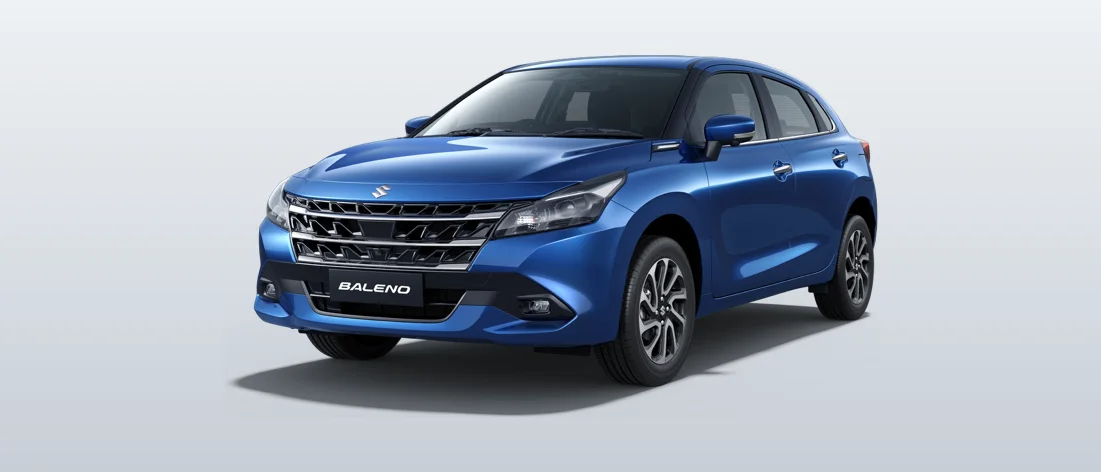 Hatchback · On Sale
Maruti Suzuki
Maruti Baleno
₹5.99 – 9.99 Lakh (ex-showroom)
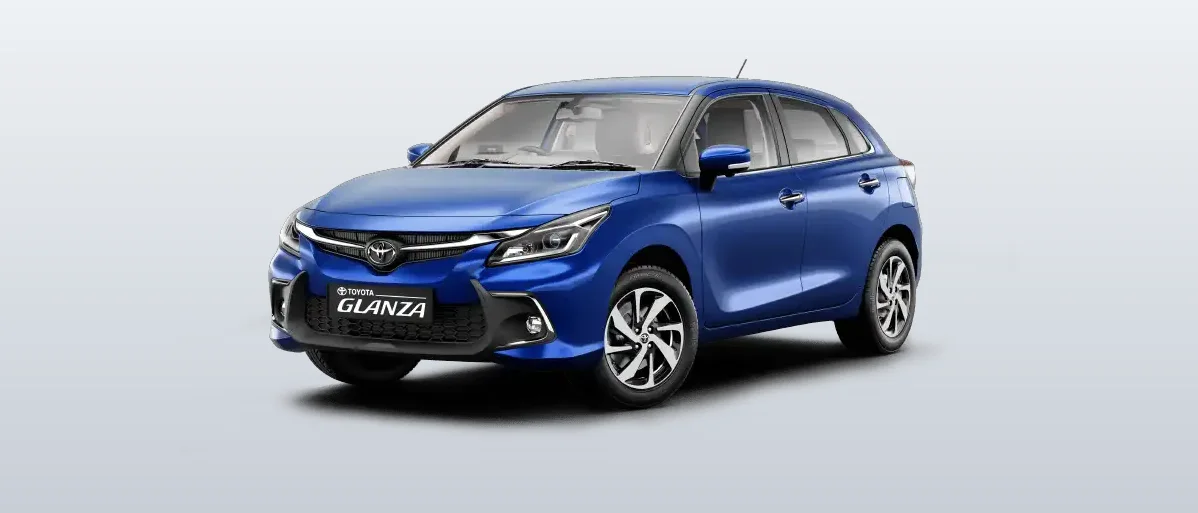 Hatchback · On Sale
Toyota
Toyota Glanza
₹6.73 – 9.99 Lakh (ex-showroom)
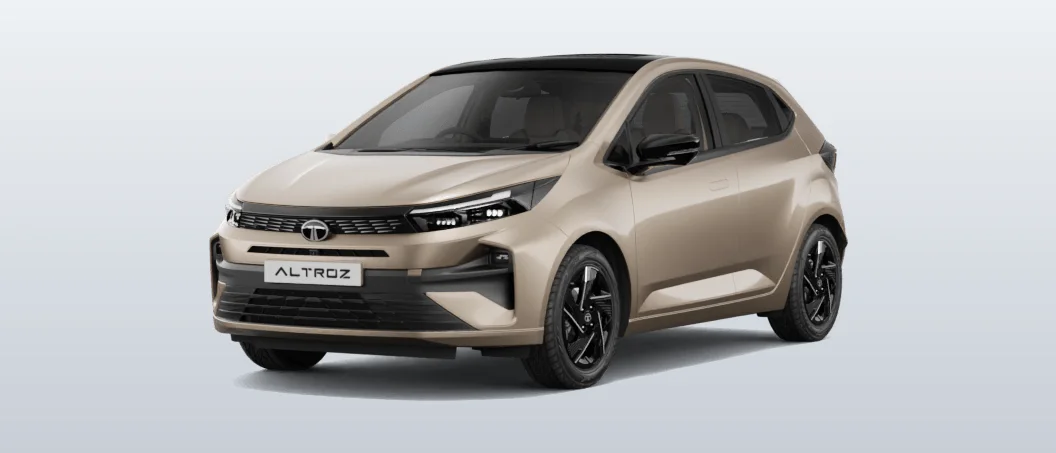 Hatchback · On Sale
Tata Motors
Tata Altroz
₹6.00 – 10.75 Lakh (ex-showroom)
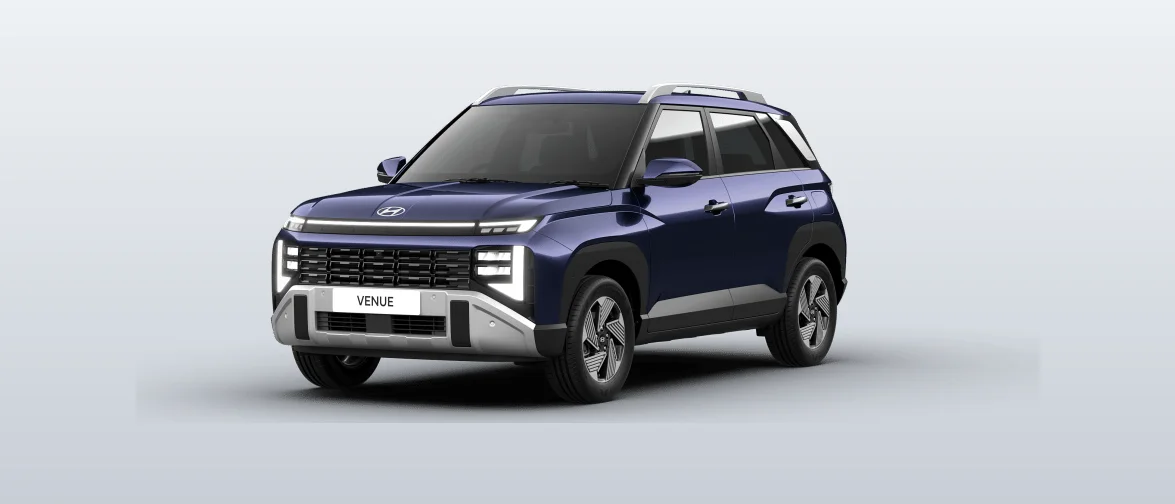 SUV · On Sale
Hyundai
Hyundai Venue
₹7.99 – 15.65 Lakh (ex-showroom)
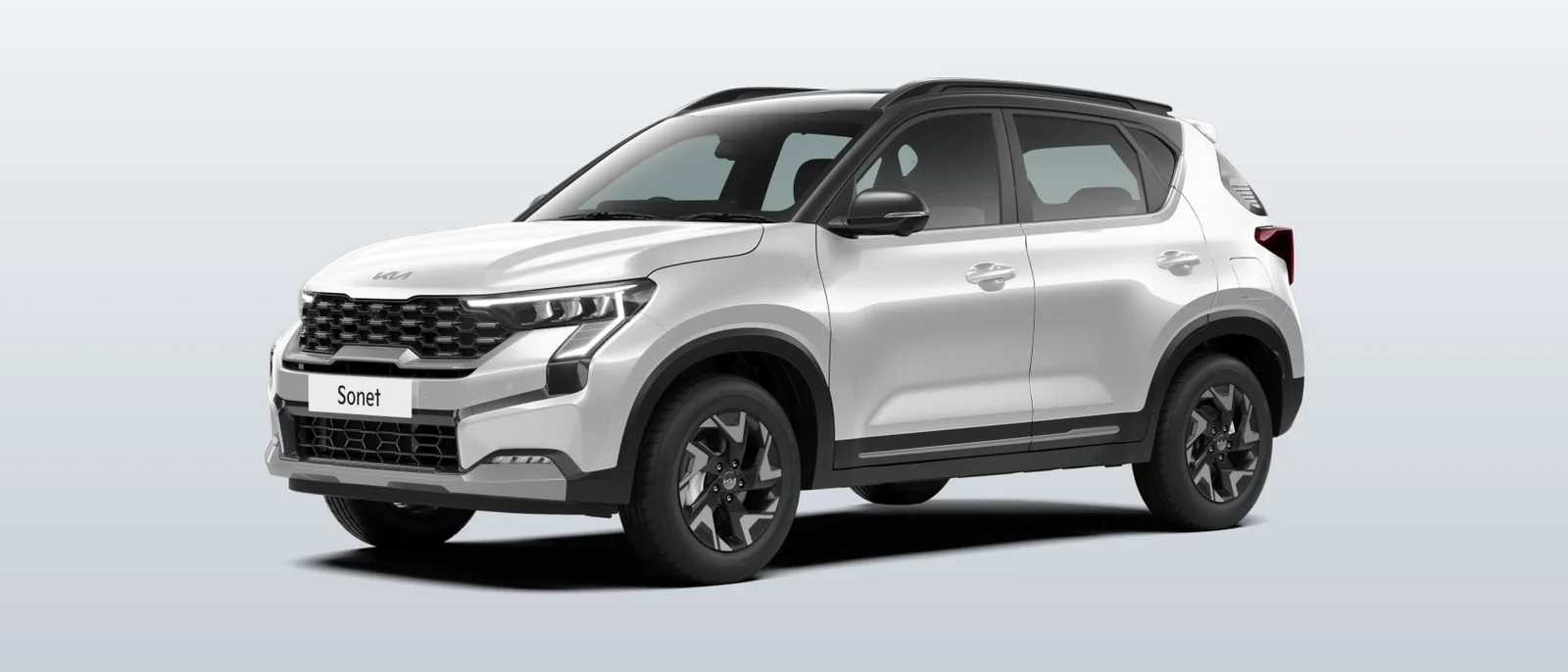 SUV · On Sale
Kia
Kia Sonet
₹7.31 – 13.79 Lakh (ex-showroom)
Latest news
2026 Maruti Baleno vs Hyundai i20, Tata Altroz & Toyota Glanza: Price, Mileage & Specs Compared in India
The 2026 Baleno undercuts all rivals on price (from Rs 5.99 lakh), gains Level 2 ADAS and ventilated seats, but still misses a sunroof and a large touchscreen that the i20 and Altroz offer.
What Will the Hyundai Bayon Cost in India? October 2026 Launch, Features & Comparison to Maruti Victoris
The Hyundai Bayon launches October 26, 2026, priced Rs 9–14 lakh (ex-showroom), with a 1.5L 115 PS petrol engine and segment-first Generative AI Voice Assistant, rivalling the Maruti Victoris and Toyota Hyryder.
Will Hyundai and Kia's New Hybrid SUVs in 2026-2027 Change Your Buying Decision? Creta, Seltos Hybrid Launch Timeline
Kia Seltos Hybrid (178 hp, 2027 India launch) and Hyundai Creta Hybrid are coming to challenge the Grand Vitara and Hyryder in the ₹15–20 lakh strong-hybrid SUV space.
FAQs
What is the price of the Hyundai i20?
The Hyundai i20 is priced from ₹5.99 lakh (Era MT, ex-showroom) to ₹10.63 lakh (Asta(O) Knight IVT Dual Tone, ex-showroom) as of September 2026. There are 15 configurations across nine trim levels, giving buyers a wide range of options.
What is the mileage of the Hyundai i20?
The Hyundai i20 has an ARAI-certified mileage of 20.35 km/l with the 5-speed manual transmission and 19.65 km/l with the IVT automatic. Real-world owners report 17–20 km/l on highways, with city figures typically around 13–15 km/l.
Is the Hyundai i20 worth buying?
Yes, for buyers who prioritise features, cabin quality, and safety in a premium hatchback. The i20 offers six standard airbags across all variants, a 10.25-inch touchscreen (claimed best-in-segment), and a Bose audio system — all at competitive prices starting at ₹5.99 lakh. However, it lacks ADAS and scores only 3 stars in Global NCAP, so buyers prioritising active safety may prefer the Tata Altroz.
Which engine options does the Hyundai i20 get?
The standard Hyundai i20 is powered by a single 1.2-litre Kappa naturally aspirated petrol engine (1,197 cc) producing 82–87 bhp and 114.7 Nm of torque. It is paired with either a 5-speed manual or an IVT automatic. There is no diesel, CNG, or turbo-petrol option in the standard i20 range — the turbo-petrol 1.0 T-GDi is exclusive to the i20 N Line.
Does the Hyundai i20 have ADAS?
No, the standard Hyundai i20 does not have a Level 2 ADAS suite. It does offer cruise control from the Sportz variant, a rear camera with dynamic guidelines from Sportz(O), and a Driver Rear View Monitor from Sportz. Buyers wanting autonomous emergency braking or lane-keep assist should consider the i20 N Line or a compact SUV.
Is the Hyundai i20 safe?
The i20 has received a 3-star Global NCAP safety rating. On the positive side, it is one of the few hatchbacks to offer six airbags as standard on every variant, including the base Era. ESC, HAC, VSM, ABS with EBD, ISOFIX, and seat belt pretensioners are also standard across the range.
What is the boot space of the Hyundai i20?
The Hyundai i20 offers 311 litres of boot space, which is competitive for the premium hatchback segment. The 37-litre fuel tank and 170 mm ground clearance round out its practical credentials.
Which variant of the Hyundai i20 should I buy?
The Sportz MT at ₹7.75 lakh is the sweet-spot variant, offering LED DRLs, cruise control, smart entry with push-button start, and the Bose-ready audio system without the sunroof premium. For automatic buyers wanting the full tech package, the Asta(O) IVT at ₹10.39 lakh adds the 10.25-inch screen, Bluelink, dashcam, and wireless charger.