
The Hyundai Bayon launches October 26, 2026, priced Rs 9–14 lakh (ex-showroom), with a 1.5L 115 PS petrol engine and segment-first Generative AI Voice Assistant, rivalling the Maruti Victoris and Toyota Hyryder.
The Hyundai Bayon is a midsize SUV positioned between the Venue and the Creta in Hyundai India's portfolio, expected to launch on October 26, 2026 with a price range of Rs 9 lakh to Rs 14 lakh (ex-showroom). Bookings are already open at Rs 11,000 through Hyundai dealerships and the official website, with deliveries slated to begin during the festive season.
This is not a Creta replacement or a cheaper clone — it is a deliberate tactical addition designed to capture cost-sensitive buyers who want a larger, more feature-rich SUV without paying Creta money, and who may prefer CNG as a fuel option. Here is how the Bayon stacks up against its two most direct rivals at a glance before we go deeper.
| Parameter | Hyundai Bayon (Expected) | Maruti Victoris | Toyota Hyryder |
|---|---|---|---|
| Expected/Starting Price (ex-showroom) | Rs 9 – 14 lakh | Rs 11.39 – 20.09 lakh | Rs 11.19 – 20.59 lakh |
| Engine | 1.5L NA Petrol (115 PS / 144 Nm) | 1.5L Mild Hybrid + Strong Hybrid Petrol | 1.5L Mild Hybrid + Strong Hybrid Petrol |
| Fuel Options at Launch | Petrol (CNG expected later) | Petrol, CNG, Strong Hybrid | Petrol, Strong Hybrid |
| Gearbox Options | 6MT / CVT (IVT) | 5MT / 6AT / e-CVT | 5MT / 6AT / e-CVT |
| Key Tech Highlight | Gen AI Voice Assistant, NVIDIA ccNC, 19-controller C-OTA | SmartPlay Pro+, Suzuki Connect | Toyota Connected, Head-Up Display |
| Panoramic Sunroof | Yes | Yes (select variants) | Yes (select variants) |
| ADAS | Yes (radar confirmed) | Yes | Yes |
| Segment Position | Below Creta, above Venue | Mid-size SUV | Mid-size SUV |
Maruti Victoris and Toyota Hyryder prices are current on-sale figures; Hyundai Bayon price is manufacturer-expected ex-showroom at launch.
Why is Hyundai launching the Bayon when the Creta already exists?
Hyundai's strategy employs a two-model approach in the midsize SUV space — similar to what Maruti Suzuki already does with the Victoris and the Grand Vitara. The Creta occupies the premium end of the segment and will continue to do so, particularly with a next-generation hybrid version expected in 2027. The Bayon fills the gap between the sub-4-metre Venue and the Creta, targeting buyers who want a larger footprint and a richer feature set without the Creta's price premium.
Hyundai specifically does not want to dilute the Creta's premium positioning by offering it with CNG. The Bayon, therefore, becomes the brand's CNG carrier in the midsize segment — a first for Hyundai above 4 metres. This distinction matters: the Maruti Victoris already offers CNG and has found a loyal audience among fleet operators, cab aggregators, and high-mileage private buyers. Hyundai is now entering that conversation with a product that brings considerably more technology to the table.
The timing is deliberate. Alternative-fuel cars collectively outsold petrol-powered cars in August 2026, led by CNG. Hyundai is reading that shift correctly and positioning the Bayon to benefit from it.
What engine does the Hyundai Bayon get, and is CNG confirmed?
At launch, the Hyundai Bayon will be powered by a 1.5-litre four-cylinder naturally aspirated MPi petrol engine producing 115 PS (84.4 kW) and 144 Nm of torque. Transmission choices are a 6-speed manual (6MT) or an Intelligent Variable Transmission (IVT), which is Hyundai's branding for a CVT. This is the same engine family used in the Creta, so refinement and reliability credentials are already established.
No ARAI-certified fuel efficiency figure has been officially announced ahead of the October 26 launch. Experience with this unit in the Creta suggests it is smooth and efficient, particularly with the IVT — making it well-suited to urban commuting, which is the Bayon's primary use case.
CNG variants are expected to arrive after the initial petrol launch. Critically, the CNG tank will be mounted under the body — similar to the Maruti Victoris CNG setup — so boot space is not compromised. This is a significant engineering decision. Most CNG cars in India sacrifice boot space because the cylinder sits in the luggage area; an underbody tank removes that penalty and makes the Bayon CNG a more practical proposition for families.
What the Bayon will not get: the Creta's 1.5-litre turbo-petrol and 1.6-litre diesel engines. Hyundai has deliberately kept the powertrain lineup simple to prioritise value and low running costs. Buyers wanting a diesel or a hot-hatch-style turbo petrol will need to look at the Creta, Volkswagen Taigun, or Skoda Kushaq.
Compared to the Maruti Victoris, the Bayon's petrol-only launch lineup is narrower. The Victoris is available with a mild-hybrid petrol, a strong hybrid (which returns claimed fuel efficiency of around 27.97 km/l on the ARAI cycle in e-CVT guise), and a CNG option from day one. The Bayon's strong suit is technology, not powertrain breadth — at least at launch.
What does the Hyundai Bayon look like on the outside?
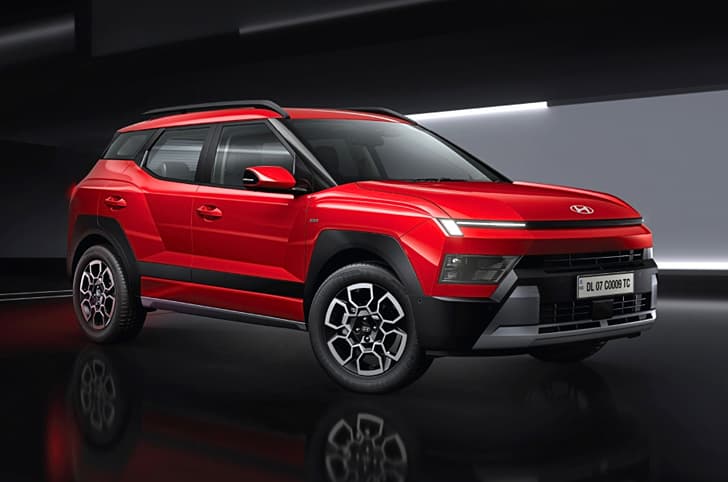
The Bayon follows Hyundai's global 'Art of Steel' design language, giving it a crossover-esque silhouette rather than the boxy proportions of a traditional SUV. The front is defined by a split headlamp arrangement: LED daytime running lamps styled to resemble Hyundai's 'H' motif are positioned high and connected by a black strip, while the main LED headlamps sit lower in the bumper. A full-width LED light bar spans the front, a sculpted bonnet with ridges creates a muscular appearance, and chunky bumper trim with black and silver cladding completes the look.
A radar unit is visible on the air intake — confirming the presence of an ADAS suite, though the specific functions have not been detailed ahead of launch.
On the sides, the windowline has an upward kink, blacked-out pillars and a quarter glass create a floating roof effect, and continuous black cladding runs along the wheel arches and lower door sills. The alloy wheels are 17 inches in diameter with a dual-tone design. Roof rails and a shark-fin antenna complete the profile.
At the rear, LED tail-lamps echo the 'H' motif from the front, a roof-mounted spoiler with a high-mounted stop lamp adds a sporty touch, and 'Bayon' branding appears on the tailgate. The overall look is distinctly European in character — the Bayon has been sold in Europe since 2021 — and stands apart from the more conventional styling of the Maruti Victoris and Toyota Hyryder.
What technology and features does the Hyundai Bayon offer inside?
This is where the Bayon makes its strongest argument. Hyundai Motor India's official press release describes the Bayon as an "Intelligent Utility Vehicle" built around the philosophy of "Intelligence That Moves" — and the feature list backs that positioning up.
Dual 12.3-inch curved panoramic displays form the centrepiece of the dashboard, creating a unified digital cockpit that covers the instrument cluster and infotainment screen. The interior follows a black-and-white theme with a dual-tone three-spoke steering wheel, vertical air vents, and a mix of physical buttons and haptic HVAC controls.
Generative AI Voice Assistant is the headline technology feature — and it is a genuine first for Hyundai Motor India. The system combines Intelligence by Perplexity with Voice AI powered by SoundHound AI. Unlike conventional voice recognition that depends on a fixed command library, the assistant is designed to understand conversational requests — asking it to plan a road trip itinerary, find nearby restaurants, or provide live sports scores are all cited as examples. The system supports over 500 embedded voice commands in English, Hindi, Hinglish, Tamil, Bengali, and Telugu, and the interface supports 10 regional and 2 international languages.
NVIDIA-accelerated Connected Car Navigation Cockpit (ccNC) brings together online onboard navigation, a personalised control panel, split-screen functionality, and smartphone-like quick controls in a single integrated interface. This is a meaningful hardware distinction — NVIDIA's automotive-grade processing enables smoother graphics and faster response than the typical ARM-based infotainment chips used in most rivals.
Vehicle Controller Over-the-Air (C-OTA) updates cover up to 19 controllers, meaning Hyundai can push software improvements, security patches, and new features remotely without requiring a dealership visit. This is a software-defined vehicle architecture that the Maruti Victoris and Toyota Hyryder do not currently match.
Hyundai Bluelink brings over 70 connected features, including remote start/stop, remote vehicle controls, smartphone and smartwatch connectivity, location services, and safety and security functions.
Other notable features include ventilated front seats, a panoramic sunroof, wireless phone charging, drive modes, and a panoramic sunroof. The ADAS suite's specific functions — lane keep assist, autonomous emergency braking, adaptive cruise control — have not been itemised ahead of launch, but the radar hardware is confirmed.
The Maruti Victoris offers SmartPlay Pro+ infotainment and Suzuki Connect, which covers the basics of connected car functionality. It does not offer a generative AI assistant, NVIDIA-accelerated processing, or 19-controller OTA updates. The Toyota Hyryder counters with a head-up display and Toyota Connected services, but again falls short of the Bayon's technology depth. If technology leadership is the buying criterion, the Bayon is likely to set a new benchmark in this price band.
One honest caveat: the cabin is described as similar to the i20 in layout, which means it is functional and well-organised but not class-leading in perceived premium quality. The Creta's interior feels more upmarket, and the Bayon's positioning below it means some material quality compromises are expected. Real-world assessments will only be possible after the October 26 launch.
How does the Hyundai Bayon compare to the Maruti Victoris?
The Maruti Victoris is a midsize SUV sold through Maruti's Nexa premium retail channel, available with mild-hybrid petrol, strong hybrid petrol, and CNG powertrains. It is built on the same platform as the Toyota Hyryder and shares its strong hybrid system with the Hyryder — a 1.5-litre Atkinson-cycle petrol motor paired with a lithium-ion battery and an e-CVT.
The Victoris's strongest card is its strong hybrid drivetrain, which delivers claimed fuel efficiency of approximately 27.97 km/l (ARAI, e-CVT variant) — a figure no naturally aspirated petrol-only SUV can match. For buyers who cover high annual mileage, the running cost advantage of the Victoris strong hybrid is substantial and real.
The Victoris CNG is also available from launch, with an underbody tank (like the expected Bayon CNG) that preserves boot space. CNG pricing at the pump makes the per-kilometre running cost of the Victoris CNG lower than any petrol-only variant of the Bayon at launch.
Where the Bayon has a clear advantage is technology. The Victoris does not offer a generative AI voice assistant, NVIDIA-accelerated infotainment, or 19-controller OTA updates. Its dual-screen setup exists but does not match the Bayon's curved panoramic display quality. The Bayon's ADAS suite, once fully detailed, is expected to be more comprehensive than the Victoris's offering.
On pricing, the Victoris starts at approximately Rs 11.39 lakh (ex-showroom) for the base mild-hybrid variant. If the Bayon's Rs 9 lakh entry point holds, it will undercut the Victoris at the base level — but top-spec Bayon variants at Rs 14 lakh will overlap with mid-spec Victoris territory. The Victoris's strong hybrid tops out around Rs 20 lakh, which is well above the Bayon's ceiling.
The Victoris's weaknesses are worth naming honestly: its infotainment system is not as advanced as the Bayon's, the mild-hybrid variants do not offer the same fuel efficiency advantage as the strong hybrid, and the cabin design is more conservative. The strong hybrid's e-CVT can feel rubbery under hard acceleration, which is a known characteristic of this powertrain architecture.
For a buyer who prioritises technology, a modern design, and a lower entry price, the Bayon is likely to be more compelling. For a buyer who prioritises fuel efficiency, powertrain variety, and an established service network, the Victoris — particularly in strong hybrid or CNG guise — remains a strong choice.
How does the Hyundai Bayon compare to other rivals?
Beyond the Victoris, the MG Astor, Volkswagen Taigun, and Skoda Kushaq emerge as petrol-segment rivals.
The Volkswagen Taigun and Skoda Kushaq are both powered by turbocharged petrol engines — a 1.0-litre TSI (115 PS) and a 1.5-litre TSI (150 PS) — giving them a performance edge over the Bayon's naturally aspirated 1.5-litre unit. Neither offers CNG. Both are priced broadly in the Rs 11–20 lakh range (ex-showroom) and are known for their European driving dynamics and build quality. The Bayon's technology suite is likely to surpass both, but buyers who enjoy spirited driving will find the turbocharged alternatives more engaging.
The MG Astor offers an AI assistant (though not generative AI in the Bayon's sense) and a strong connected car package. It is priced from approximately Rs 9.98 lakh (ex-showroom) and competes closely on features, but MG's after-sales network in India is smaller than Hyundai's.
The Toyota Hyryder mirrors the Victoris in powertrain — same platform, same strong hybrid system — and adds a head-up display. Its pricing is similar to the Victoris. Like the Victoris, it will be outgunned by the Bayon on technology but remains competitive on fuel efficiency.
For safety-conscious buyers, Bharat NCAP crash test results for the Bayon are not yet available. The Creta has performed well in safety assessments, and the Bayon's ADAS confirmation is encouraging, but formal crash test ratings will only emerge after the car is on sale. Buyers can check our guide to 5-star Bharat NCAP SUVs under Rs 25 lakh for context on which rivals have already been rated.
What is the expected price of the Hyundai Bayon, and how should buyers interpret it?
An expected price range of Rs 9 lakh to Rs 14 lakh (ex-showroom) is being reported, though this is a pre-launch estimate, not a confirmed manufacturer figure — the actual prices will be announced on October 26, 2026.
A Rs 9 lakh entry point, if it holds, would make the Bayon one of the most affordable midsize SUVs in India and would undercut the Maruti Victoris's starting price by a meaningful margin. However, buyers should be cautious about base-variant pricing: entry variants typically come with fewer features, and the technology highlights — the generative AI assistant, dual curved displays, panoramic sunroof, ventilated seats — are likely to be reserved for mid and top variants, which will be closer to the Rs 12–14 lakh range.
The booking amount of Rs 11,000 is relatively low, which suggests Hyundai is prioritising volume and accessibility over exclusivity. Deliveries are scheduled to begin during the festive season, so buyers who book early should receive their cars before the end of 2026.
On-road prices will vary by state due to differences in road tax and registration charges. The ex-showroom figures quoted here and at launch are the baseline; add approximately 10–15% for on-road costs depending on your city.
Should you wait for the CNG variant, or buy the petrol at launch?
This depends entirely on your use case. The petrol Bayon at launch makes sense for buyers who:
- Drive primarily in cities with good petrol availability
- Value technology and connected features above all else
- Want a modern design and a lower entry price than the Victoris or Hyryder
- Are comfortable with a naturally aspirated engine's performance characteristics
The CNG variant, when it arrives, will make sense for buyers who:
- Cover more than 1,500 km per month
- Have reliable CNG pump access on their regular routes
- Want the lowest possible per-kilometre running cost in a midsize SUV above 4 metres
- Can wait — CNG variants are expected post-launch, with no confirmed timeline yet
The underbody tank design, mirroring the Maruti Victoris CNG approach, means the CNG Bayon will not sacrifice boot space — a genuine practical advantage over CNG cars with in-boot cylinders. But until Hyundai confirms the CNG launch date and pricing, buyers with a strong CNG preference may find the Victoris CNG a more immediately available option.
What are the Hyundai Bayon's honest weaknesses?
No car is without trade-offs, and the Bayon is no exception.
Powertrain breadth is limited at launch. A single naturally aspirated petrol engine means no diesel option (unlike the Creta), no turbo-petrol punch (unlike the Taigun or Kushaq), and no hybrid efficiency (unlike the Victoris strong hybrid or Hyryder). Buyers wanting maximum fuel efficiency from day one will find the Victoris strong hybrid's claimed 27.97 km/l hard to ignore.
CNG is not available at launch. Despite the CNG positioning being central to the Bayon's India strategy, buyers who want CNG will have to wait for a post-launch variant. The Victoris and Hyryder CNG are available now.
Interior material quality is uncertain. The cabin is described as similar to the i20, which is a good car but not a premium one. At Rs 12–14 lakh, buyers will compare it against the Creta's more upmarket feel, and the Bayon may feel like a step down in tactile quality.
ADAS specifics are unconfirmed. The radar hardware is visible, but Hyundai has not detailed which ADAS functions are included or which variants they come on. This matters for safety-conscious buyers.
No Bharat NCAP rating yet. The car has not been crash-tested under the Indian programme. For buyers who prioritise a verified safety rating, this is a gap that will take time to fill. Our guide to 5-star Bharat NCAP-rated SUVs under Rs 15 lakh lists alternatives that already carry a rating.
What is the verdict — who should buy the Hyundai Bayon?
The Hyundai Bayon is a well-timed product that addresses a real gap in the market. It is the first Hyundai above 4 metres to offer CNG, the first Hyundai India product with a generative AI voice assistant, and the brand's answer to the Maruti Victoris's dominance in the value-focused midsize SUV space.
If you are a tech-forward buyer who wants the most connected, software-rich midsize SUV under Rs 14 lakh, the Bayon is likely to be the answer when it launches on October 26. The NVIDIA-accelerated infotainment, 19-controller OTA updates, and conversational AI assistant are genuine differentiators that no rival in this price band currently matches.
If you are a high-mileage buyer primarily motivated by running costs, the Maruti Victoris strong hybrid or CNG — both available now — offer proven fuel efficiency advantages that the petrol-only Bayon at launch cannot match. The Victoris's service network through Maruti's Nexa channel is also more extensive than Hyundai's, though Hyundai's own network is large.
If you are a driving enthusiast who wants a turbocharged engine and European dynamics, the Volkswagen Taigun or Skoda Kushaq remain the better choice, even if they lack the Bayon's technology depth.
The Bayon's October 26 launch will confirm the final prices, variant lineup, ADAS feature list, and ARAI fuel efficiency figures. Until then, the Rs 9–14 lakh range is an expectation, not a guarantee. Buyers should wait for the official price announcement before committing — but putting down the Rs 11,000 booking amount to secure a place in the queue is a low-risk way to keep options open.
For buyers comparing safety credentials across the segment, our guide to SUVs with 6 airbags under Rs 25 lakh provides a useful reference point while Bayon's Bharat NCAP results are awaited.