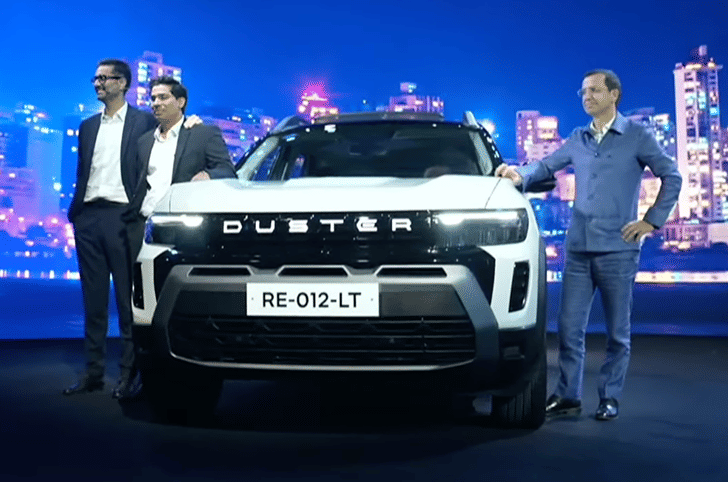

Renault Duster Hybrid E-Tech 160 launches at ₹16.99–19.49 lakh with a segment-best ARAI claim of 29 kmpl, undercutting the Maruti Grand Vitara Hybrid on price and mileage.
Renault Duster Hybrid Launched October 2026 at ₹16.99 Lakh: 29 kmpl Mileage & How It Compares to Maruti Grand Vitara Hybrid in India
The Renault Duster Strong Hybrid E-Tech 160 is a self-charging strong-hybrid midsize SUV that pairs a 1.8-litre naturally aspirated petrol engine with two electric motors and a 1.4 kWh lithium-ion battery, delivering a combined system output of 160 PS and an ARAI-certified fuel efficiency of 29 kmpl — the highest claimed figure in the Indian midsize SUV strong-hybrid segment at launch. Prices start at ₹16.99 lakh (ex-showroom) for the base Evolution trim and go up to ₹19.49 lakh for the top-spec Emotion trim, with deliveries scheduled to begin in November 2026.
This is the fourth strong-hybrid option in the midsize SUV segment, joining the Maruti Suzuki Grand Vitara Hybrid, Maruti Suzuki Victoris Hybrid and Toyota Urban Cruiser Hyryder Hybrid. Here is how the key rivals stack up at a glance:
| Model | Starting Price (ex-showroom) | ARAI Mileage | System Power | Battery Size | 0–100 kmph |
|---|---|---|---|---|---|
| Renault Duster Hybrid E-Tech 160 | ₹16.99 lakh | 29 kmpl | 160 PS | 1.4 kWh | 9.61 sec (claimed) |
| Maruti Grand Vitara Hybrid | ~₹17.99 lakh | 27.97 kmpl | 116 PS | 0.76 kWh | ~12 sec (est.) |
| Toyota Urban Cruiser Hyryder Hybrid | ~₹18.49 lakh | 27.97 kmpl | 116 PS | 0.76 kWh | ~12 sec (est.) |
| Maruti Suzuki Victoris Hybrid | ~₹18.49 lakh | 28.65 kmpl | 116 PS | 0.76 kWh | ~12 sec (est.) |
Prices are ex-showroom India. ARAI figures are manufacturer claims and real-world mileage will vary with traffic, driving style and ambient conditions. Grand Vitara, Hyryder and Victoris prices are approximate based on available market data at time of writing.
The Duster Hybrid enters with a price advantage over the Grand Vitara Hybrid's strong-hybrid variants while claiming a 1.03 kmpl mileage lead over the Grand Vitara and Hyryder, and a 0.35 kmpl lead over the Victoris, according to Times of India. The Grand Vitara Hybrid's Toyota-sourced powertrain has a longer real-world track record in India, though Renault's newer E-Tech system will need independent road tests to validate its efficiency claims.
What exactly is the Renault Duster Hybrid E-Tech 160 powertrain?
A strong hybrid allows the electric motor to drive the vehicle independently at low speeds without petrol engine input, while the battery recharges itself through regenerative braking and engine-driven generation — no external plug required. The Duster's E-Tech 160 system fits this definition precisely.
The architecture combines a 1.8-litre four-cylinder Atkinson-cycle petrol engine producing 110 PS and 175 Nm with two electric motors. A high-voltage starter-generator (approximately 20 PS) mounted on the engine handles engine starts, smooths gearshifts and charges the 1.4 kWh, 247V NMC battery pack. A dedicated 50 PS traction motor connects directly to the driveline, producing 208 Nm and driving the front wheels. Combined system output is rated at 160 PS.
Renault claims the Atkinson-cycle engine achieves thermal efficiency of up to 41 percent, the highest in the segment. The 1.8-litre displacement is also the largest petrol engine in the midsize SUV hybrid segment — the Grand Vitara, Victoris and Hyryder all use a 1.5-litre unit from Toyota's THS II architecture.
The transmission is what Renault calls a "multi-mode automatic" gearbox with two electric gears and four petrol-engine gears, enabling 15 drive combinations. The system switches automatically between six operating modes — pure electric, petrol-only, series hybrid, series-parallel hybrid, and combinations thereof — based on speed, battery state and driver demand.
This differs meaningfully from the Toyota Hybrid System (THS II) used in the Grand Vitara, Victoris and Hyryder. Toyota's system uses an e-CVT and a planetary power-split device for a smooth, step-free driving feel where engine rpm rises and falls with vehicle speed in a predictable, linear manner. Renault's multi-mode gearbox uses fixed gear ratios, so engine rpm will rise and fall more like a conventional automatic, and gear engagements may be perceptible as the system switches between modes. Whether this is better or worse depends on personal preference, but buyers accustomed to the Toyota hybrid's refinement should be aware of the difference before test-driving.
The 1.4 kWh battery pack is more than twice the size of the 0.60 kWh unit in the Toyota-based rivals. Renault claims this larger buffer allows up to 80 percent of city driving in pure electric mode, which is the primary source of the efficiency advantage. A B mode increases regenerative braking intensity when the driver lifts off the accelerator, and an E-Save mode preserves battery charge for later use — useful when approaching city traffic after a highway run.
The Duster Hybrid is built on Renault's RGMP platform, designed to accommodate petrol, hybrid and CNG powertrains. Ground clearance stands at 212 mm, and the 50-litre fuel tank gives a claimed total range of over 1,400 km on a full tank.
How does the Duster Hybrid's mileage compare to the Grand Vitara Hybrid in real-world terms?
The ARAI-certified mileage of 29 kmpl for the Duster Hybrid versus 27.97 kmpl for the Grand Vitara and Hyryder hybrids looks significant on paper, but several caveats apply.
ARAI figures are measured under controlled laboratory conditions and are manufacturer claims — not independent tests. Real-world fuel economy for strong hybrids in Indian urban conditions typically lands 15–25 percent below ARAI figures, depending on traffic density, air conditioning use, ambient temperature and driving style. The Grand Vitara Hybrid has been on sale long enough that independent testers and owners have reported real-world figures in the range of 18–22 kmpl in mixed urban-highway driving. The Duster Hybrid has no real-world data at the time of this article's publication (October 2026), so its actual efficiency advantage over the Grand Vitara remains to be established.
The two systems achieve efficiency through different means. The Toyota THS II in the Grand Vitara is a mature, globally proven architecture with millions of units on the road. Renault's E-Tech system has sold over one million units globally since 2020, primarily in European markets where driving conditions differ from India's stop-and-go urban traffic. The larger battery in the Duster should theoretically help in Indian city conditions, but this needs validation.
The Duster Hybrid's 1.8-litre engine is also larger and heavier than the Grand Vitara's 1.5-litre unit, which could partially offset the efficiency gains from the bigger battery in highway driving where the petrol engine carries more of the load.
The Duster Hybrid has a credible claim to segment-best efficiency based on ARAI numbers, and the larger battery is a genuine technical advantage for city driving. Buyers should wait for independent road tests before treating the 29 kmpl figure as a reliable real-world benchmark.
What are the Duster Hybrid's variant prices and what does each trim offer?
The Duster Hybrid is available in three variants: Evolution (₹16.99 lakh), Techno (₹18.99 lakh) and Emotion (₹19.49 lakh), all ex-showroom. These introductory prices apply to all deliveries until December 31, 2026. Bookings are open at ₹21,000 through Renault dealerships and the company's website, with deliveries scheduled from November 2026.
The base Evolution trim includes a 10.1-inch touchscreen infotainment system, a 7-inch digital driver's display, dual-zone automatic climate control, 18-inch flex wheels, the illuminated Duster grille logo and the full E-Tech 160 hybrid powertrain. It is the entry point for buyers who want the hybrid system without the premium feature set.
The mid-spec Techno trim adds full-LED headlamps, Desert Beige semi-leatherette upholstery and a larger digital cluster. It represents the sweet spot for most buyers who want a reasonable feature set without paying for the top trim.
The top-spec Emotion trim adds Dune Brown leatherette upholstery, ventilated front seats with six-way power adjustment, 18-inch diamond-cut alloy wheels, a panoramic sunroof, an electrically powered tailgate and dual-zone climate control. This variant competes most directly with the fully loaded Grand Vitara Hybrid Alpha+ or the Hyryder's top trim.
Renault has introduced its Forever Protect 360 ownership programme starting at ₹89,900, which bundles three years of zero-depreciation motor insurance, a three-year or 30,000-km annual maintenance contract and an assured resale value of 60 percent after three years. This addresses a common concern with newer hybrid systems — long-term ownership costs and resale value uncertainty.
How does the Duster Hybrid compare to the Maruti Grand Vitara Hybrid on features and space?
The Maruti Grand Vitara Hybrid is a self-charging strong-hybrid midsize SUV using Toyota's THS II powertrain, available through Maruti's Nexa premium retail channel. It has been on sale in India since 2022 and has established a strong ownership base, which gives it a meaningful advantage in terms of known reliability, service network depth and resale value data.
On powertrain, the Grand Vitara Hybrid uses a 1.5-litre three-cylinder petrol engine paired with a single electric motor, producing a combined 116 PS. The Duster's 160 PS system is a clear advantage for buyers who prioritise performance — the claimed 0–100 kmph time of 9.61 seconds for the Duster compares favourably to the Grand Vitara Hybrid's estimated 12-second-plus time. The Duster also has a larger 1.4 kWh battery versus the Grand Vitara's 0.76 kWh unit, which should translate to longer electric-only running in city traffic.
On interior space, both are five-seat midsize SUVs with broadly comparable cabin dimensions. The Duster's 212 mm ground clearance is competitive. The Grand Vitara offers a 373-litre boot, while Renault has not officially published the Duster Hybrid's boot volume at time of writing.
The Grand Vitara Hybrid's weaknesses merit acknowledgment: its 116 PS system feels underwhelming when overtaking at highway speeds, the three-cylinder engine can be audible under hard acceleration, and the small 0.76 kWh battery means the electric-only window is narrower than the Duster's. The e-CVT transmission, while smooth, can feel rubbery under hard acceleration.
The Duster Hybrid's weaknesses are equally real: it has no proven long-term reliability record in India yet, its multi-mode gearbox may feel less refined than the Grand Vitara's e-CVT for some drivers, and the larger battery adds weight that could affect handling dynamics. Renault's service network in India is also smaller than Maruti's, which is a practical consideration for buyers in smaller cities.
For buyers who prioritise safety ratings, both models are available in the midsize SUV segment where 5-star Bharat NCAP-rated options under ₹25 lakh are increasingly available. Check the Duster Hybrid's Bharat NCAP rating once it becomes available, as the turbo-petrol Duster's rating may not automatically apply to the hybrid variant.
Why is Renault positioning the Duster Hybrid against diesel SUVs?
Francisco Hidalgo, vice-president of sales and marketing at Renault Group India, stated at the launch that nearly half of diesel vehicles in the Duster's segment are sold in the ₹17–20 lakh price band, rising to more than 90 percent for diesel automatics. The Duster Hybrid's pricing is calibrated precisely to this band.
The logic is straightforward: diesel SUVs in this segment — primarily the Hyundai Creta diesel and Kia Seltos diesel — offer strong fuel economy and torque but carry a price premium over petrol variants and higher service costs. A strong hybrid at a similar price point, with comparable or better fuel efficiency and lower running costs (no diesel particulate filter maintenance, quieter operation), is a credible alternative.
The Duster Hybrid does not offer all-wheel drive, which is a disadvantage against some diesel rivals that do. Renault's positioning is primarily around urban and highway efficiency rather than off-road capability.
Stéphane Deblaise, chief executive of Renault Group India, said the launch forms part of the company's futuREady India roadmap, which combines global technologies with features developed for Indian market requirements. The E-Tech system's Formula One heritage — Renault says it draws on more than a decade of research in electrified mobility and F1 expertise — is a marketing point, but the underlying technology is the same system used in the Renault Clio E-Tech and Captur E-Tech sold in Europe.
What does the Duster Hybrid's ownership programme mean for buyers?
The Forever Protect 360 package, priced from ₹89,900, addresses the two biggest concerns buyers have with a new hybrid system from a brand with a smaller India service network.
The three-year zero-depreciation insurance component is standard in the market but convenient as a bundle. The three-year or 30,000-km annual maintenance contract covers scheduled servicing costs, which removes uncertainty about hybrid battery and system maintenance expenses. The most significant element is the assured resale value of 60 percent after three years — a direct response to the fact that the Duster Hybrid has no resale history in India yet, and buyers naturally worry about depreciation on a new powertrain technology.
For context, the Grand Vitara Hybrid has established resale values after three years of market presence, and its Toyota-backed powertrain gives buyers confidence in long-term reliability. Renault's 60 percent assured resale guarantee partially bridges this gap, but buyers should read the terms carefully — "assured resale value" programmes typically have conditions around vehicle condition, mileage and the buyback mechanism.
R-Pass loyalty programme members get priority deliveries, which is relevant given that deliveries begin only in November and introductory pricing runs until December 31, 2026.
What are the Duster Hybrid's exterior and interior highlights?
The Duster Hybrid's exterior is largely identical to the existing turbo-petrol Duster, a deliberate choice — the hybrid does not need to look different to sell. Key visual identifiers include E-Tech Hybrid badges on the front doors and tailgate, an illuminated Duster grille emblem and, on the Techno and Emotion trims, full-LED headlamps. The rear features an LED horizontal light bar. The base Evolution rides on 18-inch flex wheels; the Emotion gets 18-inch diamond-cut alloys.
The 212 mm ground clearance is carried over from the petrol Duster and is competitive in the segment. The chunky body cladding, C-pillar-mounted rear door handles and roof rails give the Duster a more rugged visual character than the Grand Vitara or Hyryder, which have a more conventional crossover aesthetic.
Inside, the dual-screen layout — 10.1-inch touchscreen and 7-inch digital driver's display on the Evolution — mirrors the petrol Duster. The Techno adds Desert Beige semi-leatherette upholstery, while the Emotion gets Dune Brown leatherette with ventilated front seats and six-way power adjustment. The panoramic sunroof and electrically powered tailgate are Emotion-only features.
The connected multimedia system supports wireless smartphone integration, and dual-zone automatic climate control is standard across all variants — a notable inclusion on the base Evolution trim. Frequency-dependent dampers are fitted to the hybrid, which should improve ride quality over broken surfaces compared to conventional passive dampers.
Should you buy the Duster Hybrid or wait for more real-world data?
The Duster Hybrid makes a strong case on paper: segment-best claimed mileage, the highest system power output in the hybrid midsize SUV segment, competitive entry pricing and a larger battery than any rival. The Forever Protect 360 package mitigates some of the ownership risk associated with a new hybrid system.
The case for waiting is equally rational. The Grand Vitara Hybrid has four years of real-world data behind it, a proven Toyota powertrain, Maruti's extensive service network across India and established resale values. The Victoris Hybrid, which uses the same Toyota architecture, is the closest rival on claimed mileage at 28.65 kmpl and is available through Maruti's Nexa channel with the same service benefits.
Buyers who drive primarily in urban traffic and cover high annual mileage — the profile where strong hybrids deliver the most savings — will benefit most from the Duster Hybrid's larger battery and higher claimed efficiency. Buyers who prioritise proven reliability, a wider service network and known resale values should give the Grand Vitara Hybrid serious consideration despite its lower power output and smaller battery.
If you are in the market now, book the Duster Hybrid at ₹21,000 to secure the introductory price, but drive both the Duster Hybrid and Grand Vitara Hybrid before committing. The introductory pricing window runs until December 31, 2026, which gives you time to read independent road tests as they emerge in November and December.
For buyers also considering safety as a primary criterion alongside fuel efficiency, the 5-star Bharat NCAP-rated SUVs under ₹25 lakh guide is a useful reference while the Duster Hybrid's own rating is awaited. Similarly, buyers comparing airbag counts across the segment can refer to the 6-airbag SUVs under ₹25 lakh roundup for a broader safety comparison.
The Duster Hybrid is a genuinely competitive product that raises the bar in the midsize SUV strong-hybrid segment. Whether it delivers on its efficiency promise in Indian conditions is the question that only real-world testing will answer — and that data should be available within weeks of deliveries beginning in November 2026.
Sources
- Renault launches Duster strong hybrid at ₹16.99 lakh — ETAuto
- Renault Duster hybrid launched at Rs 16.99 lakh — Autocar India
- Renault Duster hybrid launch on October 17 — Autocar India
- Renault Duster Hybrid fuel-efficiency revealed: Beats Grand Vitara, Hyryder — Times of India
- Renault Duster Strong Hybrid targets diesel SUV buyers with ₹16.99 lakh price, 29 km/l mileage — The Hindu BusinessLine
- Renault India — Official Website
- Maruti Suzuki Grand Vitara — Official Page