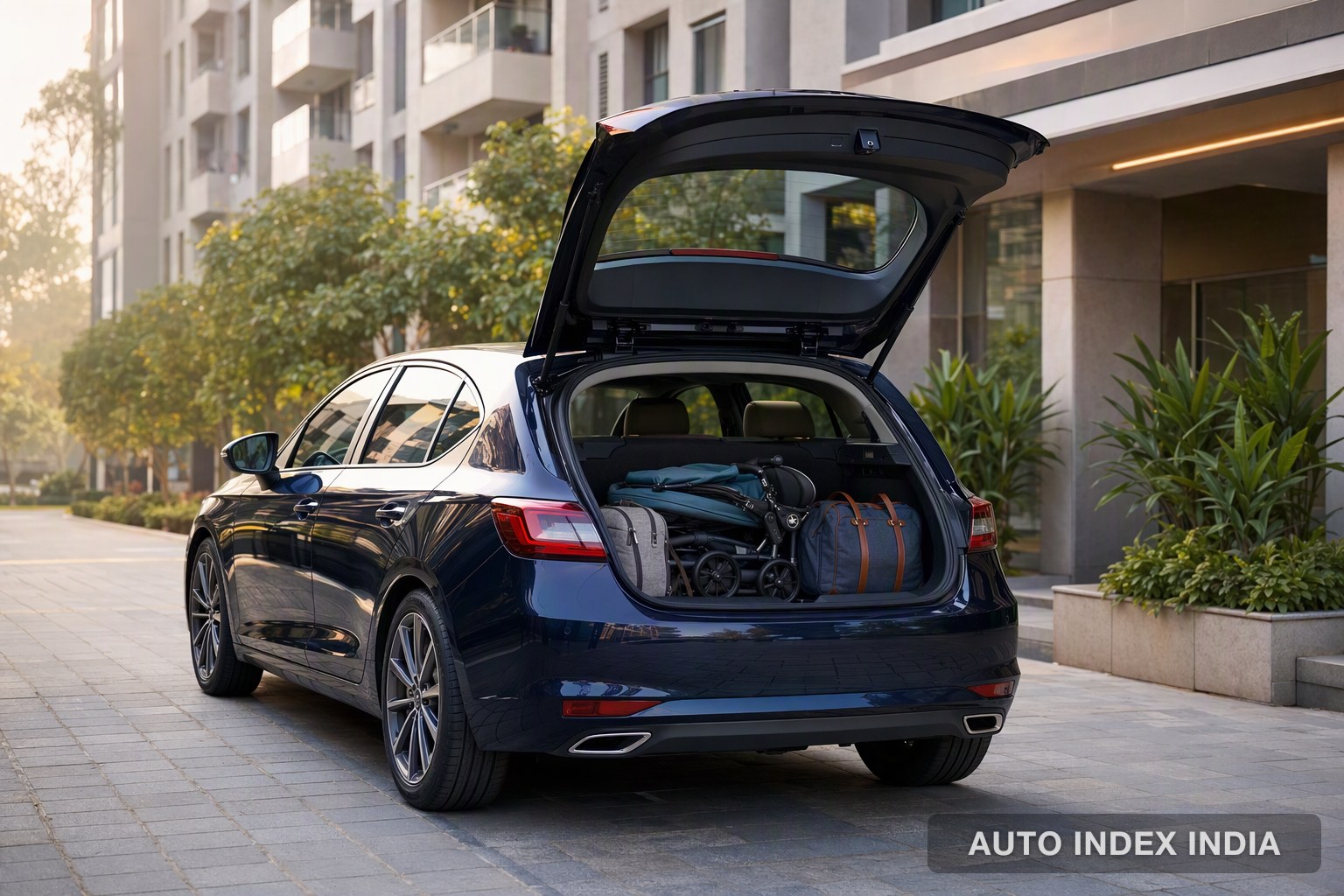
Best Hatchback for a Small Family in India: Boot, ISOFIX and Crash Ratings Compared (2026)
Six airbags are now standard on every family hatchback here, so the differences are in the boot, the rear seat and child-seat anchorages. The Altroz, Baleno, Swift, i20 and Tiago fit ISOFIX to every variant; the Grand i10 Nios has it on the Asta only, and the WagonR, Celerio and Alto K10 brochures do not list it. Boots run from 345 litres (Altroz) and 318 (Baleno) down to 265 (Swift) and 242 (Tiago), and the Altroz iCNG drops to 210. Only the Altroz and Baleno have Bharat NCAP results, and the Baleno's applies to the previous car's petrol trims, with a 3-star child score of 34.81 of 49.
For a family of three or four, the Tata Altroz is the hatchback with the strongest case on paper: a 345-litre boot, ISOFIX anchorages and stability control on every variant, and a 5-star Bharat NCAP result (29.65 out of 32 for adults, 44.90 out of 49 for children) that covers its petrol, diesel and CNG versions. The Maruti Suzuki Baleno is the closest alternative, with 318 litres, ISOFIX, six airbags and ESP from the base Sigma at Rs 5,98,900, and a certified 23.80 to 24.77 km/l. The Maruti Suzuki Swift is the right size for a couple with one child who mostly drive in town, but its 265-litre boot is the tightest of the three.
This is a narrower test than a general "best hatchback" list. It looks at four things a family actually uses: boot litres, the rear seat, child-seat anchorages by variant, and what the crash rating really covers. Every figure comes from the manufacturer's current brochure or price page, and where a maker does not publish a number, the table says so.
Family hatchbacks compared
| Hatchback | Boot | ISOFIX | Airbags | Stability control | Crash rating | Starts at (ex-showroom) |
|---|---|---|---|---|---|---|
| Tata Altroz | 345 L (210 L on CNG) | Every variant | 6, standard | Every variant | Bharat NCAP 5 star adult, 5 star child | Rs 5,99,990 |
| Maruti Suzuki Baleno | 318 L | Every variant | 6, standard | Every variant, with hill hold | Bharat NCAP 4 star adult, 3 star child, on the previous car | Rs 5,98,900 |
| Maruti Suzuki Swift | 265 L | Every variant | 6, standard | Every variant, with hill hold | No Bharat NCAP result | Rs 5,83,900 |
| Hyundai i20 | Not in Hyundai's brochure | Every variant | 6, standard | Every variant | Global NCAP 3 star (2022, older two-airbag car) | Rs 5,99,000 |
| Tata Tiago | 242 L | Every variant | 6, standard | Pure+ and above | Global NCAP 4 star (2020, older two-airbag car) | Rs 4,76,990 |
| Hyundai Grand i10 Nios | Not in Hyundai's brochure | Asta only | 6, standard | Not on Era or Magna | Global NCAP 2 star (2020, older two-airbag car) | Rs 5,59,700 |
Prices are ex-showroom starting prices from each maker's own price page, checked on 13 October 2026. Boot figures for the Maruti cars are for the petrol versions.
What a small family should check first
ISOFIX on the variant you can afford. A child seat clipped into ISOFIX anchorages is far harder to fit wrongly than one held by the seat belt. Five of the six cars above fit the anchorages to every variant. The Grand i10 Nios does not: Hyundai's brochure grid shows ISOFIX on the top Asta trim only, so the seven trims below it go without.
Boot litres, and what CNG does to them. A folded stroller and a week's shopping need roughly the space the Baleno and Altroz have. CNG changes the picture. Tata quotes 210 litres for the Altroz iCNG against 345 for the petrol and diesel. Maruti prints no boot figure at all for the Swift S-CNG, and Tata prints none for the Tiago iCNG, so see the boot in person before choosing a gas variant as the family car.
Which car the crash rating belongs to. Only two hatchbacks on sale have a Bharat NCAP result. The rest carry older Global NCAP results from two-airbag cars, or nothing. A star rating is worth reading down to its applicability list, which is where the Baleno and Altroz differ most.
1. Tata Altroz
The Altroz was rated by Bharat NCAP in 2025 at 29.65 out of 32 for adult protection and 44.90 out of 49 for child protection, 5 stars on both. The child score is the one a family should look at: 23.90 of 24 in the dynamic test and the full 12 for child-seat installation. The applicability table, revised in June 2026, lists petrol manual, AMT and DCA variants, the diesel, and the CNG manual and AMT. That includes the base Smart trim, so a buyer at the bottom of the range gets the same rating as one at the top.
Tata's brochure gives the boot as 345 litres on petrol and diesel and 210 litres on the iCNG, which uses twin cylinders under the floor. Six airbags, ESP, ISOFIX and three-point belts with reminders are on the Smart trim. Rear AC vents arrive on the Creative, and height-adjustable rear headrests and a rear armrest only on the Accomplished S, so the middle trims are less generous to rear passengers than the safety sheet suggests.
Tata lists the range at Rs 5.99 lakh to Rs 10.74 lakh, so the top trims sit above Rs 10 lakh. Its brochure carries no certified mileage table for any engine, so there is no manufacturer figure to set against the Maruti cars here. The turning radius is 5.0 metres, the widest in this group.
2. Maruti Suzuki Baleno
The Baleno is the family pick among the Maruti hatchbacks, and the reason is how much sits on the base car. NEXA's brochure ticks six airbags, ESP with hill hold assist, ISOFIX anchorages, adjustable headrests for all occupants and a 60:40 split rear seat on the Sigma. Rear AC vents and tyre pressure monitoring start on the Delta at Rs 6,99,900, a rear view camera on the Zeta, and the 360 view camera and head up display on the Alpha. Level 2+ ADAS is on the Alpha (O), from Rs 9,49,900.
The boot is 318 litres by the VDA method. The 1.2-litre Z-series engine makes 82.93 PS and 112.4 Nm, and Maruti certifies 23.80 km/l for the manual and 24.77 km/l for the AGS. The S-CNG, offered on Delta and Zeta, is rated at 33.61 km/kg manual and 34.47 km/kg AGS.
The crash rating needs care. Bharat NCAP published two Baleno results in 2025. The six-airbag car scored 26.52 out of 32 for adults and the two-airbag car 24.04, both with 34.81 out of 49 for children. That child score, 3 stars, is well short of the Altroz's, with 16.81 of 24 in the dynamic test. Both results list petrol trims only, so no S-CNG variant is covered, and both predate the facelifted Baleno that went on sale in September 2026, which has not been retested.
Price: Rs 5,98,900 to Rs 9,99,000 across 13 variants.
3. Maruti Suzuki Swift
The Swift suits a smaller family than the Baleno does. At 3,860 mm it is 130 mm shorter, turns in 4.8 metres and has a 265-litre boot, which takes a stroller or the shopping but not comfortably both. In return it has the best certified petrol figures here, 25.35 km/l manual and 26.25 km/l AMT, and the S-CNG is rated at 35.07 km/kg manual and 35.34 km/kg AMT.
Safety equipment is even across the range. The Arena brochure lists six airbags, ESP, hill hold assist, ISOFIX, three-point belts and reverse parking sensors on every variant from the LXi at Rs 5,83,900. The rear seat is where the trims separate: rear AC vents, adjustable rear headrests and the 60:40 split rear seat are on the ZXi and ZXi+ only, and the rear parking camera is ZXi+ only. A family buying the Swift should be looking at the ZXi, which starts at Rs 7,61,900.
There is no Bharat NCAP or Global NCAP result for the current India-spec Swift. Six airbags and ESP are a statement about equipment and say nothing about how the structure performs in a test.
Price: Rs 5,83,900 to Rs 8,88,900.
4. Hyundai i20
On equipment the i20 is the Baleno's closest rival. Hyundai's brochure marks six airbags, ESC, hill-start assist, vehicle stability management, ISOFIX and rear parking sensors as standard on every trim from the Era. Rear AC vents start on the Magna. Adjustable rear headrests appear only on the Asta (O) and above, which matters for whiplash protection in the back seat.
Two gaps keep it out of the top three here. Hyundai's brochure prints no boot volume and no certified mileage, so neither can be compared with the Maruti and Tata figures from a manufacturer source. And the only independent crash result is Global NCAP's from 2022, 3 stars for adults and 3 for children on a two-airbag car under the older protocol.
Price: from Rs 5,99,000 for the Era, per Hyundai's price page, which does not expose a variant-level list.
5. Tata Tiago
The Tiago is the least expensive way to get ISOFIX and six airbags together, at Rs 4,76,990 for the Smart trim. Tata's 2026 brochure also lists three-point belts with reminders for all seats and ABS with EBD and corner stability control on that base car. ESP with traction control and hill hold come in at Pure+.
The limit is space. The petrol boot is 242 litres and the wheelbase is 2,400 mm, the shortest of the six, so this is a car for one child rather than two. Global NCAP's 4-star adult and 3-star child result dates from 2020 and a two-airbag car. Tata publishes no certified mileage for it.
6. Hyundai Grand i10 Nios
The Nios has six airbags on every trim and adjustable rear headrests from the base Era, which is more than the Swift manages. It still ranks last for family use because of two lines in Hyundai's own feature grid. ISOFIX is fitted to the Asta alone. ESC, vehicle stability management and hill-start assist are absent on the Era and Magna and are AMT-only on the Corporate. The brochure gives no boot volume, and the Global NCAP result (2 stars adult, 2 stars child) is from 2020.
A note on the cheaper tall hatchbacks
The Maruti Suzuki WagonR has a 335-litre boot, more than the Baleno, and starts at Rs 4,98,900 with six airbags and ESP on every variant. It is not on this list because its brochure feature grid lists no ISOFIX anchorages, and Global NCAP's 2023 test of the older two-airbag car gave it 1 star for adults and 0 for children. The Celerio (292 litres) and Alto K10 are in the same position on ISOFIX. They are good city cars, and they are covered in the daily-use hatchback comparison.
How this list was built, and what was not verified
Boot, dimensions, engine output, mileage and feature-by-variant claims were read from each maker's current brochure: NEXA for the Baleno, Arena for the Swift, WagonR, Celerio and Alto K10, Tata for the Altroz and Tiago, Hyundai for the i20 and Grand i10 Nios. Maruti prices are the full variant lists on its price pages. Tata and Hyundai price pages gave starting prices only.
Three things could not be verified from a manufacturer source and are left out instead of being filled in from aggregators: certified mileage for the Tata and Hyundai cars, boot volume for the two Hyundais, and rear legroom for all six, which no brochure states. Bharat NCAP scores were read from bncap.in on 13 October 2026. The Global NCAP results are quoted from Global NCAP's factsheets and apply to the older cars named.
The Tata Punch is left out because it is sold and rated as a micro SUV. The Toyota Glanza shares the Baleno's body but is not in the table: Toyota publishes no ex-showroom prices, and it has no Bharat NCAP result of its own. Both, along with the full crash-test picture, are in the Bharat NCAP hatchback ratings guide.
Frequently asked questions
Which hatchback is best for a small family in India?
The Tata Altroz, if crash protection for children and boot space decide it: 345 litres, ISOFIX on every variant and 44.90 out of 49 for child protection at Bharat NCAP. The Maruti Suzuki Baleno is the alternative for buyers who want certified mileage of 23.80 to 24.77 km/l and driver assistance, with a 318-litre boot.
Which family hatchback has the biggest boot?
The Altroz at 345 litres on petrol and diesel. The WagonR is next at 335 litres, then the Baleno at 318, the Celerio at 292, the Swift at 265 and the Tiago at 242. Hyundai does not print a boot figure for the i20 or Grand i10 Nios in its brochures.
Do all these hatchbacks have ISOFIX child seat anchorages?
No. The Altroz, Baleno, Swift, i20 and Tiago list ISOFIX on every variant. The Grand i10 Nios has it on the top Asta trim only, and the WagonR, Celerio and Alto K10 brochures do not list it at all.
Does the Baleno's Bharat NCAP rating apply to the car on sale now?
Not strictly. Both Baleno results were published in 2025 for the previous car and list petrol trims only. The September 2026 facelift has not been tested, and the S-CNG variants were never covered.
Is the Swift big enough for a family of four?
For city use, yes, with limits. The 265-litre boot is the smallest of the three main picks here, and rear AC vents, adjustable rear headrests and the split rear seat come only on the ZXi and ZXi+. A family of four that travels with luggage will be better served by the Baleno or Altroz.
Is a CNG hatchback a good family car?
It cuts fuel cost, at the price of luggage room. The Altroz iCNG drops from 345 to 210 litres. Maruti and Tata print no boot figure for the Swift S-CNG or the Tiago iCNG. Among the two Bharat NCAP rated hatchbacks, only the Altroz rating extends to the CNG variants.
Last verified: 2026-10-13
Sources
- Bharat NCAP: Tata Altroz crash test result
- Bharat NCAP: Maruti Baleno Gasoline (6 airbags) result
- Bharat NCAP: Maruti Baleno Gasoline (2 airbags) result
- NEXA: Maruti Suzuki Baleno brochure
- Maruti Suzuki Arena: Swift brochure
- Tata Motors: Altroz brochure (May 2026)
- Tata Motors: Tiago brochure (May 2026)
- Hyundai India: i20 brochure
- Hyundai India: Grand i10 Nios brochure
- Maruti Suzuki Arena: WagonR brochure
- NEXA: Baleno price list
- Maruti Suzuki Arena: Swift price list