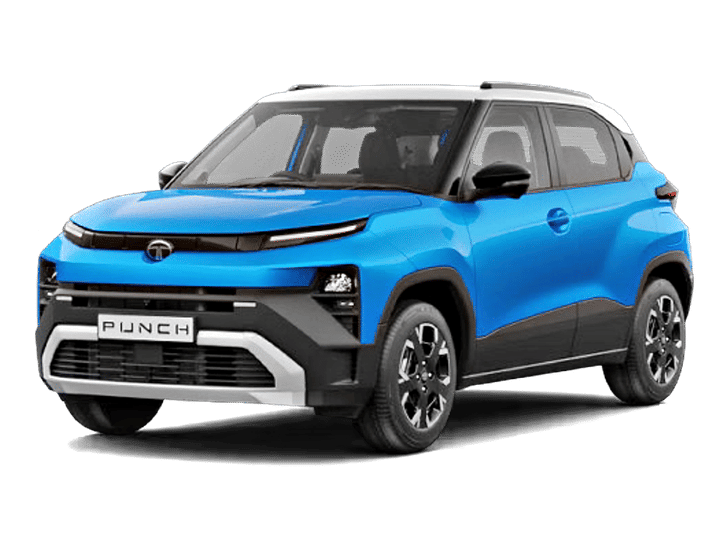

Tata launched the turbo-petrol Punch in South Africa at ~₹10.5–12.6 lakh equivalent, with 6 airbags standard and 88 kW/170 Nm. India already has the 120 PS turbo-petrol from ₹8.47 lakh.
The Tata Punch turbo-petrol is defined as the performance-oriented variant of Tata's sub-4-metre micro-SUV, producing 88 kW (approximately 118 bhp) and 170 Nm from a 1.2-litre turbocharged three-cylinder petrol engine — a specification that Tata Motors introduced to the South African market for the first time on 30 October 2026, priced at approximately ₹12.6 lakh at the top of a three-variant range. For Indian buyers, this launch matters because it confirms Tata's global confidence in the turbo-petrol Punch powertrain — the same engine that has been available in India since the 2026 facelift, starting at ₹8.47 lakh ex-showroom for the Adventure 1.2 Turbo MT.
The comparison below covers the three compact SUVs that a buyer considering the Punch turbo-petrol in India would realistically cross-shop: the Punch itself, the Maruti Suzuki Fronx turbo-petrol (the direct Nexa-channel rival with 6 airbags), and the Nissan Magnite turbo-petrol.
| Specification | Tata Punch Turbo MT (India) | Maruti Suzuki Fronx Turbo MT | Nissan Magnite Turbo CVT |
|---|---|---|---|
| Price (ex-showroom, India) | ₹8.47 lakh (Adventure Turbo MT) | ₹9.99 lakh (Alpha+ Turbo MT, approx.) | ₹10.99 lakh (Tekna+ Turbo CVT) |
| Engine | 1.2L turbo-petrol | 1.0L turbo-petrol (K10C Boosterjet) | 1.0L turbo-petrol |
| Power | 120 PS / 88 kW | 100 PS | 100 PS |
| Torque | 170 Nm | 148 Nm | 152 Nm |
| Gearbox | 5-speed MT only | 5-speed MT / 6-speed AT | 5-speed MT / CVT |
| ARAI Mileage | Not yet published (ARAI) | 21.79 kmpl (MT, ARAI claim) | 17.9 kmpl (ARAI claim) |
| Airbags | 6 (standard on Accomplished trims) | 6 (standard across range) | 6 |
| Bharat NCAP | 5-star (2026) | Not yet rated under Bharat NCAP | 5-star (Global NCAP) |
| Boot space | 366 litres | 308 litres | 336 litres |
| Ground clearance | 193 mm | 163 mm | 205 mm |
| Automatic option | No (turbo variant is MT only) | Yes (6-speed AT) | Yes (CVT) |
| Key weakness | No automatic, no ADAS | Lower ground clearance, smaller boot | Smaller engine, CVT-only auto |
Prices are ex-showroom India. Mileage figures are manufacturer ARAI claims unless stated otherwise.
What exactly did Tata launch in South Africa, and why does it matter to Indian buyers?
Tata Motors Passenger Vehicles launched the all-new Punch in South Africa through distribution partner Motus Holdings on 30 October 2026. The South African range spans three variants:
- Pure+ 1.2L 5MT — naturally aspirated, 65 kW / 115 Nm, priced at approximately ₹10.5 lakh
- Adventure 1.2L 5MT — naturally aspirated, same engine, approximately ₹11.4 lakh
- Accomplished+ S 1.2L Turbo 6MT , turbocharged, 88 kW / 170 Nm, approximately ₹12.6 lakh
This marks the first time Tata has offered a turbo-petrol Punch in South Africa. Six airbags come as standard on every variant — not just the top trim — and the car carries a five-star Bharat NCAP safety rating. Infotainment is an 8-inch or 10.25-inch HD Harman unit (variant-dependent) with wireless Apple CarPlay and Android Auto.
For Indian buyers, the South Africa launch is a signal rather than a product announcement. The turbo-petrol Punch already exists in India; what the international rollout confirms is that Tata views this powertrain as globally competitive and is building volume around it. The company also noted that the Punch has crossed 8 lakh customers in India — a sales milestone that gives Tata the confidence to export the platform with the same engine tune.
Yash Khandelwal, Head of International Business at Tata Motors Passenger Vehicles, said the new model builds on the Punch's proposition with enhanced technology, safety and contemporary styling. Thato Magasa, CEO of Motus Holdings' Tata Motors Passenger Vehicles distribution business, said the launch strengthens the brand's SUV portfolio in South Africa.
What is the Punch turbo-petrol engine, and how does it perform in India?
The turbo-petrol engine in the Punch is a 1.2-litre, three-cylinder turbocharged unit producing 120 PS (approximately 88 kW) and 170 Nm of torque, paired exclusively with a 5-speed manual gearbox in the Indian market. In South Africa, Tata has fitted a 6-speed manual to the same engine — a detail worth noting because Indian buyers have asked for a more refined gearbox on the turbo variant.
In India, the Punch turbo-petrol is available in a single variant: the Adventure 1.2 Turbo MT at ₹8.47 lakh ex-showroom. That makes it the only way to get the 120 PS engine, and it comes with no automatic option at any price point. This is the Punch turbo's most significant limitation for urban buyers who want the performance without the manual gearbox.
The ARAI mileage figure for the Punch turbo-petrol has not been published as a standalone certified number yet — treat any figure circulating online as unverified until Tata publishes it officially. The naturally aspirated 1.2-litre Punch petrol is ARAI-rated at 20.09 kmpl (manual) and 18.80 kmpl (AMT), so the turbo variant will realistically return less, likely in the 16–18 kmpl range under real-world conditions based on comparable turbocharged engines in this segment.
The Punch turbo's 170 Nm torque figure stands highest in its immediate price band. The Maruti Fronx turbo makes 148 Nm, and the Nissan Magnite turbo makes 152 Nm. On paper, the Punch turbo has a meaningful torque advantage, which translates to stronger mid-range pull — useful on highways and for overtaking on two-lane roads.
How does the Punch turbo compare with the Maruti Suzuki Fronx turbo-petrol?
The Maruti Suzuki Fronx is a compact SUV sold through Nexa dealerships, built on the Heartect platform, and available with a 1.0-litre Boosterjet turbo-petrol engine producing 100 PS and 148 Nm. It is the most direct rival to the Punch turbo in the Nexa channel, and it is the car buyers most frequently compare against the Punch when they walk into a showroom.
The Fronx has a genuine edge where it matters most: it offers a 6-speed automatic torque-converter gearbox with the turbo engine, which the Punch turbo does not. If you want a turbocharged compact SUV with an automatic, the Fronx is currently the only option in this price bracket that delivers it. The Fronx turbo AT is also ARAI-rated at 20.01 kmpl (manufacturer claim), though real-world figures from owner logs tend to be closer to 14–16 kmpl in mixed driving.
The Fronx's weaknesses deserve attention. Its ground clearance of 163 mm is significantly lower than the Punch's 193 mm — a difference that matters on broken roads, speed bumps and waterlogged streets that are routine in Indian cities. Its boot space of 308 litres is also smaller than the Punch's 366 litres. The Fronx has not yet been rated under Bharat NCAP, so buyers who prioritise a certified safety score should note that the Punch holds a 5-star Bharat NCAP rating from 2026 with scores of 30.58/32 for adult occupants and 45/49 for child occupants.
Both cars offer 6 airbags on the safety front. The Fronx has 6 airbags as standard across its range, which is a meaningful differentiator in the Nexa lineup. The Punch also offers 6 airbags, but this is variant-dependent in India — the base Smart and Pure trims carry fewer airbags, and you need to go to the Pure+ and above to get the full six. If 6 airbags are a non-negotiable requirement, verify the specific variant before booking.
For buyers who want to explore SUVs with 6 airbags under ₹25 lakh, both the Punch and Fronx qualify at their respective price points.
What does the 5-star Bharat NCAP rating mean for the Punch, and how does it compare to rivals?
A 5-star Bharat NCAP rating represents the highest safety classification awarded under India's domestic crash-test protocol, which tests adult occupant protection, child occupant protection and safety assist systems including ESC and seatbelt reminders. The Tata Punch received this rating in 2026, scoring 30.58 out of 32 for adult occupants and 45 out of 49 for child occupants — marginally higher than the Tata Nexon's 2024 scores of 29.41/32 adult and 43.83/49 child.
The Nissan Magnite holds a 5-star Global NCAP rating, which uses a different test protocol and is not directly comparable to Bharat NCAP scores. The Maruti Fronx has not been submitted for Bharat NCAP testing as of October 2026.
What the Punch's Bharat NCAP score does not cover is ADAS (Advanced Driver Assistance Systems). No variant of the Punch offers ADAS — no automatic emergency braking, no lane-keep assist, no adaptive cruise control. The Tata Nexon, which starts at ₹7.40 lakh, offers a basic Level 1 ADAS suite (360-degree camera, blind-view monitor, cruise control) from the Pure+ PS trim at ₹9.72 lakh. If ADAS is a priority, the Punch cannot deliver it at any price point, and buyers should look at the Nexon instead.
For a broader look at 5-star Bharat NCAP-rated SUVs under ₹15 lakh, the Punch is among the most affordable options with this rating.
Is the Punch turbo-petrol available with an automatic gearbox in India?
No. As of October 2026, the Punch 1.2 Turbo is available only with a 5-speed manual gearbox in India, in a single variant — the Adventure 1.2 Turbo MT at ₹8.47 lakh ex-showroom. There is no AMT or torque-converter automatic option for the turbo engine.
This gap is significant. The naturally aspirated Punch 1.2-litre petrol is available with a 5-speed AMT from the Pure+ AMT at ₹7.75 lakh, and the CNG variants also get an AMT option. But the turbo engine has no automatic pairing in India, which limits its appeal for city buyers who want the performance without the clutch work.
The South African launch is interesting in this context: Tata has paired the same turbo engine with a 6-speed manual there, not an automatic. This suggests the automatic pairing for the turbo Punch — if it comes — is not imminent. Buyers who want a turbocharged automatic in this segment should consider the Maruti Fronx turbo AT or wait for Tata to announce an AMT or DCT pairing for the Punch turbo.
How does the Punch turbo-petrol fit into Tata's India sales picture?
The Tata Punch sold 20,333 units in September 2026, up 28 percent year-on-year from 15,891 units in September 2025. It was narrowly outsold by the Tata Nexon (20,456 units) during the festive season, when buyers tend to opt for larger family cars. For most of the year, the Punch is Tata's highest-volume model.
The turbo-petrol variant is a small fraction of overall Punch sales — the naturally aspirated petrol and CNG variants drive the volume. The Adventure 1.2 Turbo MT at ₹8.47 lakh sits in a price band where buyers are also looking at the Nexon entry trims (from ₹7.40 lakh) and the Fronx turbo. The turbo Punch's value is straightforward: more power (120 PS vs 88 PS for the NA Punch) at a price that undercuts the Fronx turbo by a meaningful margin, with better ground clearance and a stronger Bharat NCAP score.
The Punch has crossed 8 lakh cumulative customers in India, according to Tata Motors — a figure cited at the South Africa launch. That installed base gives Tata a strong service network argument, which matters for buyers outside metro cities where Nexa or Nissan dealer density may be lower.
What does the South Africa launch tell us about potential India updates?
The South African Punch range introduces two details that Indian buyers will notice are absent from the current India lineup:
A 6-speed manual with the turbo engine. India gets a 5-speed manual. South Africa gets a 6-speed. A 6-speed gearbox typically improves highway refinement and fuel efficiency by allowing a taller top gear. Whether Tata will bring this to India is not confirmed, but the existence of the 6-speed pairing suggests the engineering work has been done.
6 airbags as standard on all variants. In South Africa, even the base Pure+ gets 6 airbags. In India, the base Smart MT gets 2 airbags. The Indian government has mandated 6 airbags as standard for all new passenger vehicles from October 2023, but implementation timelines and variant-level compliance have varied. The Punch's India lineup already offers 6 airbags from the Pure+ trim upward — the South Africa launch simply confirms Tata's global standard is now 6 airbags across the board.
What the South Africa launch does not suggest is an imminent turbo-automatic pairing or ADAS addition for the Punch in India. Neither feature appears in the South African spec sheet, and Tata has not announced any such update for the Indian market.
Which Punch variant makes the most sense for Indian buyers right now?
The answer depends on what you're optimising for.
If you want the turbo engine: The Adventure 1.2 Turbo MT at ₹8.47 lakh is the only option. You get 120 PS, 170 Nm, 6 airbags (verify at booking), and the 5-star Bharat NCAP rating. You do not get an automatic gearbox, ADAS, or a sunroof. If those matter, look at the Nexon or Fronx instead.
If you want the best value in the Punch range: The Pure+ Petrol MT at ₹7.17 lakh is the variant most frequently cited as the sweet spot. It includes the touchscreen, 6 airbags, and the 5-star NCAP body — without paying the turbo premium for power you may not need in city driving.
If you want an automatic: The Pure+ AMT at ₹7.75 lakh or the Accomplished AMT at ₹9.05 lakh give you the naturally aspirated engine with a 5-speed AMT. The top-spec Accomplished+ S CNG AMT at ₹10.77 lakh adds the CNG option with an automatic — the only CNG-automatic combination in the Punch range.
If you're comparing with the Fronx turbo: The Fronx turbo AT is the better choice if you want a turbocharged automatic. The Punch turbo MT is the better choice if you want more power, more ground clearance, a larger boot, and a certified Bharat NCAP score — and you're comfortable with a manual gearbox.
For buyers who place safety at the top of their list, both the Punch and the Fronx now offer 6 airbags in their respective ranges. A broader comparison of SUVs with 6 airbags under ₹30 lakh shows how the Punch and Fronx sit relative to larger SUVs in the safety-first buyer's consideration set.
What are the Punch turbo's honest weaknesses?
No buying guide is complete without this section. The Punch turbo-petrol has real limitations that buyers should weigh:
No automatic gearbox. This is the single biggest gap. Every competitor in this price band — the Fronx turbo, the Magnite turbo — offers an automatic option. The Punch turbo does not. For buyers in stop-go city traffic, this is a daily inconvenience.
No ADAS at any price. The Punch's safety story is built on passive safety (airbags, body structure, Bharat NCAP score). It offers no active safety technology — no automatic emergency braking, no lane departure warning, no blind-spot monitoring. The Nexon offers basic ADAS from ₹9.72 lakh. If you want active safety tech, the Punch cannot deliver it.
Boot space is modest. At 366 litres, the Punch's boot is larger than the Fronx (308 litres) but smaller than the Magnite (336 litres) and significantly smaller than the Nexon (382 litres). For a family that regularly travels with luggage, this matters.
No ARAI-certified mileage for the turbo. The turbo Punch's fuel efficiency has not been independently certified and published as of October 2026. Buyers should treat any mileage claim for this variant as unverified until Tata publishes the ARAI figure.
Single variant. The turbo engine is available in only one trim — the Adventure Turbo MT. There is no choice of features or gearbox within the turbo range. You take it as-is or move to a different powertrain.
How does the Punch's 8-lakh customer milestone change the used-car and resale picture?
With over 8 lakh Punch units on Indian roads, the used-car market for this model is now deep enough to give buyers meaningful price discovery. A 2024 Punch petrol manual with 30,000 km typically trades in the ₹5.5–7 lakh range depending on variant and condition, based on listings on major platforms. The turbo variant is newer (2026 facelift) and used examples are scarce, so resale data is thin — treat any resale estimate for the turbo as speculative for now.
The large installed base also means Tata's service network is well-stocked with Punch-specific parts, and independent garages in smaller cities are familiar with the platform. This is a practical advantage over the Fronx (Nexa-only service) and Magnite (thinner dealer network outside metros).
Bottom line: should India buyers care about the South Africa Punch launch?
Directly, no — the South African launch does not add a new product to the Indian market. Indirectly, yes, for two reasons.
First, it validates the turbo-petrol Punch as a globally competitive powertrain. Tata is not keeping this engine only for India; it is confident enough to export it and price it as the premium option in a new market. That is a signal about the engine's refinement and reliability.
Second, the 6-speed manual pairing in South Africa hints that Tata has the engineering ready for a gearbox upgrade on the turbo Punch. Whether that comes to India — and whether it arrives alongside an automatic option — is the question Indian buyers should watch for in Tata's next product announcement cycle.
For now, the Punch Adventure 1.2 Turbo MT at ₹8.47 lakh remains the most powerful and best-crash-tested option under ₹9 lakh in the compact SUV segment, with the honest caveat that it offers no automatic gearbox and no ADAS. Buyers who can live with those limitations get a genuinely strong package. Buyers who cannot should look at the Fronx turbo AT or the Nexon PS trims instead.
Sources
- Tata Motors Introduces All-New Punch SUV in South Africa with Competitive Pricing, ETAuto
- Tata Punch vs Nissan Magnite (2026) - Price, Mileage & Features | Autocar India
- Tata Punch vs Nexon 2026: Prices, Mileage, Best Variant | TheSpecd
- New Tata Punch 2026 Price, Features, Images, Specs & Reviews | HT Auto
- September 2026: Top Selling Tata Cars | Spinny
- Tata Punch Official Page | Tata Motors
- 5-Star Bharat NCAP-Rated SUVs Under Rs 15 Lakh in India (2026) | AutoindexIndia
- 9 Best SUVs With 6 Airbags Under Rs 25 Lakh in India (2026) | AutoindexIndia
- 10 Best SUVs With 6 Airbags Under Rs 30 Lakh in India (2026) | AutoindexIndia