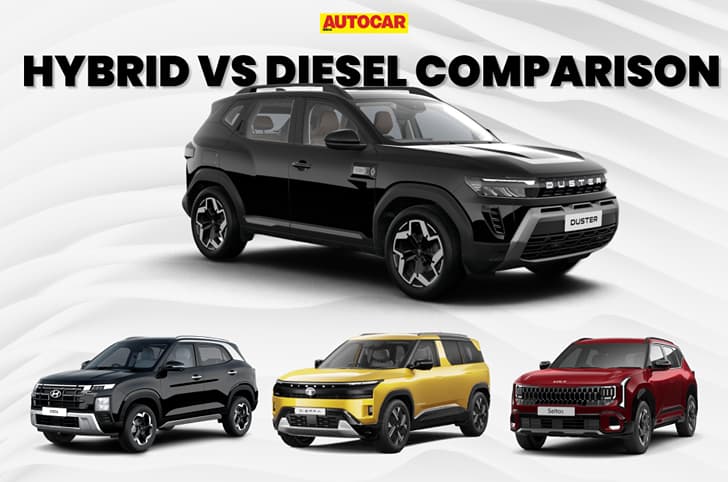

The Renault Duster Hybrid claims 29 km/l ARAI, beats all diesel automatics and the Maruti Grand Vitara Hybrid on paper, priced from Rs 16.99 lakh ex-showroom, but loses 146 litres of boot space to its battery.
The Renault Duster Hybrid (E-Tech 160) is the first strong-hybrid variant of the Duster nameplate in India, launched on October 17, 2026, with an ARAI-certified fuel efficiency of 29 km/l — the highest claimed figure in the mid-size SUV segment today. That single number is Renault's central argument for why city-heavy buyers should skip diesel automatics entirely.
But paper figures only tell part of the story. Before you decide between the Duster Hybrid, a diesel automatic rival, or the established Maruti Grand Vitara Hybrid, you need to understand what each powertrain actually delivers, where each car wins, and where it falls short.
Full Comparison: Duster Hybrid vs Diesel Automatics vs Maruti Grand Vitara Hybrid
The table below covers the five key decision points — powertrain, ARAI mileage, price range, boot space, and ground clearance — across the Renault Duster Hybrid and its most relevant rivals in the mid-size SUV segment.
| Renault Duster Hybrid | Maruti Grand Vitara Hybrid | Hyundai Creta Diesel AT | Kia Seltos Diesel AT | Tata Sierra Diesel AT | |
|---|---|---|---|---|---|
| Engine | 1.8L petrol + 2 e-motors | 1.5L petrol + e-motor | 1.5L diesel | 1.5L diesel | 1.5L diesel |
| System Power (hp) | 160 | 116 | 116 | 116 | 116 |
| Torque (Nm) | 172 (motor: 208) | 141 | 250 | 250 | 280 |
| Gearbox | DHT (multi-mode auto) | eCVT | 6-speed AT | 6-speed AT | 6-speed AT |
| ARAI Mileage (km/l) | 29.00 | 27.97 | 19.10 | 17.80 | 19.22 |
| Price Range (Rs lakh, ex-showroom) | 16.99–19.49 | ~17–21 (est.) | 16.08–19.78 | 15.32–21.82 | 15.99–21.29 |
| Boot Space (litres) | 372 | 373 | 433 | 447 | 450 |
| Ground Clearance (mm) | 212 | 210 | 190 | 200 | 205 |
| Drive Layout | FWD | FWD | FWD | FWD | FWD |
| Battery Size | 1.4 kWh / 247V | 0.60 kWh / 177.6V | — | — | — |
All prices ex-showroom India. ARAI figures are manufacturer claims; real-world mileage will be lower depending on traffic, speed, temperature, and driving style.
What exactly is the Duster Hybrid's powertrain, and how does it differ from the Grand Vitara Hybrid?
The Renault Duster Hybrid uses a full strong-hybrid system — meaning it can run on electric power alone at low speeds without external charging — built around a 1.8-litre naturally aspirated four-cylinder petrol engine paired with two electric motors. The first is a 20 hp generator (hybrid starter generator, or HSG) and the second is a 49 hp traction motor that drives the front wheels. Together with a 1.4 kWh battery pack operating at 247V, the system produces a combined 160 hp and 172 Nm. The traction motor alone contributes 208 Nm, which is why the Duster Hybrid feels brisk off the line despite the modest combined torque figure.
The gearbox is a dedicated hybrid transmission (DHT) with fixed gear ratios — two gears for the electric motors and four for the petrol engine — which Renault says creates an effective eight-speed combination in hybrid mode. This differs meaningfully from the eCVT used by the Maruti Grand Vitara Hybrid, the Maruti Victoris, and the Toyota Urban Cruiser Hyryder. Fixed gear ratios give the Duster Hybrid more predictable power delivery and, Renault claims, a 0–100 km/h time of 9.61 seconds — quicker than any other hybrid mid-size SUV currently on sale.
The Maruti Grand Vitara Hybrid pairs a 1.5-litre three-cylinder petrol engine with a single electric motor, a smaller 0.60 kWh battery at 177.6V, and an eCVT. Its ARAI-claimed efficiency is 27.97 km/l — impressive, but 1.03 km/l behind the Duster Hybrid. The Grand Vitara's system has proven itself over several years of Indian market operation, which matters for long-term reliability confidence. The Duster Hybrid's larger battery and higher voltage point to greater electric assistance capacity, though it remains too early to draw real-world reliability conclusions.
Diesel automatics — the Creta, Seltos, and Sierra — all use 1.5-litre diesel engines making 116 hp but substantially more torque: 250 Nm for the Creta and Seltos, 280 Nm for the Sierra. Paired with conventional 6-speed torque converter automatics, these powertrains excel at sustained highway cruising where diesel's torque advantage and efficiency at constant speeds shine.
How does the ARAI mileage gap translate to real-world savings?
The claimed gap is enormous: 29 km/l for the Duster Hybrid versus 17.80–19.22 km/l for the diesel automatics. That is a 9.78–11.2 km/l advantage on paper. In practice, strong-hybrid systems like the Duster's E-Tech deliver their biggest gains in urban stop-and-go traffic, where the petrol engine can shut off, the electric motor handles low-speed movement, and regenerative braking recovers energy that would otherwise be lost as heat.
Renault claims that up to 80 percent of city driving can be done in electric-only mode, with a total range of approximately 1,400 km on a full tank. These are manufacturer claims, and real-world urban mileage for comparable strong hybrids in India typically falls in the 20–24 km/l range depending on city, traffic density, and air conditioning load. Diesel automatics, by contrast, typically return 13–16 km/l in city conditions.
Highway driving tells a different story. Diesel engines are thermodynamically efficient at constant, moderate speeds — exactly what highway driving demands. The Duster Hybrid's petrol engine works harder at highway speeds where there is less opportunity for electric assistance or regenerative braking. Autocar India notes directly that "if you frequently go on highway trips, any of the diesel SUVs will be better, as diesel engines lend themselves well to long-distance cruising."
For a buyer who drives predominantly in a metro — say, 70–80 percent city and 20–30 percent highway — the Duster Hybrid's fuel savings over a diesel automatic could be substantial over three to five years, especially as petrol prices in India remain lower per litre than diesel in many states. For a buyer who regularly covers 400–600 km highway runs, the diesel automatic's torque advantage and consistent highway efficiency make it the more practical choice.
How do the prices compare, and is the Duster Hybrid good value?
The Duster Hybrid is priced from Rs 16.99 lakh to Rs 19.49 lakh (ex-showroom). At the entry level, all three diesel automatic rivals undercut it: the Kia Seltos diesel AT starts at Rs 15.32 lakh (Rs 1.67 lakh cheaper), the Tata Sierra diesel AT from Rs 15.99 lakh, and the Hyundai Creta diesel AT from Rs 16.08 lakh. Budget-conscious buyers seeking an automatic mid-size SUV will find more choice at the lower end with diesel options.
At the top of the range, the equation reverses. The Duster Hybrid's Rs 19.49 lakh ceiling is the lowest of the group — the Creta diesel AT reaches Rs 19.78 lakh, the Sierra Rs 21.29 lakh, and the Seltos Rs 21.82 lakh. Buyers looking at fully loaded variants will find the Duster Hybrid up to Rs 1.8 lakh cheaper than its diesel rivals at equivalent trim levels.
The Maruti Grand Vitara Hybrid sits in a broadly similar price band. Maruti's established hybrid platform and wide service network are genuine advantages, but the Grand Vitara's hybrid system is less powerful (116 hp vs 160 hp) and its ARAI mileage trails the Duster Hybrid by just over 1 km/l.
One cost factor working in the Duster Hybrid's favour over time is maintenance. Strong-hybrid systems use regenerative braking to reduce wear on friction brakes, and the petrol engine spends more time off or at low load, reducing engine wear. Diesel automatics, while solid, carry higher service costs for diesel-specific components and the torque converter automatic. These are long-term considerations that are difficult to quantify without ownership data on the new Duster Hybrid specifically.
How do the dimensions and practicality compare?
Size matters in a family SUV, and the numbers here are more detailed than the efficiency story. The Duster Hybrid measures 4,346 mm long, 1,815 mm wide, and 1,694 mm tall, on a 2,657 mm wheelbase. It ranks second-longest and second-tallest of the four SUVs compared, but its wheelbase is shorter than both the Seltos (2,690 mm) and the Sierra (2,730 mm). A longer wheelbase generally translates to more rear legroom, so back-seat passengers may feel slightly more cramped in the Duster Hybrid than in the Seltos or Sierra.
Ground clearance is where the Duster Hybrid genuinely stands out: 212 mm, the highest of the group, ahead of the Sierra (205 mm), Seltos (200 mm), and Creta (190 mm). For buyers in cities with poor road surfaces or those who occasionally venture onto unmade roads, this is a meaningful real-world advantage. The Duster's off-road DNA from its global lineage shows here.
Boot space is the Duster Hybrid's most significant practical weakness. The hybrid battery pack is packaged under the boot floor, cutting luggage capacity from 518 litres in the petrol Duster to 372 litres in the hybrid — a loss of 146 litres. All three diesel rivals offer more boot space: the Creta at 433 litres, the Seltos at 447 litres, and the Sierra at 450 litres. The Grand Vitara Hybrid faces a similar constraint, with its battery also eating into luggage space (approximately 373 litres). Families who regularly travel with large amounts of luggage or use their SUV for airport runs should factor this in seriously.
Wheel size is a minor but notable point: the Duster Hybrid comes with 18-inch alloy wheels as standard, while the Creta and Seltos offer 18-inch wheels only in higher trims, and the Sierra goes up to 19 inches in its top variants.
Where does the Maruti Grand Vitara Hybrid fit, and what are its honest weaknesses?
The Maruti Grand Vitara Hybrid is the established benchmark in the strong-hybrid mid-size SUV space. It pioneered this segment in India, and its Toyota-sourced hybrid system (shared with the Urban Cruiser Hyryder) has accumulated meaningful real-world reliability data. Maruti's service network — the widest in India — is a genuine ownership advantage that no rival can currently match.
On specifications, however, the Grand Vitara Hybrid is outgunned by the Duster Hybrid on almost every performance metric. Its 116 hp and 141 Nm feel adequate in the city but noticeably less energetic on highway overtakes compared to the Duster Hybrid's 160 hp. The 0.60 kWh battery at 177.6V is smaller and lower-voltage than the Duster's 1.4 kWh / 247V pack, meaning less electric-only range and less regenerative capacity. The eCVT, while smooth, can feel strained under hard acceleration — a characteristic of the platform rather than a fault.
The Grand Vitara Hybrid's ARAI mileage of 27.97 km/l is excellent, but it trails the Duster Hybrid by 1.03 km/l. The Maruti Victoris, which uses the same hybrid system, claims 28.65 km/l — closer to the Duster but still behind. Neither Maruti hybrid matches the Duster Hybrid's power output or battery capacity.
Where the Grand Vitara genuinely wins is in long-term ownership confidence. Buyers who are cautious about being early adopters of Renault's E-Tech system in India — which is new to this market — may prefer the Grand Vitara's proven track record, even at the cost of some efficiency and performance.
What features does the Duster Hybrid offer, and how does it compare on safety?
The new-generation Duster's India-spec interior has been substantially redesigned, with a dual-screen layout comprising a 10.1-inch touchscreen infotainment system with wireless Android Auto and Apple CarPlay, and a 10.25-inch digital instrument cluster. The cabin features soft-touch surfaces, silver accents, contrast green stitching, dual-zone climate control, a panoramic sunroof, a wireless phone charger, 6-way powered and ventilated front seats, 48-colour ambient lighting, and a powered tailgate.
Safety equipment includes six airbags, ABS with EBD, electronic stability control, rear parking sensors, a 360-degree camera, an electric parking brake, disc brakes on all four wheels, and Level 2 ADAS features. For buyers who prioritise safety ratings, check our guide to 5-star Bharat NCAP-rated SUVs under Rs 25 lakh — crash test results for the new Duster Hybrid specifically are not yet published at the time of writing.
The Hyundai Creta and Kia Seltos both offer comparable feature sets in their top trims, including ADAS, large touchscreens, and ventilated seats. The Tata Sierra's ARGOS platform brings its own feature-rich cabin, and Tata's safety credentials in the Indian market are well established. The Grand Vitara Hybrid's feature list is broadly similar to the Duster Hybrid's, with Maruti's connected car suite adding some convenience features.
What are the other powertrain options in the Duster range, and how do they compare?
The Duster Hybrid is the third and most expensive powertrain option in the new Duster range. The base engine is a 1.0-litre three-cylinder turbocharged petrol producing 100 hp and 160 Nm, paired with a 6-speed manual, with an ARAI-claimed 19.41 km/l — the most efficient petrol-only option in the range. It is available in Authentic, Evolution, and Techno trims priced between Rs 10.49 lakh and Rs 13.49 lakh (ex-showroom).
The middle option is a 1.3-litre four-cylinder turbocharged petrol making 163 hp and 280 Nm, available with either a 6-speed manual (17.75 km/l ARAI) or a 6-speed DCT automatic (18.45 km/l ARAI). This is the performance-oriented choice for buyers who want a quick automatic without the hybrid premium.
The Duster Hybrid at Rs 16.99–19.49 lakh commands a significant premium over the 1.3-litre turbo DCT. Whether that premium is recovered through fuel savings depends entirely on annual mileage and driving pattern. A buyer covering 20,000 km per year predominantly in city traffic will likely recover the premium faster than one doing 10,000 km per year on highways.
Renault has not offered a diesel engine in the new Duster — a deliberate choice, positioning the hybrid as the answer to diesel's efficiency appeal. This is a calculated bet on urban buyers' willingness to pay a premium for hybrid technology.
What is the broader mid-size SUV hybrid space in India?
The mid-size SUV segment is defined as the category of five-seat SUVs priced broadly between Rs 10 lakh and Rs 25 lakh (ex-showroom) competing on a combination of space, features, efficiency, and powertrain variety. As of October 2026, strong-hybrid options in this segment are limited to four models: the Renault Duster Hybrid, Maruti Grand Vitara Hybrid, Maruti Victoris, and Toyota Urban Cruiser Hyryder.
The Hyundai Creta is expected to adopt a hybrid powertrain in its next generation, due in 2027, and the Kia Seltos is set to follow. Tata's Sierra uses the ARGOS platform, which is hybrid-ready, giving Tata the option to introduce a hybrid Sierra in the future. Volkswagen and Skoda are also working on hybrid mid-size SUVs for India. This means the Duster Hybrid is entering a market that is about to get significantly more competitive on the hybrid front — buyers who wait 12–18 months will have more options to compare.
For now, the Duster Hybrid is the most powerful and most efficient strong-hybrid mid-size SUV in India, and its pricing is competitive enough to make a genuine case against both the diesel automatics and the established Maruti hybrid options.
Who should buy the Duster Hybrid, and who should look elsewhere?
The Duster Hybrid makes the most sense for buyers who:
- Drive primarily in urban or semi-urban conditions (city commutes of 30–80 km per day)
- Want the highest possible fuel efficiency without plugging in
- Prioritise performance alongside efficiency (160 hp is class-leading for a hybrid here)
- Value high ground clearance for city road conditions
- Are comfortable with a smaller boot (372 litres) as a trade-off
The diesel automatics — Creta, Seltos, Sierra — make more sense for buyers who:
- Cover significant highway distances regularly (400+ km runs)
- Need maximum boot space for family travel or luggage-heavy use
- Want a lower entry price (from Rs 15.32 lakh for the Seltos diesel AT)
- Prefer the proven long-distance efficiency of diesel at constant speeds
The Maruti Grand Vitara Hybrid is the right choice for buyers who:
- Want a proven strong-hybrid system with an established service record in India
- Prioritise Maruti's unmatched service network for peace of mind
- Are willing to accept lower power (116 hp) and a slightly lower efficiency claim (27.97 km/l) in exchange for ownership confidence
If safety ratings are a key criterion, our roundup of 5-star Bharat NCAP-rated SUVs under Rs 25 lakh is worth consulting alongside this comparison, as Bharat NCAP results for the new Duster Hybrid are pending.
The Renault Duster Hybrid is a genuinely strong product on paper — the efficiency leader, the power leader, and competitively priced at the top of the range. Its weaknesses are real: a shrunken boot, a shorter wheelbase than the Seltos and Sierra, and the uncertainty that comes with being a first-generation product in a new market. For city-first buyers who can live with 372 litres of boot space, it is the most compelling automatic mid-size SUV in India right now. For everyone else, the diesel automatics and the Grand Vitara Hybrid remain credible, well-rounded alternatives.
Sources
- Renault Duster hybrid vs diesel-AT rivals: Claimed mileage, specs compared | Autocar India
- New Renault Duster hybrid vs midsize cars spec comparison | Autocar India
- Renault Duster hybrid bookings open ahead of October 17 launch | Autocar India
- Renault Duster Hybrid fuel-efficiency revealed: Beats Grand Vitara, Hyryder | Times of India
- Renault Duster SUV fuel-efficiency revealed: More efficient than these SUVs! | Times of India
- Renault Duster – Official Model Page | Renault India
- Maruti Suzuki Grand Vitara – Official Model Page | Maruti Suzuki India