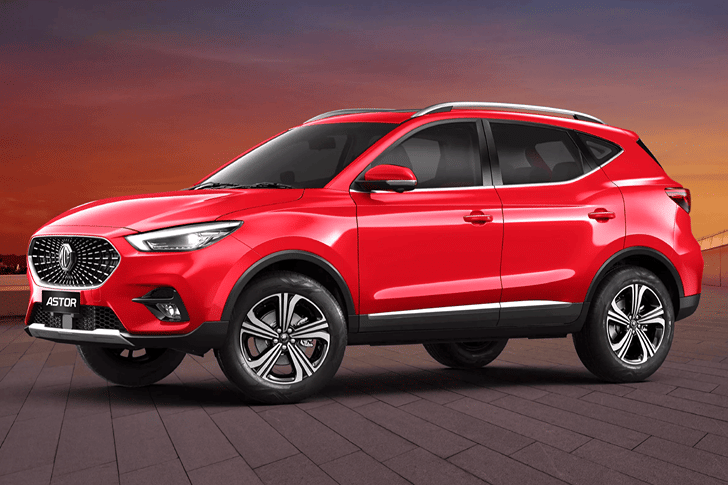

MG discontinued the Astor in October 2026 after averaging just 112 monthly sales; a petrol-only lineup and crossover-esque design couldn't compete. A SIGMA-platform successor is expected in 2027.
The MG Astor is defined as a mid-size SUV that went on sale in India in October 2021, priced from ₹9.79 lakh to ₹15.30 lakh (ex-showroom), and was officially discontinued in October 2026 after averaging just 112 units a month in the twelve months from September 2025 to September 2026. For buyers currently in the market for a mid-size SUV, the discontinuation closes one option but also clarifies the competitive space — and the alternatives available right now are stronger than ever.
How does the discontinued MG Astor compare to its mid-size SUV rivals?
The table below captures where the Astor stood at the time of discontinuation versus the segment's active contenders. The Maruti Suzuki Grand Vitara is included because it competes directly in this price band.
| Model | Ex-showroom price (base) | Engine options | Peak power | ARAI mileage (best claim) | Key gap vs segment |
|---|---|---|---|---|---|
| MG Astor (discontinued) | ₹9.79 lakh | 1.5L NA petrol only | 110 hp | ~15 km/l (manufacturer estimate) | No diesel, no CNG, no hybrid |
| Hyundai Creta | ₹10.99 lakh | 1.5L petrol, 1.5L diesel, 1.5L strong hybrid | Up to 140 hp | Up to 28.76 km/l (hybrid, ARAI) | None — segment benchmark |
| Kia Seltos | ₹11.25 lakh | 1.5L petrol, 1.5L diesel, 1.5L turbo petrol | Up to 160 hp | Up to 21.4 km/l (diesel, ARAI) | Slightly higher entry price |
| Maruti Suzuki Grand Vitara | ₹10.70 lakh | 1.5L mild hybrid petrol, 1.5L strong hybrid | Up to 103 hp (hybrid system) | Up to 27.97 km/l (strong hybrid, ARAI) | No diesel; strong hybrid is a genuine strength |
| Renault Duster | ₹10.49 lakh | 1.0L turbo petrol, 1.3L turbo petrol, strong hybrid (arriving Oct 2026) | Up to 163 hp | Up to 29 km/l (hybrid claim) | Cabin not as spacious as rivals; no spare tyre standard |
| Skoda Kushaq | ₹11.89 lakh | 1.0L turbo petrol, 1.5L turbo petrol | Up to 150 hp | Up to 21.5 km/l (ARAI) | No diesel or hybrid option |
Sources: Autocar India – MG Astor, Autocar India – Renault Duster
The table makes the Astor's structural problem visible at a glance: it was the only car in the segment with a single, naturally aspirated petrol engine and no alternative fuel path whatsoever.
Why did MG discontinue the Astor?
Powertrain poverty is the core reason. The mid-size SUV segment is defined as a hotly contested space where buyers expect at least two or three fuel-type choices, and the Astor had none of that breadth by the time it was pulled.
When the Astor launched in 2021, it offered two petrol engines: a 110hp 1.5-litre naturally aspirated unit and a 140hp 1.3-litre direct-injection turbocharged three-cylinder. The turbo engine gave the car genuine performance credentials and differentiated it from the base-spec crowd. But MG dropped the 1.3-litre turbo in February 2025, leaving the Astor with only the 1.5-litre NA motor — an engine that produces 144 Nm of torque and pairs with either a 5-speed manual or a CVT automatic. That is a workable powertrain for city use, but it is not a compelling reason to choose the Astor over a Hyundai Creta with a strong hybrid or a Kia Seltos with a diesel.
The segment moved fast. The Hyundai Creta added a strong hybrid variant delivering an ARAI-claimed 28.76 km/l. The Maruti Suzuki Grand Vitara's strong hybrid system achieves up to 27.97 km/l (ARAI), making it a genuine fuel-efficiency story. The Renault Duster returned to India with turbo-petrol engines and a strong hybrid launching in October 2026. The Astor had no answer to any of this.
Design perception compounds the problem. The Astor's relatively low-slung, crossover-esque silhouette made it look smaller than its more upright rivals, which matters in a segment where buyers associate height and visual bulk with value. In India's mid-size SUV market, the appearance of road presence influences purchase decisions.
The result was an average of 112 units a month over the twelve months ending September 2026. For context, the Hyundai Creta crossed 15 lakh cumulative sales in October 2026, a milestone that underlines just how lopsided the segment's demand distribution had become.
What did the MG Astor get right?
It would be unfair to write the Astor off entirely. At its price point, it offered a genuinely strong feature set. The mid-spec Select trim included 6 airbags, a panoramic sunroof, wireless Apple CarPlay and Android Auto, connected car technology, leatherette upholstery, and heated ORVMs — the last of which was a segment-first at the time.
The top-spec Savvy Pro CVT added Level 2 ADAS, a 360-degree camera, ventilated front seats, a 6-way powered driver's seat, auto-dimming IRVM, and rain-sensing wipers. At ₹15.30 lakh ex-showroom, that is a credible equipment list. The Astor also carried an Autocar India score of 7 out of 10, which reflects a competent but not class-leading package.
The problem was not that the Astor was a bad car. It was that the segment raised the bar faster than MG could respond.
Which mid-size SUVs should buyers consider now that the Astor is gone?
Buyers who were considering the Astor typically fell into two camps: those drawn by the price-to-feature ratio, and those who liked the idea of a less common alternative to the Creta or Seltos.
For the price-conscious buyer who wants maximum features per rupee:
The Maruti Suzuki Grand Vitara starts at ₹10.70 lakh (ex-showroom) and brings a strong hybrid option that is genuinely frugal. The mild hybrid variants are more affordable and still deliver better real-world efficiency than a naturally aspirated petrol. The Grand Vitara's weakness is its 103hp peak output in hybrid guise — it is not a fast car — and Maruti's infotainment interface has drawn criticism for being less intuitive than Hyundai's or Kia's. But for buyers who prioritise running costs, the strong hybrid's ARAI claim of 27.97 km/l is hard to argue with. If you're also evaluating safety credentials, our guide to 5-star Bharat NCAP SUVs under Rs 25 lakh covers the Grand Vitara and its rivals in detail.
For the buyer who wanted the Astor's turbo performance:
The Renault Duster is the most interesting new entrant. Autocar India gives it a 9 out of 10 and calls out its outstanding ride comfort and refined 1.3-litre turbo petrol engine. The 1.3-litre DCT variant makes 163hp and 280Nm — significantly more than anything the Astor offered — and the Duster earned a 5-star Bharat NCAP rating in April 2026. Its weaknesses are real: the cabin is not as spacious as rivals, there is no spare tyre as standard, and the infotainment interface is not the most intuitive. The strong hybrid variant launched on October 17, 2026, with an ARAI-claimed 29 km/l, which would make it the most fuel-efficient non-electric mid-size SUV in the segment. Base price is ₹10.49 lakh (ex-showroom), with the 1.3-litre DCT Evolution variant at ₹14.49 lakh (ex-showroom).
For the buyer who wanted something different from the Creta-Seltos duopoly:
The Skoda Kushaq and Volkswagen Taigun remain valid alternatives. Both use the 1.0-litre and 1.5-litre TSI engines, offer strong build quality and European-style driving dynamics, and carry a premium feel. Neither offers diesel or hybrid, which is the same limitation the Astor had — but the TSI engines are more engaging than the Astor's NA unit, and the Kushaq/Taigun's 5-star Euro NCAP heritage (tested on the global platform) gives buyers confidence. The Kushaq starts at ₹11.89 lakh (ex-showroom).
For the buyer who needs diesel:
The Hyundai Creta and Kia Seltos remain the default choices. The Creta's 1.5-litre diesel makes 116hp and returns up to 21.4 km/l (ARAI), and the Seltos diesel is mechanically similar. Both are available with 6 airbags across most trims. The Creta's strong hybrid is the segment's most complete package for buyers who cover long distances.
Is there a next-generation MG Astor coming?
Yes, though buyers should not wait for it if they need a car now. MG confirmed in March 2026 that it is developing an Astor replacement based on the SIGMA (SAIC Intelligent Global Modular Architecture) platform. This modular architecture can accommodate pure-combustion, hybrid, and electric powertrains — which would directly address the powertrain variety problem that killed the current Astor.
Autocar India expects the next-generation Astor replacement to launch in 2027. Spy shots and international references suggest it could draw on the global MG One design language. The expected price is around ₹12 lakh (ex-showroom) at launch, per early estimates, though that figure should be treated as speculative until MG makes an official announcement.
For buyers who are specifically loyal to the MG brand and can wait, the 2027 launch window is a reasonable horizon. For everyone else, the current segment has enough strong options that waiting is not necessary.
What happens to existing MG Astor owners?
This is a legitimate concern. MG Motor India has not made a public statement about parts availability or service continuity at the time of writing, but the standard industry practice in India is to maintain spare parts supply for at least eight years after a model's discontinuation. The Astor's 1.5-litre NA engine is a known, relatively simple unit, and its mechanical components are not exotic. Owners should, however, confirm with their nearest MG dealership about the availability of body panels, infotainment components, and ADAS sensors — these are the parts most likely to become scarce over a long ownership horizon.
The Astor's ZS EV sibling remains on sale, which means MG's dealer network is not disappearing from the mid-size SUV space entirely. Service infrastructure should remain intact.
How does the Astor's discontinuation fit into MG's broader India strategy?
MG Motor India — now operating as JSW MG Motor following JSW Group's stake acquisition — is repositioning itself across multiple segments simultaneously. The brand is preparing three new electrified SUVs for 2026–2027, including the MG IM6 luxury SUV-coupe (expected October 2026, ~₹60 lakh via CBU), a rebadged Wuling Starlight 560 seven-seater with PHEV and EV options (expected late 2026), and the next-generation ZS EV successor on the SIGMA platform (2027). The Astor replacement fits into this last category.
The discontinuation is therefore less a retreat from the mid-size SUV segment and more a clearing of the decks before a more competitive product arrives. MG is not walking away from a segment that, by any measure, is India's most lucrative SUV category. The Hyundai Creta's 15-lakh cumulative sales milestone is proof enough of that.
What the discontinuation does signal is that MG has accepted it cannot compete in this segment with a petrol-only, single-engine lineup. The SIGMA platform's multi-powertrain capability is the direct response to that lesson.
Should you buy a remaining MG Astor stock unit at a discount?
Dealers may offer significant discounts on remaining Astor inventory — this is standard practice when a model is discontinued. Whether that represents good value depends on your priorities.
A discounted Astor makes sense if you drive primarily in the city and do not need diesel efficiency or hybrid frugality. The feature set at mid-spec is genuinely strong, the 1.5-litre NA engine is reliable and low-maintenance, and a discount of ₹1–2 lakh could make the Shine or Select trim very competitive on price. The CVT is a pleasant urban companion.
Against this, resale value will be under pressure because the model is discontinued and no successor carries the Astor name forward immediately. Parts for the ADAS system and infotainment could become harder to source in five to seven years. For roughly the same money after discounts, the Renault Duster's base 1.0-litre turbo petrol or the Grand Vitara's mild hybrid offer more powertrain headroom and better long-term parts security.
A heavily discounted Astor Select MT or CVT is not a bad buy for a first-time SUV buyer on a tight budget — but it is not the obvious choice it might have been in 2022. The segment has moved on, and the alternatives are better.
For buyers focused on safety ratings across this segment, our roundup of SUVs with 6 airbags under Rs 25 lakh covers several of the Astor's rivals in detail and is worth reading before making a final decision.
Sources
- MG Astor discontinued in India | Autocar India
- MG Astor (2026) - Price, Mileage & Expert Reviews | Autocar India
- Renault Duster (2026) - Price, Mileage & Expert Reviews | Autocar India
- JSW MG Motor readying new Astor / ZS EV replacement | Autocar India
- JSW MG Motor India's 2026-27 Roadmap: 3 New Electrified SUVs to Watch | EVINDIA
- MG ZS HEV Specifications & Features | ZigWheels