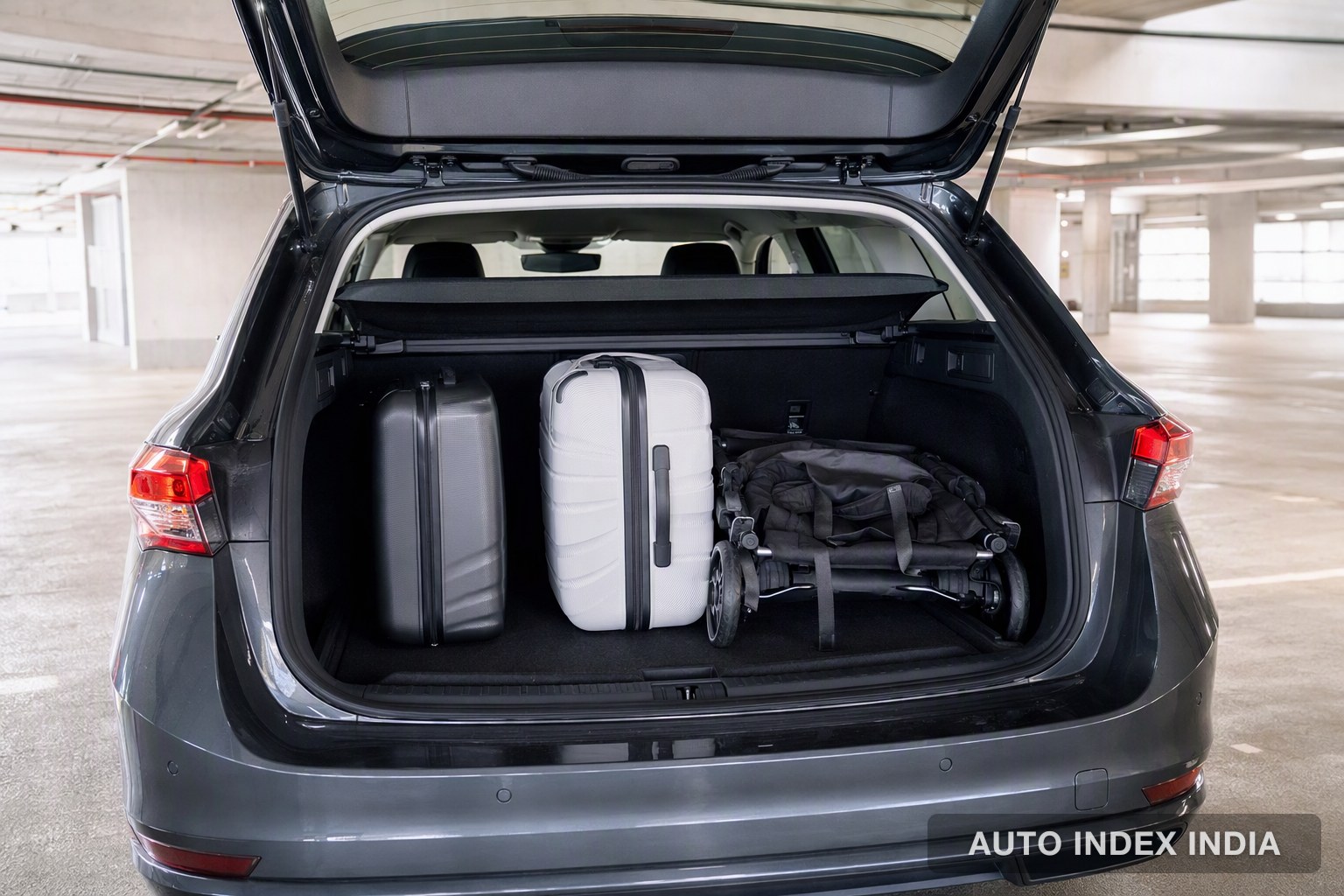
Best Hatchback With Good Boot Space in India (2026)
This ranking uses only boot volumes the manufacturer prints in its own brochure, with the rear seats upright. That rules out the Toyota Glanza, Hyundai i20, Hyundai Grand i10 Nios, Maruti Alto K10 and Maruti S-Presso, none of which carry a luggage row in their specification tables. Among the cars that do publish a figure, the Tata Altroz leads at 345 litres and the Maruti WagonR is the value pick at 335 litres from Rs 4,98,900. The Baleno is the only car here with a 60:40 split rear seat on every variant.
The Tata Altroz has the largest published boot of any hatchback on sale in India at 345 litres, ahead of the Maruti WagonR on 335 litres, the Maruti Baleno on 318 and the Citroen C3X on 315. Below those sit the Maruti Celerio at 292 litres, the Renault Kwid at 279 and the Maruti Swift at 265. Prices run from Rs 4,69,900 for the Celerio to about Rs 10.74 lakh for the top Altroz, ex-showroom, read from each maker's own material in October 2026.
Two things make this list shorter than you might expect. The first is that several makers print no boot figure at all, so the Toyota Glanza, Hyundai i20, Hyundai Grand i10 Nios, Maruti Alto K10 and Maruti S-Presso cannot be ranked here even though all five are on sale. The second is CNG. A factory gas system eats into the luggage bay, and only Tata states by how much: the Altroz drops from 345 litres to 210 on iCNG. Maruti prints a dash against the boot row for every one of its CNG hatchbacks.
How this list was built
Every capacity below comes from the manufacturer's current brochure, with the rear seats upright. Where a brochure names the measurement standard, we say so. Maruti marks its figures "VDA Method" without saying whether the volume is taken to the parcel shelf or to the roof, and Tata, Citroen and Renault name no standard at all for their hatchbacks. That matters because the two conventions can differ by a third on the same car. Renault, for instance, does make the distinction on the Duster SUV, where it quotes 518 litres to the parcel shelf and 700 litres to the roof. None of the hatchback brochures here do the same.
Prices are ex-showroom and were checked in October 2026. Maruti prices come from Maruti's own price feed and the NEXA Baleno price page and are for single-tone paint. Where a maker does not render an ex-showroom price on its own site, the cell says so rather than borrowing a figure from elsewhere.
Hatchback boot space compared
| Hatchback | Boot, rear seats up | Standard named | Boot on factory CNG | 60:40 split rear seat | Price, ex-showroom |
|---|---|---|---|---|---|
| Tata Altroz | 345 litres | None named | 210 litres (iCNG) | No, single-piece fold | Rs 5.99 lakh to Rs 10.74 lakh |
| Maruti WagonR | 335 litres (petrol) | VDA | Not published | From VXi | Rs 4,98,900 to Rs 7,23,900 |
| Maruti Baleno | 318 litres | VDA | Not published | Every variant | Rs 5,98,900 to Rs 9,99,000 |
| Citroen C3X | 315 litres | None named | No factory CNG offered | Not listed in the brochure | Not rendered by Citroen |
| Maruti Celerio | 292 litres | VDA | Not published | From VXi | Rs 4,69,900 to Rs 6,75,400 |
| Renault Kwid | 279 litres | None named | No factory CNG offered | Not listed in the brochure | Not rendered by Renault |
| Maruti Swift | 265 litres | VDA | Not published | From ZXi | Rs 5,83,900 to Rs 8,73,900 |
| Tata Tiago | 242 litres | None named | Not published (iCNG) | Not listed in the brochure | Not fully rendered by Tata |
Swift and WagonR prices are for single-tone paint. Dual-tone adds Rs 15,000 on the Swift ZXi+ and Rs 11,000 on the WagonR ZXi+. The WagonR's Rs 7,23,900 top figure is the ZXi+ BioFlex; the highest-priced petrol WagonR is the ZXi+ 1.2 AGS at Rs 6,86,400.
The seven hatchbacks worth shortlisting
Tata Altroz, 345 litres
The biggest boot in the segment, and the only hatchback here that publishes a CNG figure instead of leaving the buyer to guess. Tata puts twin cylinders under the boot floor on the iCNG, which leaves 210 litres rather than the sixty or seventy litres a single conventional cylinder tends to leave behind. That is still a drop of 135 litres, so judge the gas car on 210, not on 345.
The Altroz is also the only one here with a diesel, and Tata's price page quotes 25.1 km/l for it, although the brochure itself prints no certified efficiency figure. Bharat NCAP rated the car 29.65 out of 32 for adults and 44.90 out of 49 for children in September 2025, five stars on both counts.
The weakness is the rear seat. It folds as one piece, so a long item and a rear passenger cannot travel together, which is exactly the trick a 60:40 split exists to perform. For a car sold on luggage space that is an odd omission.
Maruti WagonR, 335 litres
The surprise of the list. A car that starts at Rs 4,98,900 holds within ten litres of the Altroz and more than the Baleno, and the tall-boy body means the volume comes as height rather than as a long shallow tray. A pram goes in upright. So does a water dispenser.
Maruti quotes 335 litres by the VDA method for the petrol car and prints nothing for the CNG, where the LXi CNG and VXi CNG start at Rs 5,93,900. The 60:40 split and the rear parcel tray both arrive on the VXi, so the entry LXi gets a fixed bench.
The rest of the car is modest. Certified efficiency is 24.35 km/l for the 1.0-litre manual, 25.19 for the AGS, 23.56 and 24.43 for the 1.2, and 33.47 km/kg on CNG. The tank holds 32 litres and the turning radius is 4.7 metres, the tightest here.
Maruti Baleno, 318 litres
The Baleno is the only car in this group with a 60:40 split on every variant, which means the Rs 5,98,900 Sigma can do something the Rs 10 lakh Altroz cannot. The opening is wide and the floor flat, so a suitcase laid on its side goes in without a fight.
The engine is the 1.2-litre three-cylinder making 61 kW, or 82.93 PS, with 112.4 Nm. Maruti certifies 23.80 km/l for the manual, 24.77 for the AMT, and 33.61 or 34.47 km/kg for the CNG manual and AMT. The CNG boot figure is a dash in the brochure.
One caveat buyers should hear. Bharat NCAP rated the six-airbag Baleno at 26.52 out of 32 for adults and 34.81 out of 49 for children in June 2025, which is four stars and three stars. That is the weakest crash result of any car on this page with a published rating.
Citroen C3X, 315 litres
Citroen's hatchback is the only one here with no factory CNG option at all, which means its 315 litres applies across the range rather than to the petrol variants alone. The body is 3,981 mm long on a 2,540 mm wheelbase, and the upright tailgate converts most of that into vertical loading space.
Engines are the 82 PS PureTech 82 and the 110 PS PureTech 110, the latter with either a six-speed manual or a six-speed automatic. Certified efficiency is 19.3 km/l for both manuals and 18.3 for the automatic, the lowest numbers on this page. The tank is 45 litres, which is large for a hatchback.
Citroen's site did not render an ex-showroom price when we checked, and the brochure lists LIVE, FEEL and SHINE trims without prices, so take a quote from a dealer.
Maruti Celerio, 292 litres
The cheapest car here at Rs 4,69,900, and 292 litres is a lot of boot for the money. Maruti uses the VDA method again, prints nothing for the CNG, and puts the 60:40 split, the rear parcel shelf and the integrated headrests on the VXi and above.
The Celerio is the efficiency pick among the naturally aspirated cars: 25.24 km/l on the LXi manual, 24.97 on the other manuals, 26.00 on the AGS automatic and 34.43 km/kg on the VXi CNG. It is not, however, the most efficient hatchback on this page. The Swift AMT is certified at 26.25 km/l and the Swift CNG at 35.07, both ahead of the Celerio.
At 810 kg for the LXi manual it is also the lightest car here, which is why a full boot does less to its fuel bill than it would to a heavier car's.
Renault Kwid, 279 litres
A 279-litre boot in a car with a 184 mm ground clearance and a 28-litre tank. Renault names no measurement standard, and the brochure lists no 60:40 split, so assume the bench folds as one piece until a dealer shows you otherwise.
Read the variant list before you commit. Renault's brochure puts the reversing camera and six airbags on the Climber variant only, and the reverse parking sensors run only as far up as the Evolution. For a car that will spend its life reversing into tight urban slots, that is worth knowing before the test drive.
Maruti Swift, 265 litres
The smallest boot of the cars that clear 265 litres, and the sloping tailgate takes vertical height away from the opening. In exchange you get the best certified efficiency here, 25.35 km/l manual and 26.25 AMT on petrol, and 35.07 and 35.34 km/kg on CNG, which is the highest CNG figure of any Maruti hatchback.
Note that Maruti's own site still shows an older 32.85 km/kg CNG number in places. The current brochure says 35.07 and 35.34, and the brochure is the figure to use.
The 60:40 split arrives on the ZXi, so the LXi, VXi and VXi (O) get a fixed bench. The Z12E engine makes 61 kW, or 82.93 PS, and 112.4 Nm, the same output as the Baleno's.
The hatchbacks we could not rank
Five cars on sale in India carry no boot figure in their manufacturer's brochure, and we have left them out of the ranking rather than borrow a number from a third party.
The Toyota Glanza shares its body and its 3,990 mm length with the Baleno, and its brochure carries a VDA footnote, but the technical specification table prints length, width, height, wheelbase, turning radius and tank capacity with no luggage row. The Hyundai i20 and the Hyundai Grand i10 Nios are the same story: Hyundai's technical specification tables stop at fuel tank capacity. The Maruti Alto K10 and Maruti S-Presso brochures both run a full specification sheet without a boot row, which is a strange gap given that Maruti publishes one for every other hatchback it sells.
The Tata Tiago does publish a figure, 242 litres, but it falls below the threshold we set for this list. Tata prints a dash for the iCNG.
What the litre count does not tell you
Volume is a comparison tool rather than a promise. Three things decide whether a boot works for you.
Shape beats capacity. A deep, square 292-litre boot with a low loading lip takes a pram better than a wide, shallow 345-litre one, and the lip is the part you feel on every grocery run.
The rear seat arrangement decides flexibility. Only the Baleno fits a 60:40 split to every variant. The WagonR and Celerio start theirs at the VXi, the Swift at the ZXi, and the Altroz, C3X, Kwid and Tiago brochures list no split at all.
CNG changes the answer entirely. If you intend to buy the gas variant, the petrol figure is irrelevant. Tata is the only maker here that tells you what you are left with.
Frequently asked questions
Which hatchback has the biggest boot in India?
The Tata Altroz, at 345 litres with the rear seats upright. The Maruti WagonR is second at 335 litres and the Maruti Baleno third at 318. All three figures come from the makers' current brochures.
Which Maruti hatchback has the largest boot?
The WagonR, at 335 litres by the VDA method. That is 17 litres more than the Baleno and 43 more than the Celerio, from a car that starts at Rs 4,98,900.
How much boot space does a CNG hatchback lose?
Tata is the only maker here that publishes the answer. The Altroz goes from 345 litres to 210 on iCNG, a loss of 135 litres, and the twin-cylinder layout under the boot floor is the reason it is not worse. Maruti prints no boot figure for any of its CNG hatchbacks, so ask the dealer to let you load the actual car.
Does the Hyundai i20 have a bigger boot than the Baleno?
Hyundai does not publish a boot volume for the i20 in its brochure, so there is no manufacturer figure to compare against the Baleno's 318 litres. Numbers for the i20 circulate widely, but none of them come from Hyundai's own specification table.
Which hatchback here has a 60:40 split rear seat on the base variant?
Only the Maruti Baleno, from the Rs 5,98,900 Sigma upward. The WagonR and Celerio fit the split from the VXi, the Swift from the ZXi, and the Altroz folds its bench as a single piece on every variant.
Is a bigger boot worth giving up fuel efficiency for?
Rarely, on these numbers. The WagonR gives you 335 litres and 24.35 km/l, while the Swift gives you 265 litres and 25.35, so the gap in efficiency between the biggest and the smallest boot here is about a kilometre per litre. For a longer look at the efficiency side, see our ranking of the highest-mileage hatchbacks in India.
Last verified: 2026-10-15
Sources
- Tata Altroz brochure: Tata Motors
- Tata Altroz price: Tata Motors
- Tata Altroz crash test result: Bharat NCAP
- Tata Tiago brochure: Tata Motors
- Maruti WagonR brochure: Maruti Suzuki
- Maruti Baleno brochure: Maruti Suzuki NEXA
- Maruti Baleno 6-airbag crash test result: Bharat NCAP
- Maruti Celerio brochure: Maruti Suzuki
- Maruti Swift brochure: Maruti Suzuki
- Citroen C3X brochure: Citroen India
- Renault Kwid brochure: Renault India
- Hyundai i20 brochure: Hyundai Motor India