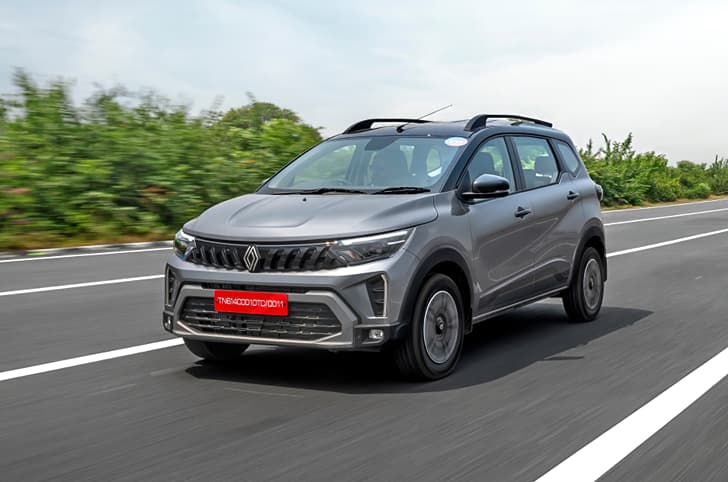

Renault Triber 100PS launched 28 Sep 2026 at ₹7.84–₹8.99 lakh (ex-showroom); 100 PS turbo engine, 21 km/l ARAI, new RGEP platform — significantly cheaper than the Maruti XL6 at ₹11.62 lakh.
The Renault Triber 100PS, launched on 28 September 2026 at an introductory ex-showroom price of ₹7.84 lakh, is the most affordable 7-seat MPV with a turbocharged petrol engine currently on sale in India — and the first vehicle in the country to debut Renault's new Renault Group Entry Platform (RGEP).
Since its 2019 debut, the Triber has faced one persistent criticism: its naturally aspirated 72 PS engine felt underpowered for a vehicle designed to carry seven people. The 100PS variant changes that equation. With 100 PS and 180 Nm now available — backed by a comprehensively re-engineered platform — Renault is positioning this as a genuine family MPV rather than just an affordable space-maximiser.
At a Glance: Triber 100PS vs Maruti XL6 vs Kia Carens
The table below compares the three most relevant 7-seater MPV options for Indian family buyers across key decision-stage parameters. All prices are ex-showroom.
| Parameter | Renault Triber 100PS | Maruti Suzuki XL6 | Kia Carens |
|---|---|---|---|
| Starting price (ex-showroom) | ₹7.84 lakh | ₹11.62 lakh | ₹11.02 lakh |
| Top variant price (ex-showroom) | ₹8.99 lakh | ~₹14.50 lakh (est.) | ~₹19.50 lakh (est.) |
| Engine | 1.0L turbo petrol, 100 PS / 180 Nm | 1.5L mild-hybrid petrol, 103 PS / 137 Nm | 1.5L petrol / 1.5L diesel / 1.4L turbo petrol |
| ARAI fuel efficiency | 21 km/l (manufacturer claim) | ~22 km/l (manufacturer claim, SHVS) | 16–20 km/l (varies by variant) |
| Seating configurations | 5 / 6 / 7 (modular) | 6 only (captain seats) | 6 or 7 |
| Length | Under 4 metres (sub-4m tax benefit) | Over 4 metres | Over 4 metres |
| GST rate | 18% (small petrol car) | 28% + cess | 28% + cess |
| 0–100 km/h (claimed) | 10.8 seconds | Not officially stated | Not officially stated |
| Safety (crash test) | 4-star GNCAP (earlier iteration) | Not yet tested by BNCAP | 3-star BNCAP |
| Platform | RGEP (new, 2026) | Heartect | Kia K platform |
| Airbags (standard) | 6 | 6 | 6 |
The price gap between the Triber 100PS and the XL6 exceeds ₹3.75 lakh at entry level. The XL6's mild-hybrid system, larger engine displacement, and dedicated 6-seat captain-chair layout appeal to a different buyer. The Triber's sub-4-metre footprint also qualifies it for the 18% GST rate applicable to small petrol cars, a structural cost advantage the XL6 and Carens cannot match.
What exactly is the RGEP architecture, and why does it matter?
The Renault Group Entry Platform (RGEP) represents a comprehensively re-engineered evolution of the CMF-A platform that underpinned the original Triber. It was developed to support multiple powertrain solutions and evolving regulatory and customer requirements. This is not a simple engine swap bolted onto an existing chassis.
Renault India details the RGEP package on the Triber 100PS:
- A new Renault Engine Management System (R-EMS) calibrated specifically for the TCe 100 engine in this application
- Revised suspension geometry with front and rear anti-roll bars added
- MTV (Multi-Tune Valve) Damper Technology for improved ride compliance
- Structural enhancements to the body shell to handle the increased torque output
- Optimised braking calibration to match the higher performance envelope
- A Brushless Direct Current (BLDC) cooling fan for more precise thermal management and improved energy efficiency
Vikraman Vellandi, Head of Renault Engineering at Renault Group India, explained the rationale: "Delivering 100 PS and 180 Nm of torque while retaining the Triber's modularity, comfort and efficiency required the engine, thermal-management, structural, suspension, braking and vehicle-dynamics systems to work together as one package."
The Triber 100PS marks the first Renault India model to use RGEP, making it a platform debut rather than a mid-cycle refresh. The architecture is designed to accommodate future powertrain solutions — which, given the confirmed factory-fitted CNG option being developed for this engine, suggests the platform is built with regulatory flexibility in mind.
What is the new engine, and how does it compare to the old one?
The TCe 100 is a 1.0-litre, three-cylinder turbocharged petrol engine (codenamed HR10) that produces 100 PS and 180 Nm of torque. It powers the Renault Kiger and Nissan Magnite compact SUVs, though the Triber's application produces notably more torque — 180 Nm versus 160 Nm in the Kiger and 166 Nm in the Duster, a difference Renault attributes to the new R-EMS calibration.
Compared to the outgoing naturally aspirated 1.0-litre engine (72 PS / 96 Nm), the gains are substantial: 28 PS more power and 84 Nm more torque. The ARAI-certified fuel efficiency of 21 km/l is a manufacturer claim; real-world figures in mixed urban-highway driving typically run 15–18% lower, suggesting approximately 17–18 km/l in everyday use. The claimed 0–100 km/h time of 10.8 seconds is a manufacturer figure and has not yet been independently verified.
Transmission options deserve attention. At launch, the Triber 100PS comes only with a 5-speed manual. The CVT option will arrive later, meaning buyers wanting an automatic with the turbo engine must wait. The naturally aspirated engine remains available with a 5-speed AMT on the top Emotion trim — though Autocar India's road test notes that the AMT shifts jerkily, so it is not an unqualified recommendation.
What variants are available and what do they cost?
The Triber 100PS is offered in three variants with the turbo engine, all with manual transmission:
| Variant | Price (ex-showroom, introductory) |
|---|---|
| Evolution MT (Turbo) | ₹7.84 lakh |
| Techno MT (Turbo) | ~₹8.49 lakh (est., between Evolution and Emotion) |
| Emotion MT (Turbo) | ₹8.99 lakh |
The Authentic trim is not offered with the turbo engine — it remains exclusive to the naturally aspirated petrol. The full Triber range (NA + turbo) now spans ₹5.81 lakh to ₹9.00 lakh (ex-showroom).
The Evolution trim, which is the entry point for the turbo, includes an 8-inch infotainment system with wired Apple CarPlay and Android Auto, 4 speakers, steering-mounted controls, a rear-view camera, rear AC vents, and a day/night interior rear-view mirror. Techno adds functional roof rails, LED tail lamps, 6 speakers, power-adjustable and folding ORVMs, driver seat height adjustment, and a rear wiper and defogger. The Emotion variant tops the range with wireless Android Auto and Apple CarPlay, a digital LED instrument cluster, automatic air-conditioning, cruise control, wireless charging, and rain-sensing wipers — a meaningful feature step-up for ₹1.15 lakh over the base turbo variant.
All variants come with six airbags and 21 safety features as standard, a genuine positive in this price bracket.
How does the Triber 100PS compare to the Maruti XL6?
The Maruti Suzuki XL6 is a 6-seat premium MPV from Maruti's Nexa channel, built on the Heartect platform and powered by a 1.5-litre K15C mild-hybrid petrol engine producing 103 PS and 137 Nm. It starts at approximately ₹11.62 lakh (ex-showroom) — over ₹3.75 lakh more than the Triber 100PS entry variant.
These two vehicles serve partially overlapping but distinct buyer profiles.
Where the Triber 100PS wins: The Triber's sub-4-metre footprint delivers the 18% GST rate, making its on-road price advantage even larger than the ex-showroom gap suggests. Its modular 2+3+2 seating allows genuine 7-person capacity, with the third row removable entirely to expand boot space from 84 litres to 625 litres. The Triber also produces more torque (180 Nm) than the XL6 (137 Nm), which matters for loaded-vehicle performance on gradients. For families on a budget who genuinely need 7 seats, the Triber is the more practical and affordable choice.
Where the XL6 wins: The XL6's 6-seat captain-chair layout with a proper middle-row walkthrough feels more premium than the Triber's bench-style second row. The mild-hybrid system (SHVS) delivers better real-world fuel efficiency in urban stop-start conditions than ARAI numbers suggest. The XL6 also carries the Maruti Suzuki brand's unmatched service network — over 4,000 touchpoints across India — a meaningful ownership advantage in smaller cities and towns. The XL6's larger 1.5-litre engine offers a more refined, less stressed character at highway speeds compared to a 1.0-litre three-cylinder unit.
The honest weaknesses of the Triber 100PS: The three-cylinder engine, while now adequately powered, will produce more vibration and noise than a four-cylinder unit at higher rpm — this is a physics reality, not a criticism unique to Renault. The CVT automatic is not available at launch, limiting the turbo's appeal to manual-gearbox buyers for now. The Triber's earlier iteration earned a 4-star GNCAP rating, but it has not yet been tested by Bharat NCAP, so buyers who prioritise the newer, stricter Indian crash-test standard will need to wait for those results. Boot space with all three rows up is a tight 84 litres. And while the RGEP platform brings meaningful engineering improvements, it is still derived from the CMF-A architecture, which is not a premium-segment foundation.
For buyers comparing the two, the decision often comes down to budget and seating priority: if you need 7 seats and have ₹8–9 lakh to spend, the Triber 100PS has no real rival. If you want a 6-seat premium experience and can stretch to ₹12–14 lakh, the XL6 is the more refined product. If you are considering the best 7-seater MUVs under ₹25 lakh, both vehicles deserve a place on your shortlist at very different price points.
What features does the Triber 100PS offer at this price?
At ₹7.84 lakh for the Evolution MT, the Triber 100PS offers a feature set that is genuinely competitive for its price point. The top Emotion variant at ₹8.99 lakh adds a layer of convenience technology that was previously unavailable on the Triber.
Standard across all turbo variants:
- Six airbags (driver, passenger, two side, two curtain)
- ABS with EBD
- Electronic Stability Programme (ESP)
- Traction control
- Hill-start assist
- Tyre Pressure Monitoring System (TPMS)
- Front and rear parking sensors
- ISOFIX child seat mounts
Evolution-onwards additions:
- 8-inch touchscreen infotainment
- Rear-view camera
- Rear AC vents
- Steering-mounted audio controls
Emotion-exclusive additions:
- Wireless Android Auto and Apple CarPlay
- Digital LED instrument cluster
- Automatic air-conditioning with separate rear blower control
- Cruise control
- Wireless phone charging
- Rain-sensing wipers
- Cooled centre storage box
The 8-inch touchscreen with wireless connectivity, digital cluster, auto AC, and cruise control on the Emotion variant at ₹8.99 lakh represents strong value when benchmarked against competitors at similar prices. For buyers interested in 6-seater MPVs with the lowest running cost per km, the Triber's 21 km/l ARAI claim (manufacturer figure) also positions it favourably.
What is the seating and space situation?
The Triber's modular seating is one of its defining characteristics, and the 100PS variant retains this entirely. The vehicle offers three seating configurations: 5-seat (third row removed), 6-seat, and 7-seat — all within a sub-4-metre footprint, a packaging achievement that no other vehicle in India currently matches at this price.
The second row slides and reclines, and offers one-touch tumble access for third-row passengers. The third row uses Easy-Fix seats that can be removed entirely — not just folded — to free up the boot. With all three rows in place, boot capacity is 84 litres, which is tight but usable for a day trip. Remove the third row and that grows to 625 litres, making it a genuinely versatile load carrier.
The trade-off is that the third row suits children or short adults best for journeys beyond 30–40 minutes. This is a structural limitation of the sub-4-metre format, not a Triber-specific failing — but buyers who regularly need to carry seven adults comfortably on long journeys should look at the Kia Carens or Toyota Rumion instead.
Is there a CNG option coming?
Yes. Autocar India reported in September 2026 that a factory-fitted CNG option will be offered with the turbo engine, using dual-cylinder technology with the cylinders placed under the boot floor for improved space utilisation. This is expected to be offered only with a manual transmission.
The dual-cylinder under-floor placement is a meaningful engineering choice: it avoids the boot intrusion that plagues most CNG conversions and aftermarket kits. Currently, the Triber is available with a dealer-level CNG kit on the naturally aspirated petrol engine, but a factory-fitted option with the turbo engine would be a first for the model and would significantly expand its appeal to high-mileage urban buyers.
No launch timeline or pricing for the CNG turbo variant has been officially announced as of 30 September 2026. For buyers tracking 7-seater MUVs with the lowest running cost per km, this variant — when it arrives — could be a compelling option.
What is Renault India's broader product strategy here?
The Triber 100PS launch is part of a stated programme of 12 product interventions over 18 months from Renault India. Francisco Hidalgo, Vice President of Sales and Marketing at Renault India, described the Triber 100PS as "an important step in Renault India's product roadmap and a strong expression of what our brand stands for: innovation that is practical, accessible and relevant to Indian customers."
The RGEP platform debut on the Triber carries strategic significance beyond this single model. Renault has described RGEP as an architecture capable of supporting multiple powertrain solutions and evolving regulatory requirements — language that points toward CNG and other future powertrain configurations being planned for the platform. The Triber has crossed 2.5 lakh cumulative sales in India since its 2019 launch, making it Renault's volume anchor in the Indian market.
The Kiger compact SUV shares the same HR10 turbo engine family, and Autocar India noted that the dual-cylinder CNG option will also be employed in the Kiger at a later date — suggesting the RGEP/CNG combination is a platform-wide strategy rather than a Triber-specific feature.
Should you buy the Triber 100PS or wait?
The Triber 100PS makes a strong case for buyers who need 7-seat flexibility within a ₹9 lakh budget. The turbo engine resolves the most significant complaint about the original Triber, the RGEP platform brings genuine engineering improvements rather than cosmetic changes, and the 21 km/l ARAI claim (manufacturer figure) suggests running costs will remain reasonable.
The case for waiting is primarily about the CVT automatic — if you want the turbo engine with an automatic gearbox, that option is not available at launch and no timeline has been given. Buyers who drive primarily in heavy urban traffic and don't want to operate a clutch in stop-start conditions should hold off until the CVT variant arrives.
The case against the Triber 100PS is more about segment expectations than product failings. If you want a more premium cabin, a four-cylinder engine's refinement, or the Maruti service network's reach, the XL6 at ₹11.62 lakh is the logical step up — though it costs significantly more and seats only six. For buyers comparing options in the broader best 6-seater MPVs under ₹20 lakh category, the Triber 100PS and XL6 represent opposite ends of the value-versus-premium spectrum.
At ₹7.84–₹8.99 lakh, the Triber 100PS is the only turbocharged 7-seater MPV in India at this price point. That is a genuinely differentiated position, and for budget-conscious family buyers who need the space, it is a compelling one.
Sources
- Renault India launches Triber 100PS at ₹7.84 lakh with new RGEP architecture, ETAuto
- Renault Triber 100PS Launched At Rs 7.84 Lakh, Debuts RGEP | Autocar Professional
- Renault Triber turbo to launch by September end | Autocar India
- Renault Triber (2026) – Price, Mileage & Expert Reviews | Autocar India
- Maruti Suzuki XL6 | Autocar India
- Renault Triber – Wikipedia