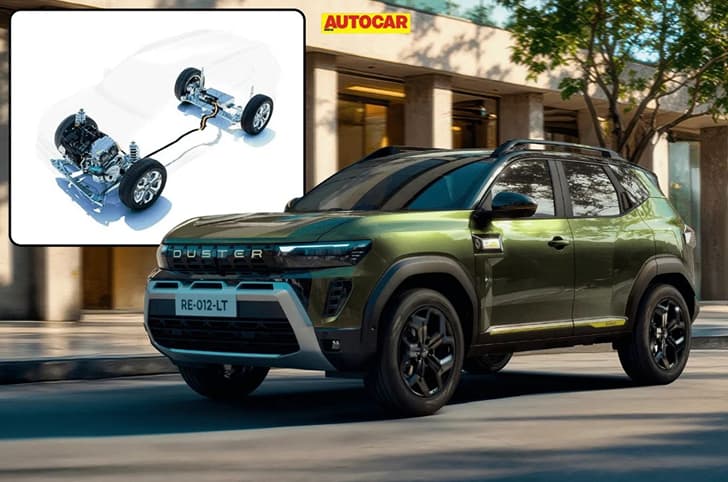

Renault Duster hybrid launches October 17, 2026, with a 160hp E-Tech strong-hybrid system, rivalling the Grand Vitara and Hyryder hybrids in the midsize SUV segment.
Renault Duster Hybrid Launch October 17, 2026: Price, Mileage & How It Compares to Diesel SUVs in India
The Renault Duster strong-hybrid is confirmed for an October 17, 2026 India launch, making it the fourth model in the midsize SUV segment to offer a strong-hybrid powertrain option — joining the Maruti Grand Vitara, Toyota Hyryder, and Maruti Victoris. Renault calls the system E-Tech, and it combines a 1,789cc naturally aspirated four-cylinder petrol engine with two electric motors for a combined output of 160hp and 172Nm, supported by a 1.4kWh battery pack. Pricing has not been announced ahead of the launch, but the existing Duster range starts at ₹10.49 lakh (ex-showroom), with the top Iconic TCe 160 DCT Dualtone variant sitting at ₹18.69 lakh (ex-showroom).
How does the Duster hybrid compare to its key rivals at a glance?
Before diving into the details, here is a side-by-side snapshot of the Duster hybrid against the two strong-hybrid midsize SUVs buyers are most likely to cross-shop — the Maruti Grand Vitara and the Toyota Hyryder — plus the Hyundai Creta diesel, which remains the benchmark for real-world efficiency in this segment.
| Specification | Renault Duster E-Tech Hybrid | Maruti Grand Vitara Strong Hybrid | Toyota Hyryder Strong Hybrid | Hyundai Creta Diesel AT |
|---|---|---|---|---|
| Engine | 1.8L NA petrol + 2 electric motors | 1.5L NA petrol + electric motor | 1.5L NA petrol + electric motor | 1.5L turbodiesel |
| System Power | 160hp / 172Nm | ~116hp (combined) | ~116hp (combined) | 116hp / 250Nm |
| Battery | 1.4kWh | 0.60kWh | 0.60kWh | N/A |
| Transmission | Multi-mode automatic (fixed ratios) | e-CVT | e-CVT | 6-speed torque converter AT |
| ARAI Mileage | TBA (launch Oct 17) | ~27.97 km/l (ARAI claim) | ~27.97 km/l (ARAI claim) | 19.1 km/l (ARAI claim) |
| Starting Price (ex-showroom) | TBA (hybrid); existing range from ₹10.49L | ₹10.77L (all variants) | ~₹15.5L (hybrid variants) | ₹20.11L (Diesel King Knight AT) |
| Drive | FWD | FWD (hybrid) / AWD (petrol) | FWD (hybrid) / AWD (petrol) | FWD |
| Ground Clearance | 212mm | 210mm | 210mm | Not specified |
Prices are ex-showroom. ARAI mileage figures are manufacturer claims and real-world numbers will vary. Duster hybrid ARAI figure and price to be announced at launch on October 17, 2026.
What exactly is the Renault Duster E-Tech hybrid system?
The Renault Duster E-Tech strong-hybrid is a full hybrid system capable of propelling the vehicle on electric power alone at low speeds, without any external charging required. It is not a mild hybrid or a plug-in hybrid — the battery recharges entirely through regenerative braking and the petrol engine acting as a generator.
The system architecture uses three components: a 1,789cc four-cylinder naturally aspirated petrol engine, a 20hp electric motor that functions as a generator (and can also assist the engine), and a 49hp electric motor that drives the front wheels. Combined system output is rated at 160hp and 172Nm. The battery pack is a 1.4kWh unit — more than double the 0.60kWh pack used in the Toyota-sourced hybrid system that powers the Grand Vitara and Hyryder.
Renault draws a direct lineage between this E-Tech system and its Formula 1 hybrid technology, citing the multi-mode transmission as the key differentiator. Unlike the e-CVT used in Toyota's power-split hybrid, the Duster's E-Tech uses fixed gear ratios and shifts between them. This means engine revs rise and fall more like a conventional automatic, and gear changes are perceptible — particularly when the system transitions between pure electric drive, petrol-only drive, and a combined mode. Buyers accustomed to the smooth, step-free feel of the Grand Vitara or Hyryder's e-CVT should factor this in before visiting a showroom.
In city driving conditions, the engine will enable 80 percent of trips to be completed in EV mode, according to Renault. Actual EV-mode usage will depend heavily on traffic density, ambient temperature, battery state of charge, and driving style.
Why is Renault launching a hybrid now, and does it replace the diesel?
The Duster's hybrid launch is directly connected to the absence of a diesel engine in the current generation. The third-generation Duster, which returned to India in 2025, was launched with only two turbo-petrol engines — a 1.0-litre three-cylinder unit producing around 100hp (ARAI mileage: 19.41 km/l) and a 1.3-litre four-cylinder direct-injection unit producing 160hp (ARAI mileage: 17.75 km/l for the MT, 18.45 km/l for the DCT). Neither matches the real-world running cost of a diesel in high-mileage use cases.
The previous-generation Duster was a diesel favourite in India, and many loyal buyers have been waiting for a fuel-efficient option in the new model. The strong hybrid is Renault's answer to that demand — it does not require the infrastructure investment of a diesel engine localisation, and it positions the Duster alongside the segment's most talked-about efficiency story.
The E-Tech hybrid does not replace the diesel in a like-for-like sense. A diesel's torque delivery, especially at highway speeds and under load, differs markedly from a petrol-hybrid's character. The hybrid excels in urban stop-go traffic where EV mode can be used frequently. On long highway runs at 100-120 km/h, the efficiency advantage over a turbo-petrol narrows considerably, and a diesel would likely still win on running cost per kilometre for buyers who cover 1,500 km or more per month predominantly on expressways.
How does the E-Tech hybrid differ from the Toyota system in the Grand Vitara and Hyryder?
The Toyota strong-hybrid system — used in both the Maruti Grand Vitara and the Toyota Hyryder — is a power-split hybrid that uses a planetary gear set (power split device) and an e-CVT. There are no fixed gear ratios; the system blends petrol and electric power in a continuously variable manner. The result is a very smooth driving experience where engine noise does not always correlate with vehicle speed. The 0.60kWh battery is smaller, but the system is highly optimised for efficiency at Indian city speeds.
The Renault E-Tech hybrid, by contrast, uses fixed gear ratios in its multi-mode automatic transmission. The system can run on electric power alone (using the 49hp motor), on petrol alone, or in a combined mode. Because of the fixed ratios, the driving experience is more conventional — you will notice gear shifts, and engine rpm will climb and fall in a pattern familiar to anyone who has driven a regular automatic. The larger 1.4kWh battery gives the Duster more electric range per charge cycle in theory, but the Toyota system's seamlessness in blending the two power sources is a proven advantage in Indian traffic.
Neither system is objectively better — they represent different engineering philosophies. The Toyota approach prioritises smoothness and efficiency optimisation; the Renault approach prioritises a more engaging, driver-focused character while still delivering strong-hybrid efficiency gains.
What is the expected price of the Renault Duster hybrid?
Renault has not announced the hybrid's price ahead of the October 17 launch. The official Renault India page confirms that "pricing details will be announced closer to its launch." Based on the existing variant structure, here is what we know:
The current Duster range spans ₹10.49 lakh (Authentic TCe 100) to ₹18.69 lakh (Iconic TCe 160 DCT Dualtone), all ex-showroom. The hybrid powertrain, being the most complex and premium option, is expected to sit above the existing 1.3-litre DCT variants. A price band of ₹17 lakh to ₹20 lakh (ex-showroom) for the hybrid variants would be a reasonable expectation, though this is speculative until October 17.
For context, the Maruti Grand Vitara strong-hybrid variants start at around ₹17-18 lakh (ex-showroom), and the Toyota Hyryder hybrid variants are priced similarly. If Renault prices the Duster hybrid aggressively within or below this band, it could be a compelling proposition given the higher system power (160hp versus approximately 116hp for the Toyota-system rivals).
Buyers considering the Duster hybrid against the Grand Vitara should also factor in that Maruti was offering benefits of up to ₹3.10 lakh on the Grand Vitara in September 2026, which can meaningfully shift the effective on-road comparison.
How does the Maruti Grand Vitara strong-hybrid compare as a direct rival?
The Maruti Grand Vitara strong-hybrid is the most direct competitor the Duster hybrid will face, and it has a significant head start in terms of market presence and buyer familiarity.
The Grand Vitara's strong-hybrid pairs a 1.5-litre naturally aspirated petrol engine with an electric motor, the Toyota-developed e-CVT, and a 0.60kWh battery. The ARAI-claimed mileage of approximately 27.97 km/l is among the highest in the segment for a petrol SUV — though real-world figures in mixed driving will be considerably lower. The system's smooth power delivery and the established Toyota hybrid reliability record are genuine strengths.
The Grand Vitara hybrid has notable weaknesses: the combined system power of around 116hp is noticeably lower than the Duster hybrid's 160hp, which matters on expressways and during overtaking. The Grand Vitara hybrid is also FWD only — the AWD option is reserved for the mild-hybrid petrol variants, not the strong-hybrid. The Duster, too, is FWD in its current generation for the Indian market, so this is not a differentiator between the two hybrids specifically.
Maruti's unmatched service network across India — over 4,000 service touchpoints — is a practical consideration for buyers in smaller cities and towns where Renault's network is thinner.
What are the existing Duster turbo-petrol mileage figures, and how might the hybrid compare?
The current Duster range offers two turbo-petrol engines. The 1.0-litre TCe 100 delivers an ARAI-claimed 19.41 km/l with the manual gearbox. The 1.3-litre TCe 160 returns 17.75 km/l with the manual and 18.45 km/l with the DCT — the latter was independently tested by Autocar India at 9.97 km/l in real-world conditions, which is a significant gap from the ARAI figure and typical of turbocharged direct-injection engines in mixed Indian driving.
The hybrid is expected to deliver meaningfully better real-world efficiency than these figures, particularly in city conditions where EV mode can be used frequently. Renault's 80 percent EV-mode claim for city drives is ambitious but not implausible given the 1.4kWh battery and the system's ability to run on the electric motor alone at low speeds. However, independent test data will be needed post-launch to validate the ARAI figure.
For buyers doing the maths on running cost: at ₹100 per litre of petrol, the 1.3-litre DCT's real-world 9.97 km/l works out to approximately ₹10 per kilometre. A strong hybrid achieving even 15 km/l in real-world mixed driving would bring that down to around ₹6.67 per kilometre — a meaningful saving for high-mileage users.
Is the Duster hybrid a better buy than a diesel SUV for Indian conditions?
Strong-hybrid SUVs can run on electric power alone for short distances and recover energy through regenerative braking, without external charging. Their efficiency advantage is most pronounced in urban and suburban driving with frequent stops — exactly the conditions where a diesel's efficiency also improves, but where the hybrid's EV-mode usage is highest.
For a buyer who drives primarily in a metro city, covers 800-1,200 km per month, and values a smoother, quieter driving experience, the hybrid makes a strong case. The absence of diesel's characteristic clatter, the lower maintenance complexity (no DPF, no AdBlue in most cases), and the potential for significantly better city fuel economy all point in the hybrid's favour.
For a buyer who covers 2,000+ km per month with a significant highway component — say, a sales professional driving between cities — a diesel's torque, highway efficiency, and lower fuel cost per litre still make a compelling argument. The Hyundai Creta diesel, for instance, offers 116hp and 250Nm from its 1.5-litre turbodiesel, with an ARAI claim of 19.1 km/l and real-world highway figures that often exceed 20 km/l in light traffic. Its on-road pricing is higher (the Creta Diesel King Knight AT is listed at ₹20.11 lakh on-road in Delhi), but the running cost equation can favour diesel for high-mileage highway users.
The Duster hybrid sits in an interesting middle ground: it offers more power than the Toyota-system hybrids (160hp versus ~116hp), which makes it more usable on highways, while still delivering the city-efficiency benefits of strong-hybrid technology. Whether it can match a diesel's highway running cost will depend on the ARAI figure announced at launch and independent real-world testing.
What variants and features can buyers expect on the Duster hybrid?
Renault has not confirmed the variant lineup for the hybrid ahead of the October 17 launch. Based on the existing structure — Authentic, Evolution, Adventure, Techno, Techno+, and Iconic — the hybrid is likely to be offered on mid-to-upper variants rather than the entry-level Authentic. The existing top Iconic variant includes features such as a panoramic sunroof, 6 airbags, adaptive cruise control, 360-degree parking camera, a fully digital instrument cluster, and 2-zone climate control, as confirmed by Autocar India's comparison data. The hybrid variants are expected to carry most of these features forward.
The Duster's 212mm ground clearance — one of the highest in the segment — is a genuine strength regardless of powertrain. It gives the Duster a practical advantage on broken roads and mild off-road use that the Grand Vitara (210mm) and Creta do not fully match.
What should buyers do before the October 17 launch?
If you are actively comparing the Duster hybrid to the Grand Vitara or Hyryder hybrid, the October 17 announcement will give you the two missing pieces: the ARAI mileage figure and the ex-showroom price. Until then, a few practical steps make sense.
Test-drive the existing Duster 1.3 DCT to understand the platform, ride quality, and cabin — the hybrid will share the same body and most of the interior. Separately, test-drive the Grand Vitara strong-hybrid to experience the e-CVT's character and compare it with the Duster's multi-mode automatic when it becomes available. The two driving experiences are genuinely different, and personal preference will matter as much as the spec sheet.
Also factor in total cost of ownership, not just ex-showroom price. Renault's service network, while expanding, is not as dense as Maruti's in tier-2 and tier-3 cities. If you live outside a major metro, the Grand Vitara's service accessibility is a real-world advantage that does not show up in a comparison table.
For buyers interested in running cost benchmarks across the segment, our guide on 7-seater MUVs with the lowest running cost per km offers a useful methodology for calculating real-world cost per kilometre that applies equally to 5-seater SUVs.
The Duster hybrid's October 17 launch is timed around Diwali 2026 — a period when manufacturers typically offer introductory pricing and festive benefits. Watch for those announcements alongside the base price reveal.