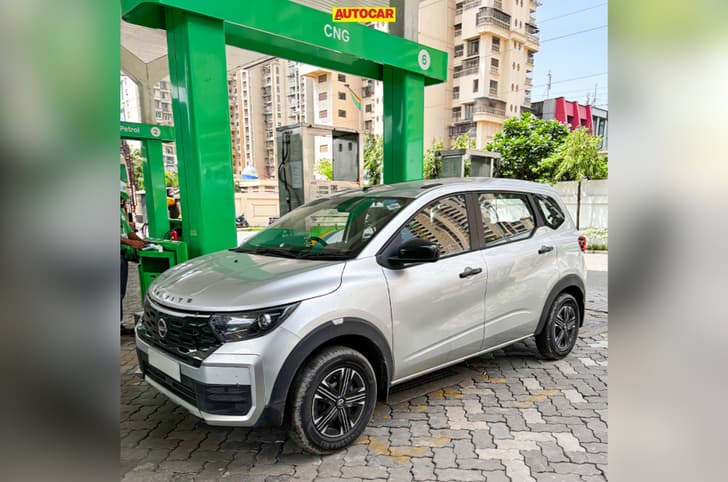

Nissan is waiving CNG retrofit kit costs (up to ₹85,999) on select Magnite and Gravite variants until November 16, 2026, significantly cutting total ownership cost versus petrol rivals including Maruti Baleno CNG and Swift CNG.
Nissan Magnite & Gravite Free CNG Kits Worth ₹86k in November 2026: How This Changes Your Ownership Cost vs Petrol
Nissan Motor India Pvt Ltd (NMIPL) is offering government-approved CNG retrofit kits worth up to ₹85,999 at zero additional cost on select variants of the Magnite compact SUV and Gravite seven-seater MPV, valid for bookings made on or before November 16, 2026. This limited-period festive scheme materially reshapes the total cost of ownership (TCO) calculation for buyers weighing a factory-fitted CNG car like the Maruti Baleno CNG or Swift CNG.
The offer works as a retrofit-at-purchase scheme: the CNG kit is installed at the dealership before delivery, covered by a separate third-party warranty of 3 years or 1,00,000 km, and sits on top of Nissan's standard vehicle warranty. It is not a cash discount or exchange bonus — it is a physical hardware benefit worth real money.
How does the Nissan free CNG offer compare with Maruti's factory-fitted CNG alternatives?
Before diving into the fine print, here is a side-by-side snapshot of the key ownership parameters across the cars most buyers in this price band will shortlist:
| Model | Segment | Ex-showroom starting price (approx.) | CNG availability | CNG kit cost | ARAI / real-world CNG efficiency | Boot space with CNG | Seating |
|---|---|---|---|---|---|---|---|
| Nissan Magnite (non-turbo, with free kit) | Compact SUV | ~₹6.00 lakh (base eligible variant) | Retrofit (govt-approved, Motozen) | ₹74,999 → ₹0 (offer) | Not officially declared; real-world ~18–20 km/kg (estimated) | Reduced (single cylinder in boot) | 5 |
| Nissan Gravite (Tekna, with free kit) | 3-row MPV | ~₹9.50 lakh (Tekna approx.) | Retrofit (govt-approved, twin-cylinder) | ₹85,999 → ₹0 (offer) | Real-world 15.9 km/kg city, 25.1 km/kg highway, 20.5 km/kg overall (Autocar India) | Retained (twin 25L cylinders, 7-seat layout preserved) | 7 |
| Maruti Baleno CNG | Premium hatchback | ~₹8.49 lakh (Sigma CNG) | Factory-fitted | Included in price | 30.08 km/kg (ARAI claim) | Reduced vs petrol variant | 5 |
| Maruti Swift CNG | Hatchback | ~₹7.49 lakh (LXi CNG) | Factory-fitted | Included in price | 32.85 km/kg (ARAI claim) | Reduced vs petrol variant | 5 |
Prices are approximate ex-showroom, Delhi. ARAI figures are manufacturer claims; real-world mileage will vary. Nissan has not published ARAI-certified CNG figures for the Magnite or Gravite retrofit configurations.
The table surfaces the central tension: Maruti's factory-fitted CNG cars carry higher ARAI efficiency numbers and OEM integration assurance, while Nissan's offer eliminates a ₹75,000–₹86,000 upfront cost entirely — effectively front-loading the fuel savings that a CNG buyer would otherwise wait months to realise.
What exactly is Nissan offering, and which variants qualify?
The offer covers government-approved CNG retrofitment on two models:
Nissan Magnite: Eligible variants are all non-turbo trims except Visia MT, Visia EZ-Shift, and Visia+ MT. The kit is a single-cylinder setup housed in the boot, with a retail price of ₹74,999 outside this offer, as confirmed by Rushlane and Autocar Professional.
Nissan Gravite: The Tekna trim qualifies for the offer. The Gravite receives a more sophisticated twin-cylinder setup — two 25-litre cylinders stacked vertically in the boot — designed to preserve the vehicle's three-row, seven-seat configuration. The kit's retail price is ₹85,999, per CNBC TV18.
Both kits are manufactured by Motozen, ICAT-approved and government-certified, and carry a 3-year or 1,00,000 km third-party warranty on CNG components — separate from Nissan's standard vehicle warranty. The offer deadline is November 16, 2026. No other festive benefits have been announced alongside it.
One practical caveat: the Magnite's single-cylinder boot setup will reduce usable luggage space, a trade-off that factory-fitted CNG cars like the Baleno CNG also make, though the packaging differs. The Gravite's twin-cylinder arrangement is genuinely segment-notable — most CNG conversions on three-row vehicles require removing the third row entirely.
How does real-world CNG fuel economy translate into rupee savings?
Autocar India's independent real-world test of the Gravite CNG — conducted using a standardised methodology with fixed city and highway loops around Navi Mumbai — returned:
- City: 15.9 km/kg
- Highway: 25.1 km/kg
- Overall average: 20.5 km/kg
The test found that a full fill from empty yielded approximately 7.7 kg of CNG (total tank capacity: 2 × 25 litres = 50 litres, though actual fill varies with pump pressure and ambient temperature), giving a real-world range of roughly 150–160 km per full CNG tank. This meaningful limitation for long-distance driving requires careful consideration in cities with sparse CNG infrastructure.
Nissan has not published ARAI-certified CNG figures for either the Magnite or Gravite in retrofit configuration. The Gravite's real-world 20.5 km/kg overall figure is the only independently verified number available.
For context, CNG in most Indian metros costs around ₹75–₹90/kg (Delhi: ~₹75/kg, Mumbai: ~₹88/kg as of late 2026), while petrol sits at approximately ₹94–₹103/litre. A petrol Magnite with its 1.0-litre naturally aspirated engine returns roughly 18–20 km/l in real-world mixed driving. For a buyer doing 1,500 km/month in Delhi:
- Petrol cost: 1,500 ÷ 19 km/l × ₹94/litre ≈ ₹7,421/month
- CNG cost (Gravite real-world 20.5 km/kg): 1,500 ÷ 20.5 × ₹75/kg ≈ ₹5,488/month
- Monthly saving: ~₹1,933
- Break-even on ₹74,999 kit (Magnite): ~38 months at normal kit price; 0 months with the free offer
The festive offer's value becomes clear: a buyer who would have needed over three years to recover the retrofit cost through fuel savings now pockets that saving from day one. The Gravite's ₹85,999 kit would have taken even longer to recover on its own.
How do Maruti Baleno CNG and Swift CNG compare on total cost of ownership?
Maruti's factory-fitted CNG cars hold a structural advantage: ARAI-certified efficiency figures are higher on paper. The Baleno CNG claims 30.08 km/kg (ARAI) and the Swift CNG claims 32.85 km/kg (ARAI). These are manufacturer claims, and real-world figures will be lower — typically 20–25% below ARAI in mixed urban driving — but even discounted, they likely outperform the Gravite's tested 20.5 km/kg overall.
Maruti's CNG variants carry a price premium over their petrol counterparts. The Baleno Sigma CNG is priced at approximately ₹8.49 lakh ex-showroom versus the petrol Sigma at around ₹6.61 lakh — a gap of roughly ₹1.88 lakh. The Swift LXi CNG is approximately ₹7.49 lakh versus the petrol LXi at around ₹6.49 lakh — a gap of about ₹1 lakh. These premiums are baked into the purchase price regardless of how many kilometres you drive.
Maruti's factory CNG integration offers real advantages: the cars are tuned from the factory for bi-fuel operation, the fuel system carries OEM warranty (not third-party), and the boot packaging — while still compromised — is more tightly engineered than an aftermarket retrofit. The Baleno CNG and Swift CNG also have a longer service history in India, with established dealer familiarity for CNG-specific maintenance.
The Nissan offer does not erase these advantages. What it does is remove the financial barrier that made retrofit CNG unattractive for buyers who could not justify paying ₹75,000–₹86,000 upfront on top of the vehicle price. A Magnite buyer who opts in during this window gets a CNG-capable SUV without paying the retrofit premium — and gets a larger, higher-riding vehicle than either the Baleno or Swift.
The honest weakness of the Nissan approach: a retrofit kit, however well-engineered and government-approved, is not the same as factory integration. The Magnite's single-cylinder boot setup reduces cargo space noticeably, Nissan has not published ARAI figures for the CNG configuration, and the 3-year third-party warranty on CNG components is more complex to claim than Maruti's integrated OEM warranty.
What makes the Gravite's twin-cylinder CNG setup significant?
The Nissan Gravite's twin-cylinder CNG arrangement uses two 25-litre cylinders stacked vertically in the boot rather than a single large cylinder laid horizontally. This design is significant because it allows the Gravite to retain its three-row, seven-seat layout in CNG mode — a feat that most CNG conversions on MPVs cannot achieve without eliminating the third row.
The Gravite is powered by the same 1.0-litre three-cylinder BR10 petrol engine used in the Renault Triber, producing 72 hp and 96 Nm in petrol mode. Output figures in CNG mode have not been officially declared by Nissan — CNG typically reduces peak power by 8–12% in retrofit configurations due to lower energy density per unit volume compared to petrol.
At an introductory kit price of ₹83,000 (as tested by Autocar India in August 2026, before the festive offer), the Gravite CNG was already among the more affordable ways to get a seven-seat CNG vehicle in India. With the kit now free for Tekna variant buyers until November 16, the effective cost of entry drops further. For families who need three rows and want CNG economics, there is currently no factory-fitted rival at a comparable price point — the Maruti XL6 does not offer a CNG variant, and the Ertiga CNG, while factory-fitted, sits in a higher price bracket.
Should Baleno CNG or Swift CNG buyers reconsider?
The answer depends on what you are optimising for.
If you drive primarily in the city, cover 1,200–2,000 km per month, and already own or plan to buy a Baleno or Swift, the factory CNG variants remain strong choices. The ARAI efficiency claims are higher, OEM warranty integration is cleaner, and Maruti's CNG service network is mature. The Swift CNG in particular ranks among the most fuel-efficient petrol/CNG hatchbacks available in India by ARAI numbers.
If you were considering a Magnite for its SUV stance, ground clearance, and feature set, and were deterred by the ₹75,000 retrofit cost, this offer removes that deterrent entirely. The Magnite is a larger, taller vehicle than either the Baleno or Swift, and its non-turbo petrol engine is already tuned for efficiency over performance — making it a reasonable candidate for CNG conversion.
The Gravite case is more distinctive. There is no direct factory-CNG competitor in the sub-₹12 lakh three-row MPV space right now. Buyers who need seven seats, want CNG economics, and are booking before November 16 are looking at a genuinely unusual value. The real-world 20.5 km/kg overall efficiency figure from Autocar India's test is not class-leading, but it is competitive — and the twin-cylinder layout that preserves all seven seats is a meaningful engineering achievement for a retrofit solution.
For safety-conscious buyers, the Magnite has received attention for its crash test performance — you can read more about 5-star Bharat NCAP-rated SUVs under ₹15 lakh to understand where it stands relative to rivals in that regard.
What are the practical limitations buyers must know before booking?
Several practical constraints apply to this offer that are not prominently featured in promotional material:
CNG range per fill: The Gravite's twin tanks hold approximately 50 litres total, but real-world fill from empty is about 7.7 kg of CNG (as tested by Autocar India). At 20.5 km/kg overall, that is 150–160 km of real-world range on CNG alone. In cities with dense CNG station networks (Delhi, Mumbai, Ahmedabad, Pune), this is manageable. In smaller cities or on highway trips, it requires planning. The car switches to petrol automatically when CNG runs out, so it is not stranded — but the CNG economics only apply when you are actually running on gas.
Boot space: The Magnite's single-cylinder setup in the boot will reduce luggage capacity. Nissan has not published the exact reduction in litres, but single-cylinder retrofit kits typically occupy 40–60 litres of boot volume. The Gravite's twin-cylinder vertical stack is more space-efficient by design, but some boot depth is still lost.
No ARAI certification for retrofit config: Nissan has not sought or published ARAI-certified mileage figures for either model in CNG retrofit configuration. This means you cannot directly compare these cars on the standard efficiency metric used for factory CNG cars. The Autocar India real-world test for the Gravite is the most reliable independent data point available.
Third-party warranty complexity: The 3-year/1,00,000 km warranty on CNG components is provided by the kit manufacturer (Motozen), not by Nissan. In the event of a CNG-related issue, warranty claims go to a different entity than the vehicle warranty. This is standard practice for retrofit CNG, but buyers should understand the distinction before assuming smooth single-point service.
Offer deadline is firm: Bookings must be made by November 16, 2026. Deliveries can presumably happen after that date, but the booking must be registered within the window. Given that this is a festive-period offer, Nissan is unlikely to extend it.
Is a retrofit CNG kit as safe as a factory-fitted system?
A government-approved retrofit CNG kit is one that has been tested and certified by the Indian government's designated agencies (ICAT — International Centre for Automotive Technology — in the case of the Motozen kits used here) and is legal for use on Indian roads. This is meaningfully different from an uncertified aftermarket kit, which carries both safety risks and insurance complications.
The ICAT approval process tests the kit for leak resistance, pressure tolerance, and compatibility with the host vehicle's fuel system. Government-approved kits are accepted by insurance companies for standard vehicle insurance purposes, which is not always the case with uncertified retrofits.
A factory-fitted CNG system — like those in the Baleno CNG, Swift CNG, or Ertiga CNG — is integrated at the manufacturing stage, with the fuel lines, ECU calibration, and tank mounting designed as part of the vehicle's original architecture. A retrofit, even a certified one, adapts an existing petrol vehicle's systems. The practical safety difference for a well-installed, certified kit is small, but the engineering integration difference is real.
Buyers who prioritise the cleanest possible integration and the simplest warranty chain will still find the Maruti factory CNG route more straightforward. Buyers who prioritise value and are comfortable with the retrofit model — which has a long, established track record in India — will find Nissan's offer hard to ignore at zero additional cost.
What should you do before November 16?
If you are in the market for a compact SUV or a three-row MPV and CNG economics matter to you, the steps are straightforward:
Visit a Nissan dealership and confirm which specific Magnite variant you are considering falls within the eligible non-turbo range (excluding Visia MT, Visia EZ-Shift, Visia+ MT). For the Gravite, confirm you are looking at a Tekna trim. Get the offer terms in writing — specifically the kit model, warranty documentation, and the name of the warranty provider (Motozen).
Compare the on-road price of the CNG-equipped Magnite or Gravite against the on-road price of the Baleno CNG or Swift CNG variant you were considering. The segment difference (SUV vs hatchback) matters for your use case — if you need ground clearance, boot space for a family, or the visual presence of an SUV, the Magnite is not directly substitutable with a Swift. If you need three rows, the Gravite has no factory-CNG competitor at its price point right now.
Run your own fuel cost calculation using your actual monthly mileage and the CNG price at your nearest station. The 20.5 km/kg real-world figure from Autocar India's Gravite test is a reasonable starting point for the Gravite; for the Magnite, use a conservative 17–19 km/kg until Nissan publishes certified figures.
For buyers interested in safety ratings alongside fuel economy, our guide to 5-star Bharat NCAP SUVs under ₹25 lakh provides useful context on how compact SUVs in this segment perform in crash tests.
The offer closes November 16, 2026. After that date, the Magnite retrofit kit reverts to ₹74,999 and the Gravite kit to ₹85,999 — and the TCO calculation changes significantly.
Sources
- Nissan Magnite, Gravite Free CNG Kits Worth Up To Rs 86k – Festive Offer | Rushlane
- Nissan Offers Free CNG Retrofitment on Select Magnite and Gravite Variants | Autocar Professional
- Nissan Gravite CNG real world fuel economy tested, explained | Autocar India
- Nissan is offering free CNG kits worth up to ₹85,999 on Magnite and Gravite | CNBC TV18
- Nissan India Official Website
- Maruti Suzuki Baleno CNG | Maruti Suzuki India
- Maruti Suzuki Swift CNG | Maruti Suzuki India