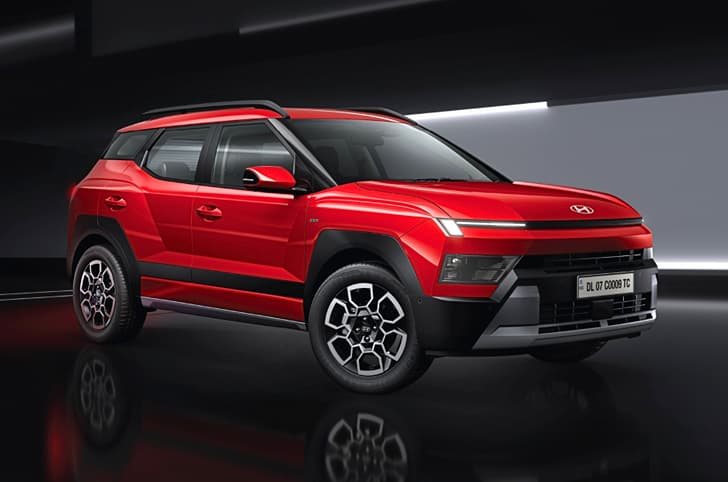

The Hyundai Bayon launches October 26, 2026, priced Rs 9–14 lakh (ex-showroom), with a 115 PS 1.5L petrol engine, India's first Generative AI Voice Assistant, and an NVIDIA-powered digital cockpit — targeting Maruti Victoris buyers.
Hyundai Bayon Launches October 26, 2026 in India: Price, AI Voice Assistant & How It Compares to Maruti Victoris
The Hyundai Bayon is a mid-size Intelligent Utility Vehicle (IUV) positioned between the Venue and Creta in Hyundai's India lineup, scheduled for launch on October 26, 2026, with an expected price range of Rs 9 lakh to Rs 14 lakh (ex-showroom) — according to Autocar India. Bookings opened on September 23, 2026, at an initial amount of Rs 11,000 through Hyundai dealerships and the official website.
The Bayon directly targets the Maruti Suzuki Victoris — the only other mainstream mid-size SUV in this exact price band — while also competing with the Kia Sonet facelift at the lower end. Here is how the three stack up on the numbers that matter most to a buyer making a decision right now:
| Feature | Hyundai Bayon | Maruti Suzuki Victoris | Kia Sonet (1.5 Petrol) |
|---|---|---|---|
| Expected Price (ex-showroom) | Rs 9–14 lakh (expected) | Rs 9.19–14.99 lakh | Rs 8.99–15.99 lakh |
| Engine | 1.5L MPi Petrol, 115 PS / 144 Nm | 1.5L DualJet Petrol, 103 PS / 137 Nm | 1.5L MPi Petrol, 115 PS / 144 Nm |
| Transmission Options | 6MT / IVT (CVT) | 5MT / 6AT | 6MT / IVT (CVT) |
| Length | ~4.2 m | 4.35 m | 3.99 m |
| AI Voice Assistant | Yes — Generative AI (Perplexity + SoundHound) | No (standard voice commands) | No (standard voice commands) |
| OTA Updates | Yes — up to 19 controllers | Yes — select controllers | Yes — select controllers |
| Infotainment Display | Dual 12.3" curved panoramic | 9-inch touchscreen | 10.25-inch touchscreen |
| Connected Car Features | Bluelink, 70+ features | Suzuki Connect, 40+ features | Kia Connect, 60+ features |
| CNG Option | Planned (post-launch) | No | No |
| Platform | Global K Enhanced (5-star safety target) | Heartect-Pro | Global K Platform |
Prices are ex-showroom India. Bayon price is expected; official price will be announced October 26, 2026. Victoris and Sonet figures are current market prices. Engine outputs are manufacturer claims.
What exactly is the Hyundai Bayon, and where does it sit in the market?
Hyundai calls the Bayon an "Intelligent Utility Vehicle" — a term that distinguishes it from a conventional SUV by placing software, AI and connectivity at the centre of its value proposition rather than treating them as add-ons. Hyundai Motor India's official press release describes this philosophy as "Intelligence That Moves."
In market positioning, the Bayon is squarely meant to take on the Maruti Victoris and allows Hyundai to adopt a two-pronged approach in the mid-size SUV space — much like Maruti does with the Victoris and Grand Vitara. Autocar India notes the Bayon takes the more affordable, tech-forward slot, while the next-generation Creta is expected to move upmarket with a wider powertrain lineup including a hybrid.
At approximately 4.2 metres in length, the Bayon slots neatly between the sub-4-metre Venue and the 4.3-metre Creta. This genuine mid-size positioning — longer than the Sonet, shorter than the Creta — gives it a physical footprint matching the Victoris without replicating the Grand Vitara's premium positioning.
What is the Generative AI Voice Assistant in the Bayon, and why does it matter?
The Bayon's Generative AI Voice Assistant is the headline feature and represents a genuine first for any Hyundai model sold in India. It combines Intelligence by Perplexity (the AI search and reasoning platform) with Voice AI powered by SoundHound AI, enabling drivers to interact with the vehicle in natural language rather than through rigid, predefined commands.
Hyundai's official announcement lists the kinds of tasks the assistant can handle during a drive:
- Planning a travel itinerary for a road trip
- Providing real-time weather information
- Suggesting hotels at a destination
- Recommending restaurants based on journey or location
- Identifying the top five shopping destinations nearby
- Sharing sports scores and insights
The distinction from conventional voice recognition matters. Standard voice systems in cars — including those in the Victoris and Sonet — work by matching spoken words to a fixed library of commands. The Bayon's Generative AI assistant is designed to understand intent and context, so a question like "What's the weather like where I'm headed?" should work even if the phrasing doesn't match a preset template.
It's worth being clear about what this system is not. It is not an autonomous driving assistant, and Hyundai has not claimed any real-world accuracy benchmarks for the AI responses. The quality of Perplexity's real-time information retrieval and SoundHound's voice recognition in Indian accents and noisy cabin environments will only be properly testable after the car goes on sale. Buyers should treat the AI assistant as a promising feature to evaluate at a test drive, not a guaranteed productivity tool.
What is immediately verifiable is the offline capability: the Bayon supports more than 500 embedded voice commands in English, Hindi, Hinglish, Tamil, Bengali and Telugu — these work without an internet connection, according to ETAuto. The multi-language interface across infotainment and cluster screens supports 10 regional and 2 international languages, a meaningful accessibility improvement for buyers outside metro markets.
What does the NVIDIA-powered cockpit actually do?
The Bayon's Connected Car Navigation Cockpit (ccNC), accelerated by NVIDIA, is the hardware backbone that makes the AI assistant and digital cockpit possible. Hyundai's press release describes it as integrating navigation, connected services and vehicle controls through a single digital interface.
The visual centrepiece is a pair of dual 12.3-inch curved panoramic displays — one for the digital instrument cluster, one for infotainment — that form a unified widescreen cockpit. Times of India's coverage notes the system supports split-screen functionality, smartphone-like quick controls and individual user profiles, allowing different drivers in the same household to have personalised settings.
Despite the heavy digital focus, Hyundai has retained "generous use of physical buttons and dials" — a band of shortcut buttons below the touchscreen, steering wheel controls and haptic buttons on the centre console. Autocar India's reveal report highlights the steering wheel's standalone pod for the drive mode selector. This deliberate design choice addresses one of the most common complaints about touch-only interfaces in modern cars, giving the Bayon a usability edge over some rivals that have gone all-in on touchscreens.
The NVIDIA chip enables the graphics performance and processing speed needed to run the AI assistant, high-resolution maps and connected services simultaneously without lag — at least in theory. Real-world performance will depend on network quality and software optimisation.
What are the OTA update capabilities, and why should buyers care?
Over-the-air (OTA) software updates are becoming a standard expectation in connected cars, but the Bayon's implementation is notably broad. ETAuto reports that the Bayon supports C-OTA (Vehicle Controller OTA) updates for up to 19 vehicle controllers — meaning software improvements can be pushed remotely not just to the infotainment system but to many vehicle control modules.
This has two practical implications for buyers. First, the car you buy on October 26 is not necessarily the car you will own in two years — Hyundai can push new features, fix bugs and improve performance without requiring a dealership visit. Second, it affects resale value: a car that stays current with software updates is less likely to feel dated after three years than one frozen at launch-day firmware.
The Victoris offers OTA updates for select controllers but does not match the Bayon's claimed 19-controller scope. The Sonet is similar. Neither rival currently offers a Generative AI voice assistant that can receive AI model updates over the air.
What engine and gearbox does the Bayon get, and how does it compare to the Victoris?
The India-spec Bayon is powered by a four-cylinder, 1.5-litre MPi naturally aspirated petrol engine producing 115 PS (84.4 kW) and 144 Nm of peak torque, as confirmed by Hyundai Motor India. This is the same engine that powers the Creta in its base petrol configuration. Transmission choices are a 6-speed manual (6MT) or Hyundai's Intelligent Variable Transmission (IVT) — a CVT-type unit.
The Maruti Suzuki Victoris uses a different approach: its 1.5-litre DualJet petrol engine produces a more modest 103 PS and 137 Nm, but Maruti pairs it with a mild-hybrid (SHVS) system on automatic variants that improves fuel efficiency in city driving. The Victoris's 6-speed automatic torque converter gearbox has a different character from the Bayon's IVT — torque converters tend to feel more responsive at low speeds, while CVTs are smoother at highway cruising.
On outright power, the Bayon has a clear advantage: 12 PS and 7 Nm more than the Victoris. Whether that translates to a meaningfully quicker or more enjoyable drive in real-world Indian conditions will only be clear after independent road tests. ARAI-certified fuel efficiency figures for the Bayon have not been released yet; Hyundai is expected to announce these at the October 26 launch event.
The Victoris's honest weakness is its relatively modest power output compared to the Bayon and Sonet. Its strength is the mild-hybrid system, which gives it a real-world fuel efficiency edge in urban driving that a pure petrol CVT cannot match. Buyers who cover high daily city mileage should weigh this carefully.
A CNG version of the Bayon is expected at a later stage, likely with an underbody tank — which would make it the first Hyundai model over four metres in length to be offered with CNG. Autocar India notes if confirmed, this would open the Bayon to a large segment of buyers in Delhi-NCR, Mumbai and other CNG-infrastructure-rich cities who currently have no option above the Venue in Hyundai's lineup. Hyundai has not officially confirmed the CNG variant or its timeline.
How does the Bayon's design compare to the Victoris?
The Bayon uses Hyundai's latest 'Art of Steel' design language, which Autocar India describes as giving it the look of "a scaled-down Tucson." Key design elements include:
- Sculpted bonnet with H-Edge LED DRLs that echo Hyundai's 'H' motif
- Split headlamp setup with main units housed in the bumper
- Sharp Z-shaped character lines on the flanks
- Geometric wheel arches with black cladding
- Petal-style alloy wheels
- Slim full-width LED tail lamps with 'Bayon' lettered boldly on the tailgate
- Bridge-type roof rails and a pronounced roof spoiler
At approximately 4.2 metres, the Bayon has a crossover-ish, athletic profile rather than the upright boxy stance of older mid-size SUVs. Traditional pull-type door handles and gloss-black pillar treatment create a floating roof effect.
The Maruti Victoris has a more conventional upright SUV silhouette. At 4.35 metres it is longer than the Bayon, which gives it a larger footprint and — on paper — more interior space. The Victoris's design is competent but does not attempt the same level of visual drama. For buyers who prioritise a distinctive, modern aesthetic, the Bayon will likely appeal more. For buyers who want the reassurance of a proven, familiar SUV shape, the Victoris remains a rational choice.
The Bayon's interior shares its layout with the Brazil-spec i20 that was revealed earlier in 2026 — a horizontal dashboard architecture dominated by the dual 12.3-inch screen array, with HVAC controls in a vertical panel below. Autocar India notes the Victoris's cabin uses a 9-inch touchscreen and a more conventional layout that some buyers will find easier to navigate without a learning curve.
What safety features does the Bayon offer?
Safety is one of the five pillars Hyundai has built the Bayon's positioning around, under the banner "Safety ON." The bookings press release confirms the Bayon is built on the Global K Enhanced Platform, engineered for 5-star Indian safety standards — meaning Hyundai is targeting a 5-star Bharat NCAP rating, though the car has not yet been tested.
Hyundai has not released a full list of safety features ahead of the October 26 launch. Based on the platform and Hyundai's recent product cadence, buyers can reasonably expect multiple airbags, electronic stability control, hill-start assist and ADAS features on higher variants — but these should be confirmed at launch before being factored into a purchase decision.
For buyers for whom a verified safety rating is a non-negotiable, our guide to 5-star Bharat NCAP-rated SUVs under Rs 15 lakh lists currently rated options while the Bayon awaits its test results.
The Victoris has similarly not been Bharat NCAP-tested as of this writing. The Sonet has received a 3-star Global NCAP rating in its older form. None of the three rivals in this price band has a confirmed 5-star Bharat NCAP result yet, so this is not a differentiator at the time of writing.
What is the Bluelink connected car suite, and how does it compare to Suzuki Connect?
Hyundai Bluelink is Hyundai's connected car platform, and the Bayon gets more than 70 connected features — as stated in the official press release. These include:
- Remote engine start and stop
- Remote vehicle controls (locks, climate pre-conditioning)
- Smartphone and smartwatch connectivity
- Online navigation with real-time traffic
- Safety and security features (geofencing, theft alerts)
- Vehicle health monitoring
Maruti's Suzuki Connect platform on the Victoris offers approximately 40+ connected features — a meaningful gap in feature count. However, feature count alone does not determine usability. Suzuki Connect's interface is simpler and has been refined over several years of real-world use. Bluelink's larger feature set comes with a steeper learning curve.
Kia Connect on the Sonet sits between the two at approximately 60+ features, and Kia's OTA update capability is comparable to Hyundai's on the infotainment side, though not at the 19-controller scope claimed for the Bayon.
What is the expected price, and is the Bayon good value against the Victoris?
Hyundai has not disclosed the Bayon's price ahead of the October 26, 2026 launch. Autocar India's estimate puts it between Rs 9 lakh and Rs 14 lakh (ex-showroom), which would place it in direct overlap with the Maruti Victoris (Rs 9.19–14.99 lakh, ex-showroom) across most variants.
At the lower end of that range, the Bayon's base variant would compete with the Victoris Sigma and Delta, where Maruti's brand trust and service network are powerful arguments. At the upper end, the Bayon's top variants with the AI assistant, NVIDIA cockpit and full Bluelink suite would compete with the Victoris Zeta and Alpha — where the technology gap between the two cars becomes most pronounced.
The honest trade-off is this: the Victoris offers Maruti's unmatched service network (over 4,000 service points across India), proven mild-hybrid fuel efficiency on automatic variants, and the peace of mind that comes with one of India's best-selling SUV brands. The Bayon offers more power, a more advanced technology stack, a more distinctive design and — if the AI assistant delivers on its promise — a genuinely differentiated in-car experience.
For a tech-forward buyer who commutes in a city with good Hyundai service coverage, the Bayon is likely the more compelling package at equivalent price points. For a buyer in a smaller city who prioritises long-term ownership costs and service accessibility, the Victoris remains a rational choice that the Bayon's feature list alone cannot override.
Who should book the Bayon now, and who should wait?
Buyers who should consider booking now (Rs 11,000 booking amount, refundable at most dealerships):
- Those who were already considering the Venue but want a larger SUV without stretching to Creta money
- Tech-forward buyers who will genuinely use connected features, AI assistance and OTA updates
- Buyers who find the Victoris's power output underwhelming and want more performance at a similar price
- Those waiting for a CNG option above 4 metres in Hyundai's lineup (though the CNG Bayon is unconfirmed)
Buyers who should wait for the October 26 price announcement:
- Anyone for whom the final variant-wise pricing is the deciding factor — the Rs 9–14 lakh range is wide, and the features that matter (AI assistant, dual screens, full Bluelink) may only be available on mid-to-top variants
- Buyers who want ARAI-certified fuel efficiency numbers before committing
- Those who want to see independent road test reviews before deciding
The Bayon's launch timing — during the festive season — is deliberate, and Hyundai will likely offer introductory benefits at launch. Waiting a few weeks after launch for early owner feedback and media road tests is a reasonable strategy for anyone not in a hurry.
What are the Bayon's known weaknesses going into launch?
No car at this price point is without compromises, and the Bayon has several that buyers should acknowledge:
Price not confirmed. The Rs 9–14 lakh range is an estimate. If top variants with the AI assistant and dual screens are priced at Rs 13–14 lakh, the value equation changes significantly versus a Victoris Alpha at similar money.
No turbo-petrol option at launch. The Sonet offers a 1.0-litre turbo-petrol with 120 PS and a 7-speed DCT — a more engaging powertrain for enthusiast buyers. The Bayon's 1.5-litre naturally aspirated engine is smooth and proven but not exciting.
No hybrid option. The Victoris's mild-hybrid system on automatic variants gives it a real-world fuel efficiency advantage in city driving. The Bayon has no electrification at launch.
AI assistant is unproven in real-world Indian conditions. The Perplexity + SoundHound combination is new to India's automotive market. Accent recognition, response accuracy in noisy cabins and the quality of real-time information retrieval are all unknowns until independent tests are conducted.
Bharat NCAP rating pending. The 5-star safety target is a target, not a result. Buyers who need a verified rating should wait for test results.
Hyundai service network vs Maruti. Hyundai has a strong network in metros and large cities, but Maruti's reach in Tier 2 and Tier 3 cities remains unmatched. For buyers in smaller markets, this is a genuine long-term ownership consideration.
Summary: Should you choose the Bayon or the Victoris?
The Hyundai Bayon and Maruti Suzuki Victoris are direct competitors in the mid-size SUV segment between Rs 9 lakh and Rs 15 lakh (ex-showroom), but they appeal to meaningfully different buyer profiles.
The Bayon wins on technology depth, engine power, design modernity and the novelty of India's first Generative AI voice assistant in a production car. The Victoris wins on service network reach, mild-hybrid fuel efficiency, proven long-term reliability data and Maruti's brand equity in the used-car market.
At equivalent price points, a buyer who spends most of their time in a metro or large city and values technology as a primary purchase criterion will find the Bayon the stronger proposition. A buyer who prioritises total cost of ownership, resale value and service accessibility — especially outside the top 20 cities — will find the Victoris harder to argue against.
The October 26 price announcement will be the most important data point. Watch for variant-wise pricing to understand which trim level actually delivers the AI assistant and NVIDIA cockpit, and compare that directly against the Victoris Alpha's price before making a final decision.
For buyers interested in safety ratings across this segment, our guide to 5-star Bharat NCAP-rated SUVs under Rs 15 lakh is a useful reference while the Bayon awaits its official test results.
Sources
- Hyundai Bayon SUV Launch in India with AI Assistant and NVIDIA Cockpit, ETAuto
- Hyundai Motor India Unveils India-Spec Hyundai Bayon — Official Press Release
- Hyundai Motor India Announces Bookings Open for Hyundai Bayon — Official Press Release
- Hyundai Bayon revealed ahead of October 26 launch — Autocar India
- Hyundai Bayon launch date out: Design, cabin images & more — Times of India
- Hyundai Bayon — Official Model Page