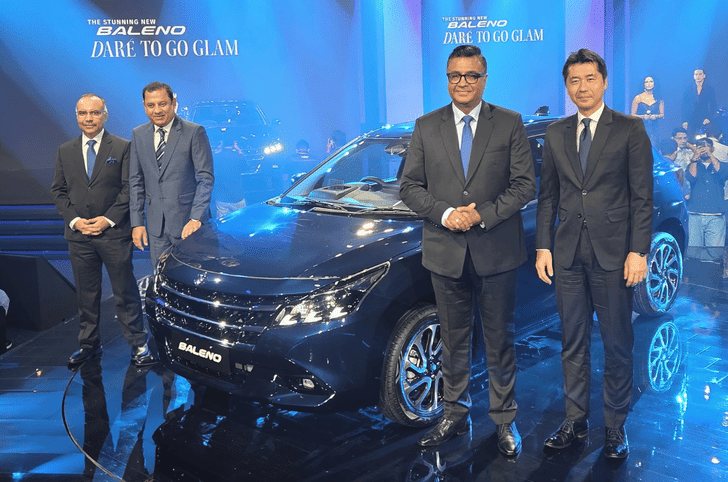

Maruti launched CNG-AMT versions of the Swift, Dzire, and Baleno in September 2026, with the Dzire topping efficiency at 36.47 km/kg (ARAI), Swift at 35.34 km/kg, and Baleno at 34.47 km/kg.
How Much Will Maruti's New CNG-AMT Swift, Dzire & Baleno Cost in India 2026? Mileage & Price Comparison
Maruti Suzuki launched automatic S-CNG variants of the Swift, Dzire, and Baleno on 19 September 2026, making India's three most popular CNG cars the first mass-market models to combine factory-fitted CNG with an automated manual transmission (AMT) — a combination that has been conspicuously absent from the segment until now. The Dzire S-CNG AMT leads the trio with an ARAI-claimed 36.47 km/kg, while the Swift returns 35.34 km/kg and the Baleno 34.47 km/kg.
The launch is part of Maruti's 'Auto Green Mission', a strategic push to grow its CNG portfolio at a time when S-CNG vehicle sales rose 58 per cent year-on-year in the first quarter of FY2027. July 2026 recorded the highest-ever monthly S-CNG sales of 83,000 units.
At a Glance: CNG-AMT Trio vs. Key Rivals
The table below compares the three new Maruti CNG-AMT models against their closest non-automatic CNG rivals and petrol-AMT alternatives. All mileage figures are ARAI-claimed; prices are ex-showroom.
| Model | Fuel Type | Transmission | ARAI Mileage | Starting Price (ex-showroom) | Key Weakness |
|---|---|---|---|---|---|
| Maruti Dzire S-CNG AMT | CNG | 5-speed AMT | 36.47 km/kg | ~₹9.40–9.60 lakh* | AMT jerkiness in city stop-go; no CNG + sunroof combo |
| Maruti Swift S-CNG AMT | CNG | 5-speed AMT | 35.34 km/kg | ~₹8.80–9.20 lakh* | Boot space reduced with CNG cylinder; no turbo option |
| Maruti Baleno S-CNG AMT | CNG | 5-speed AMT | 34.47 km/kg | ~₹9.00–9.50 lakh* | Heavier than rivals (up to 1,055 kg in CNG); no rear armrest |
| Maruti Dzire S-CNG MT | CNG | 5-speed Manual | 33.73 km/kg | ₹8.10–9.11 lakh | Manual-only until now; no clutch-free convenience |
| Maruti Baleno S-CNG MT | CNG | 5-speed Manual | 33.61 km/kg | ~₹8.50–9.00 lakh | Replaced 4-cyl engine; 83 hp vs 90 hp previously |
| Hyundai i20 CNG | CNG | 5-speed Manual | 28.49 km/kg | ~₹9.50–10.50 lakh | No CNG-AMT option available |
| Hyundai Aura CNG | CNG | 5-speed Manual | 28.40 km/kg | ~₹8.50–9.50 lakh | No CNG-AMT option available |
| Tata Altroz CNG | CNG | 5-speed Manual | 28.08 km/kg | ~₹8.50–9.50 lakh | No AMT with CNG; no ADAS |
| Maruti Dzire Petrol AMT | Petrol | 5-speed AMT | 24.79 kmpl | ₹7.67–9.36 lakh | Lower running economy vs CNG at current gas prices |
*AMT CNG prices are estimated based on the existing CNG manual price plus the typical ₹30,000–50,000 AMT premium Maruti charges across its range. Official variant-wise prices had not been published at the time of writing (19 September 2026).
What exactly is the Maruti S-CNG AMT, and why does it matter?
The S-CNG AMT is a factory-integrated CNG powertrain mated to a five-speed automated manual transmission, where an electronic actuator executes gear changes rather than a conventional clutch pedal. Maruti Suzuki's S-CNG (factory-fitted CNG) differs from aftermarket kits: the fuel system is engineered and warranted by the manufacturer, the ECU is calibrated for dual-fuel operation, and the vehicle retains its full warranty.
Until this launch, every CNG car in the Indian mass market — from Maruti's own Dzire and Baleno to the Hyundai Aura and Tata Altroz — required the driver to operate a clutch. That made CNG cars less appealing in dense urban traffic, where the fuel's cost advantage is greatest but stop-and-go driving is most tiring. The CNG-AMT combination resolves that contradiction directly.
All three models — Swift, Dzire, and Baleno — use the same 1.2-litre Z12E three-cylinder naturally aspirated engine with Dual Variable Valve Timing (Dual VVT) and Idle Start Stop technology. The transmission also allows manual gear changes without a clutch pedal, giving drivers control during overtaking or on inclines.
How much do the CNG-AMT variants cost, and how do they compare to the manual CNG versions?
Official variant-wise prices for the CNG-AMT trims were not published at the time of this article's writing. The pricing context from the existing lineup provides a reliable baseline.
The Maruti Dzire CNG manual range currently starts at ₹8.10 lakh for the VXi CNG and goes to ₹9.11 lakh for the ZXi CNG (both ex-showroom, post the June 2026 price revision). The VXi CNG saw a ₹7,500 hike in that revision, which was the largest increase across the entire Dzire range — a signal that demand for CNG trims remains solid enough to absorb price increases.
For the petrol Dzire, the AMT premium over the equivalent manual is approximately ₹45,000 (VXi MT at ₹7.22 lakh vs VXi AMT at ₹7.67 lakh; ZXi MT at ₹8.22 lakh vs ZXi AMT at ₹8.67 lakh). If Maruti applies a similar premium to the CNG-AMT variants, expect the Dzire CNG AMT to land between ₹8.55 lakh and ₹9.55 lakh ex-showroom.
The 2026 Baleno facelift was launched at ₹6.10 lakh ex-showroom (Bengaluru) for the base petrol-MT trim. The Baleno CNG manual was previously priced around ₹8.50–9.00 lakh, and the new CNG-AMT variant is expected to sit above that.
One important caveat: Maruti has historically not offered CNG and AMT together before this launch, so there is no direct historical precedent for the exact premium. Buyers should wait for the official variant-wise price announcement before booking.
What are the mileage figures, and how do they stack up against the manual CNG versions?
Conventional wisdom holds that an AMT adds a small fuel economy penalty over a manual because of the additional mechanical losses in the actuator system and slightly different shift logic. Maruti appears to have engineered around this.
The Dzire CNG AMT's ARAI-claimed 36.47 km/kg is significantly higher than the existing Dzire CNG manual's 33.73 km/kg — a difference of 2.74 km/kg. The Swift CNG AMT at 35.34 km/kg and the Baleno CNG AMT at 34.47 km/kg similarly outperform the Baleno CNG manual's 33.61 km/kg.
This improvement stems from the Z12E engine's Idle Start Stop system working in concert with the AMT's ability to cut the engine at standstill more efficiently than a driver manually would, and from the AMT's optimised shift points that keep the engine in its most efficient rev band. The Dual VVT system also plays a role in maintaining combustion efficiency across the CNG fuel map.
ARAI figures are manufacturer claims derived from standardised test cycles, not real-world driving. Autocar India's real-world test of the petrol Dzire AMT returned 11.61 kmpl in city conditions and 19.22 kmpl on the highway against the ARAI claim of 24.79 kmpl — a significant gap. Buyers should treat the CNG mileage figures as a comparative benchmark rather than a guarantee of what they will experience in daily use. Real-world CNG mileage in city traffic typically runs 20–25 per cent below ARAI claims.
What engine powers all three models, and is it the same unit?
Yes. All three — Swift, Dzire, and Baleno CNG-AMT — share the 1.2-litre Z12E three-cylinder naturally aspirated engine. This engine is Maruti Suzuki's current-generation small-displacement petrol unit, featuring Dual Variable Valve Timing and Idle Start Stop technology, replacing the older four-cylinder K12N in the Baleno's case.
In petrol guise, the Z12E produces 83 hp and 112 Nm in the Baleno, and approximately 81.58 hp and 111.7 Nm in the Dzire. In CNG mode, outputs drop — the Baleno CNG produces 70 hp and 102 Nm, and the Dzire CNG produces 68.79 bhp and 101.8 Nm. This power drop in CNG mode is a known characteristic of bi-fuel CNG systems and is not unique to Maruti — it affects all factory CNG cars.
The practical consequence is that the CNG-AMT variants will feel noticeably less punchy than their petrol counterparts, particularly during overtaking or on steep inclines. The AMT's manual-mode override helps manage this, but buyers who frequently drive on expressways or hilly terrain should factor in the reduced power availability in CNG mode.
The Baleno's Z12E also replaces the outgoing K12N four-cylinder, which produced 90 hp and 113 Nm in petrol form. The new engine is down on power but up on fuel efficiency — a trade-off Maruti has made deliberately to align with its efficiency-first positioning.
How does the Baleno CNG-AMT differ from the Swift and Dzire versions?
The Baleno occupies a different segment — it is a premium hatchback competing with the Tata Altroz, Hyundai i20, and Toyota Glanza — while the Swift is a mass-market hatchback and the Dzire is a compact sedan. The CNG-AMT powertrain is shared, but the Baleno brings a meaningfully richer feature set.
The 2026 Baleno facelift adds Level 2 ADAS — a first in its segment — including adaptive cruise control, lane-keep assist, emergency braking, and high-beam assist. It also gets ventilated front seats with leatherette upholstery, a Clarion branded sound system, a wireless charger with cooling, and a tyre-pressure monitoring system. The ADAS suite uses a radar module housed in the enlarged front grille.
The Baleno CNG AMT's ARAI mileage of 34.47 km/kg is the lowest of the three, which is consistent with its higher kerb weight. The CNG Baleno weighs up to 1,055 kg, compared to the petrol-AMT version at 990 kg. That 65 kg difference is the combined weight of the CNG cylinder, high-pressure fuel lines, and the dual-fuel ECU system.
The Baleno CNG-AMT still lacks a sunroof (absent across the CNG range), a rear centre armrest, and a fully digital instrument cluster. If these features matter to you, the petrol-AMT Baleno or a rival like the Hyundai i20 petrol-AMT may be more satisfying — though neither matches the running cost advantage of CNG.
For a broader comparison of premium hatchbacks, our guide to the 6 best premium hatchbacks to buy in India in 2026 covers the full competitive space.
Is the Dzire CNG-AMT the best value of the three?
On paper, the Dzire CNG-AMT makes the strongest case for most buyers.
The Dzire's 36.47 km/kg ARAI mileage is the highest of the three, and the sedan body style gives it a larger, more usable boot compared to the hatchbacks — even accounting for the CNG cylinder. The Dzire also carries a 5-star Global NCAP and Bharat NCAP safety rating, six airbags as standard, ABS with EBD, ESP, hill hold control, and a 360-degree camera on higher trims.
The Dzire became the best-selling car in FY2026 and has crossed 30 lakh cumulative unit sales — a volume that translates into strong resale values, a dense service network, and readily available spare parts. For a CNG car used primarily in urban commuting, these factors matter as much as the sticker price.
The sedan's proportions make it slightly less manoeuvrable in tight urban parking than the Swift or Baleno hatchbacks. Its rear seat is also more upright than the Baleno's, which some passengers find less comfortable on longer journeys.
How do these models compare against non-Maruti CNG rivals?
The competitive gap in CNG efficiency is stark. The Hyundai i20 CNG claims 28.49 km/kg, the Hyundai Aura CNG 28.40 km/kg, and the Tata Altroz CNG 28.08 km/kg — all manual-only. Against the Dzire CNG AMT's 36.47 km/kg, that is a difference of roughly 8 km/kg, which at current CNG prices (approximately ₹75–90 per kg in major cities) translates to a meaningful per-kilometre cost advantage.
None of Maruti's CNG rivals currently offer an AMT option with CNG. That is a significant product gap that Maruti is now exploiting. A buyer who drives 2,000 km per month in city traffic — a typical urban commuter — and switches from a petrol-manual car to the Dzire CNG-AMT could realistically save ₹4,000–6,000 per month on fuel, depending on local CNG and petrol prices.
The rivals are not without their own strengths. The Hyundai i20 petrol-AMT offers a sunroof, a more premium interior feel, and a turbocharged petrol option (the i20 Turbo) that the Maruti range cannot match. The Tata Altroz CNG benefits from Tata's improving build quality reputation and a more distinctive design. If you prioritise driving dynamics or interior premiumness over running costs, the Maruti CNG-AMT trio may feel utilitarian by comparison.
For buyers weighing automatic cars more broadly in this budget, our roundup of the 10 best automatic cars under ₹15 lakh in India provides a wider perspective.
What is the real-world running cost advantage of CNG over petrol?
Running cost is the total fuel expenditure per kilometre driven, calculated using the fuel price and the real-world (not ARAI) mileage. This is the number that matters most for high-mileage urban commuters.
Using approximate September 2026 prices in Delhi — CNG at ₹76 per kg, petrol at ₹95 per litre — and applying a 25 per cent real-world discount to ARAI figures:
- Dzire CNG AMT: Real-world ~27 km/kg → ₹76 ÷ 27 = ₹2.81 per km
- Dzire Petrol AMT: Real-world ~18.5 kmpl → ₹95 ÷ 18.5 = ₹5.13 per km
That is a saving of approximately ₹2.32 per km. For a driver covering 2,000 km per month, that is ₹4,640 per month or ₹55,680 per year in fuel savings. Over a typical ownership period of four to five years, the CNG-AMT variant can recover its price premium over the petrol-AMT version and then some — provided CNG infrastructure is accessible in the buyer's city.
CNG availability remains the key caveat. While Delhi, Mumbai, Pune, Ahmedabad, and Surat have dense CNG networks, buyers in smaller cities or those who frequently travel on highways may find CNG refuelling inconvenient. The bi-fuel capability (the car can run on petrol when CNG is unavailable) mitigates this, but the petrol range on a full tank is shorter than a dedicated petrol car because the CNG cylinder occupies space that would otherwise go to a larger petrol tank.
For a broader view of fuel-efficient options, see our guide to the 10 best mileage cars under ₹20 lakh in India.
What does the broader S-CNG sales surge tell us about the market?
Maruti Suzuki's claim that S-CNG sales rose 58 per cent year-on-year in Q1 FY2027, with July 2026 hitting an all-time monthly record of 83,000 units, reflects a structural shift in buyer behaviour driven by the widening gap between petrol and CNG prices.
The CNG segment is defined as the market for factory-fitted bi-fuel vehicles that run on compressed natural gas as the primary fuel and petrol as a backup, sold through OEM dealerships with full manufacturer warranty. This definition excludes aftermarket CNG conversions, which carry higher risk and do not qualify for manufacturer warranty coverage.
Maruti dominates this segment with a portfolio that now spans the Alto K10, WagonR, Celerio, Swift, Dzire, Baleno, Ertiga, and XL6 in CNG variants. The addition of AMT to the Swift, Dzire, and Baleno — three of the highest-volume models — signals that Maruti sees the CNG-AMT combination as a mainstream proposition, not a niche one.
Partho Banerjee, Senior Executive Officer, Marketing & Sales at Maruti Suzuki, stated: "The new range of automatic S-CNG models are perfectly suited for today's aspirational customers who seek the best of both worlds." The 'best of both worlds' framing — CNG running costs plus AMT convenience — is the product's core proposition, and it is a credible one.
Who should buy which model?
The Dzire CNG-AMT suits urban commuters who cover high monthly distances (1,500 km or more), need a sedan for occasional family use, and want the highest possible efficiency from the trio. Its 5-star safety rating and strong resale value make it a low-risk choice. The sedan boot, even with the CNG cylinder, is more practical than the hatchback alternatives for families.
The Swift CNG-AMT is the right pick for buyers who prioritise a compact footprint and spirited driving character over outright efficiency. The Swift's slightly sportier suspension tune and smaller dimensions make it easier to park and more fun to drive in city traffic. At 35.34 km/kg (ARAI), it is only marginally behind the Dzire.
The Baleno CNG-AMT makes sense for buyers who want the richest feature set — specifically Level 2 ADAS, ventilated seats, and the Clarion audio system — and are willing to pay a premium for it. It is the only CNG car in its segment with Level 2 ADAS, which is a genuine differentiator for safety-conscious buyers. The trade-off is the highest kerb weight of the three and the lowest CNG mileage of the trio at 34.47 km/kg (ARAI).
All three are poor choices if you regularly drive long highway stretches where CNG pumps are sparse, you need a sunroof (not available on any CNG variant), or you want a turbocharged engine for more confident overtaking.
What should buyers watch for before making a final decision?
Several data points are still pending at the time of writing:
-
Official variant-wise prices for all three CNG-AMT models. Maruti has confirmed the launch but not published the full price list. Expect this within days of the 19 September 2026 announcement.
-
Which trims get the CNG-AMT option. Maruti typically reserves AMT for mid and upper trims. The base VXi trim may remain manual-only in CNG guise.
-
Independent real-world mileage tests. The ARAI figures are manufacturer claims. Autocar India and other publications will likely conduct real-world tests within weeks of deliveries beginning. Watch for those before drawing conclusions about actual running costs.
-
Waiting periods. Given the 58 per cent YoY growth in S-CNG sales and the novelty of the CNG-AMT combination, waiting periods could stretch to 4–8 weeks, particularly for the Dzire which is already the country's best-selling car.
Buyers who are on the fence between the CNG-AMT and the petrol-AMT should run the numbers for their specific city (CNG price varies significantly — ₹76/kg in Delhi, higher in cities with less pipeline infrastructure) and their monthly mileage. Below 1,000 km per month, the fuel savings may not justify the CNG premium within a reasonable ownership period.
Sources
- Maruti Suzuki Unveils Automatic S-CNG Variants of Swift, Dzire, and Baleno — ETAuto
- Maruti Suzuki Dzire Now Costlier: CNG Trims See Biggest Increase — Times of India
- 2026 Maruti Baleno Facelift Launched at Rs 6.10 Lakh — Autocar India
- Maruti Suzuki Dzire (2026) — Price, Mileage & Expert Reviews — Autocar India
- 2026 Maruti Baleno Mileage Revealed: Up to 24.77 kmpl Despite Less Power — Mint
- Maruti Suzuki Baleno — Official Model Page
- 10 Best Automatic Cars Under ₹15 Lakh in India (2026) — AutoindexIndia
- 10 Best Mileage Cars Under ₹20 Lakh in India (2026) — AutoindexIndia
- 6 Best Premium Hatchbacks to Buy in India in 2026 — AutoindexIndia