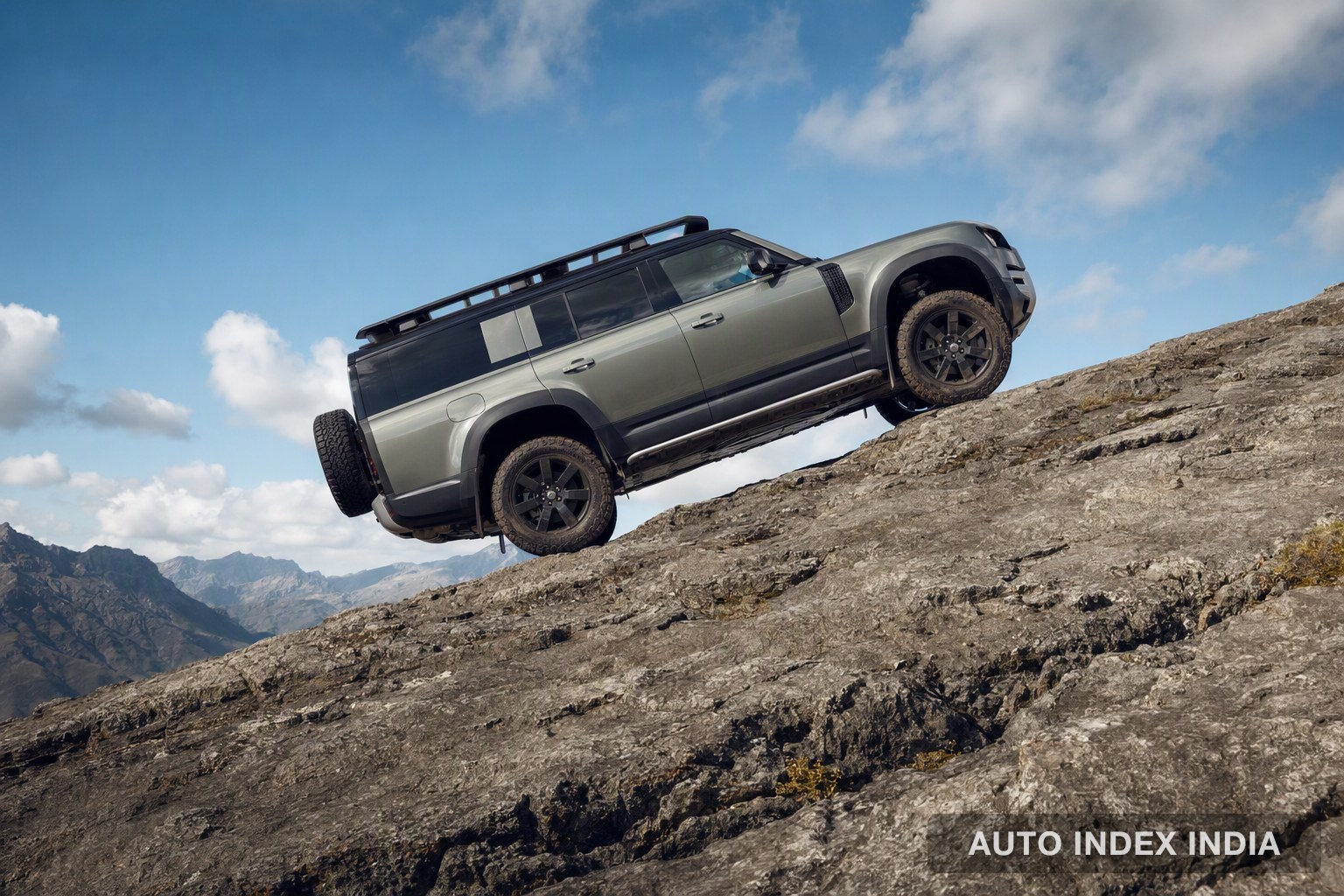
SUVs With the Best Approach and Departure Angles in India (2026)
Approach and departure angles describe how steep a slope a vehicle can take on or come off, but they work as a set with breakover, ground clearance and the hardware behind them. Two practical points matter more than the numbers: accessories like bull bars and tow hooks cut several degrees from factory figures, and several manufacturers publish these figures inconsistently or not at all.
The Maruti Jimny has the steepest departure angle of any SUV sold in India at 46 degrees, which is 9 degrees clear of the next car. The Mahindra Thar Roxx has the sharpest approach angle at about 41.7 degrees, and the Force Gurkha the best breakover at about 28 degrees. Only a handful of SUVs here publish all three figures at all, which is itself the most useful thing to know before shopping on geometry.
Steep ramps into riverbeds, broken ghat roads, rocky trails and tall speed breakers all test the same thing: whether the front or rear of a vehicle touches down before its wheels can climb. Approach and departure angles measure exactly that, and together with breakover angle they decide how confidently an SUV handles uneven ground.
This ranks the SUVs built with that geometry as a priority, and explains what the numbers mean on real terrain.
What the three angles measure
- Approach angle: the steepest slope the vehicle can drive onto before the front bumper or underbody makes contact. A higher figure lets it climb ledges head-on.
- Departure angle: the steepest slope it can come off before the rear bumper, tow hook or exhaust touches. It matters descending a ramp or climbing out of a ditch.
- Breakover angle: the sharpest crest it can cross without the underbody grounding between the axles. A shorter wheelbase generally helps.
- What reduces all three: long overhangs, low bumpers, side steps, tow bars and aftermarket bull bars.
- How they relate to ground clearance: clearance is the gap under the lowest point. The angles describe how the vehicle's shape uses that clearance at the ends and in the middle, which is why a car can have high clearance and modest angles.
Key takeaways
- Maruti Jimny: 46 degrees departure, the best here by a wide margin, on a compact body with short overhangs.
- Mahindra Thar Roxx: about 41.7 degrees approach, the steepest, though its longer wheelbase costs it on breakover.
- Force Gurkha: about 28 degrees breakover, the best of the group, plus the deepest mechanical traction hardware.
- Mahindra Thar: the most balanced set of the Mahindras, with a strong breakover figure from its short body.
- Jeep Wrangler: the deepest wading capability here at about 864 mm, though its longer body gives up breakover.
- Geometry only pays off with hardware behind it: low range, locking differentials and suitable tyres turn clean angles into actual progress.
Off-road geometry compared
| Model | Approach | Departure | Breakover | Ground clearance |
|---|---|---|---|---|
| Maruti Jimny | 36° | 46° | 24° | 210 mm |
| Mahindra Thar Roxx | about 41.7° | about 36.1° | about 23.9° | about 235 mm |
| Mahindra Thar | about 41.2° | about 36° | about 26.2° | about 226 mm |
| Force Gurkha | about 39° | about 37° | about 28° | about 233 mm |
| Jeep Wrangler | about 36° | about 31° | about 20°, 21° on Rubicon | up to about 237 mm |
| Toyota Fortuner | about 29° | about 25° | Not published | about 225 mm |
| Where these numbers come from. The Jimny figures are read off Maruti's own current brochure and the NEXA price page, which renders a range of ₹12.59 lakh to ₹14.67 lakh. Mahindra, Force, Jeep and Toyota do not publish comparable brochure specification tables in the same form, so those figures are the best available published numbers, and Mahindra in particular publishes varying figures for the same vehicle across its own materials. |
1. Maruti Jimny
Price: ₹12.59 lakh to ₹14.67 lakh. Four-wheel drive is standard on every variant.
The Jimny's short overhangs and compact body are exactly what produce steep geometry. Its 46-degree departure angle is the standout figure on this page, and it is not close: the next-best here is 9 degrees behind.
Angles: 36 degrees approach, 46 degrees departure, 24 degrees breakover. The angled bumper edges add clearance around the wheels.
Ground clearance: 210 mm unladen.
Hardware: ALLGRIP PRO shifts from 2H to 4H on the move and adds a 4L low-range transfer gear. A brake limited-slip differential brakes a spinning wheel so torque reaches the one with grip. Three-link rigid axles with coil springs at both ends keep wheels on the ground over uneven terrain.
Engine: 1.5-litre K15B petrol with idle start-stop, 77.1 kW (104.8 PS) at 6,000 rpm and 134.2 Nm at 4,000 rpm, with a 5-speed manual or 4-speed automatic.
Mileage: 16.94 km/l manual, 16.39 km/l automatic.
2. Mahindra Thar Roxx
Price: about ₹12.52 lakh to ₹23.52 lakh, with 4x4 variants from about ₹19.42 lakh.
The Thar Roxx pairs the sharpest approach angle here with a five-door, five-seat body, making it the pick for families who want to take steep ramps head-on without giving up rear doors.
Angles: about 41.7 degrees approach, about 36.1 degrees departure, about 23.9 degrees breakover. The longer wheelbase explains the lower breakover figure against the three-door vehicles here.
Ground clearance and wading: about 235 mm and about 650 mm.
Hardware: four-wheel drive with the diesel engine only, including low range, an electronic locking differential, terrain modes, a crawl function and a brake-assisted tight-turn function.
Engine: 2.2-litre diesel, about 152 PS and 330 Nm, rising to about 175 PS and 370 Nm depending on variant.
3. Mahindra Thar
Price: about ₹10.32 lakh to ₹18.99 lakh, with 4x4 variants from about ₹15.60 lakh.
The three-door Thar balances strong angles at both ends with a short body. Its breakover figure is among the best here, which helps it cross sharp crests without grounding.
Angles: about 41.2 degrees approach, about 36 degrees departure, about 26.2 degrees breakover.
Ground clearance and wading: about 226 mm and about 650 mm.
Hardware: 4x4 variants get a low-range transfer case, an electronic locking differential and terrain modes for mud, sand and snow. The entry diesel is rear-wheel drive only.
Engines: a 1.5-litre diesel at about 119 PS, a 2.2-litre diesel at about 152 PS and 330 Nm, and a 2.0-litre turbo-petrol at about 162 PS and 330 Nm.
4. Force Gurkha
Price: about ₹16.25 lakh for the 3-door and about ₹17.58 lakh for the 5-door. Four-wheel drive is standard on both.
The Gurkha has the most balanced geometry here, with strong figures at the front, rear and middle, and the hardware to match on hard trails and water crossings.
Angles: about 39 degrees approach, about 37 degrees departure, about 28 degrees breakover. The breakover figure is the best on this page, a clear advantage over ridges and rock steps.
Ground clearance and wading: about 233 mm, with a roof-mounted snorkel allowing about 700 mm.
Hardware: floor-mounted levers select high and low range. Mechanically actuated locking differentials on both axles keep it moving when wheels lift clear of the ground. No other vehicle here offers that mechanically.
Engine: 2.6-litre diesel, about 140 PS and 320 Nm, with a 5-speed manual only.
5. Jeep Wrangler
Price: about ₹66.20 lakh for the Unlimited and about ₹70.80 lakh for the Rubicon.
The Wrangler brings body-on-frame construction, a premium cabin and by far the deepest wading capability here. It is the choice for a large budget and serious trail hardware.
Angles: about 36 degrees approach, about 31 degrees departure, about 20 degrees breakover rising to about 21 on the Rubicon. Its longer body gives up breakover against the smaller vehicles above.
Ground clearance and wading: up to about 237 mm and about 864 mm, the deepest here.
Hardware: the Unlimited uses a full-time system. The Rubicon adds a 4:1 low range, front and rear locking differentials and an electronically disconnecting front sway bar for extra wheel articulation.
Engine: 2.0-litre turbo-petrol, about 274 PS and 400 Nm, with an 8-speed automatic.
Also worth knowing: Toyota Fortuner
The Fortuner's angles fall short of the five ranked above, which is why it sits outside the main list. It earns a mention for buyers who need a full-size seven-seater with genuine four-wheel-drive hardware for occasional trails.
Price: about ₹34.76 lakh to ₹50.46 lakh, with 4x4 from about ₹39.35 lakh. Toyota publishes no ex-showroom prices in India, so these are dealer-listed.
Angles: about 29 degrees approach and about 25 degrees departure, converted from the radian figures on Toyota's specification sheet. No breakover figure is published.
Hardware: diesel 4x4 variants add high and low range, an electronic rear differential lock, active traction control and downhill assist control.
Engine: 2.8-litre diesel, 150 kW (204 PS), with 420 Nm on the manual and 500 Nm on the automatic.
Which geometry suits which terrain
- Steep ramps and ledges: the Thar Roxx or Thar, whose 41-degree approach angles let the nose climb first.
- Ditch exits and steep descents: the Jimny, whose 46-degree departure angle keeps the rear bumper clear by a margin nothing else here matches.
- Sharp crests, rock and river crossings: the Force Gurkha, combining the best breakover figure with dual mechanical locking differentials and 700 mm of wading.
- A premium trail machine: the Jeep Wrangler Rubicon, with front and rear lockers and the deepest wading here.
- Space first, trails second: the Fortuner, which gives up angles for seven seats and towing ability.
Conclusion
Approach and departure angles describe how steep a slope a vehicle can take on or come off, but they work as a set with breakover, ground clearance and the hardware behind them. The vehicles with the cleanest geometry tend to have short bodies and firm rigid axles, which means a busier ride and less cabin and luggage space than a conventional SUV.
Two practical points are worth more than the numbers themselves. First, accessories matter: bull bars cut approach, tow bars cut departure and low side steps cut breakover, often by several degrees from the factory figures. Second, several manufacturers here publish these figures inconsistently or not at all, so a dealer check against the specific variant is worth more than a spec sheet comparison.
FAQs
What is a good approach angle for an off-road SUV?
Anything from about 35 degrees upward is strong. The vehicles here run from about 29 degrees on the Fortuner to about 41.7 on the Thar Roxx.
Which SUV in India has the best departure angle?
The Maruti Jimny at 46 degrees, ahead of the Force Gurkha at about 37 and the Thar Roxx at about 36.1. The margin is unusually large.
Is breakover angle as important as the other two?
It matters most on sharp crests, ridges and tall speed breakers, where the middle of the vehicle grounds. Shorter wheelbases help, which is why the three-door vehicles here score better than the longer ones.
Do bull bars and side steps reduce these angles?
Yes. Bull bars and front guards cut approach, tow bars and rear steps cut departure, and low side steps cut breakover. Accessories designed to preserve the factory geometry are worth seeking out.
Does higher ground clearance mean better angles?
Not necessarily. Clearance measures the lowest point under the vehicle, while the angles also depend on how far the body extends past the wheels. A vehicle with long overhangs can have high clearance and modest angles, which is exactly the Fortuner's position on this list.
Last verified: 2026-09-30