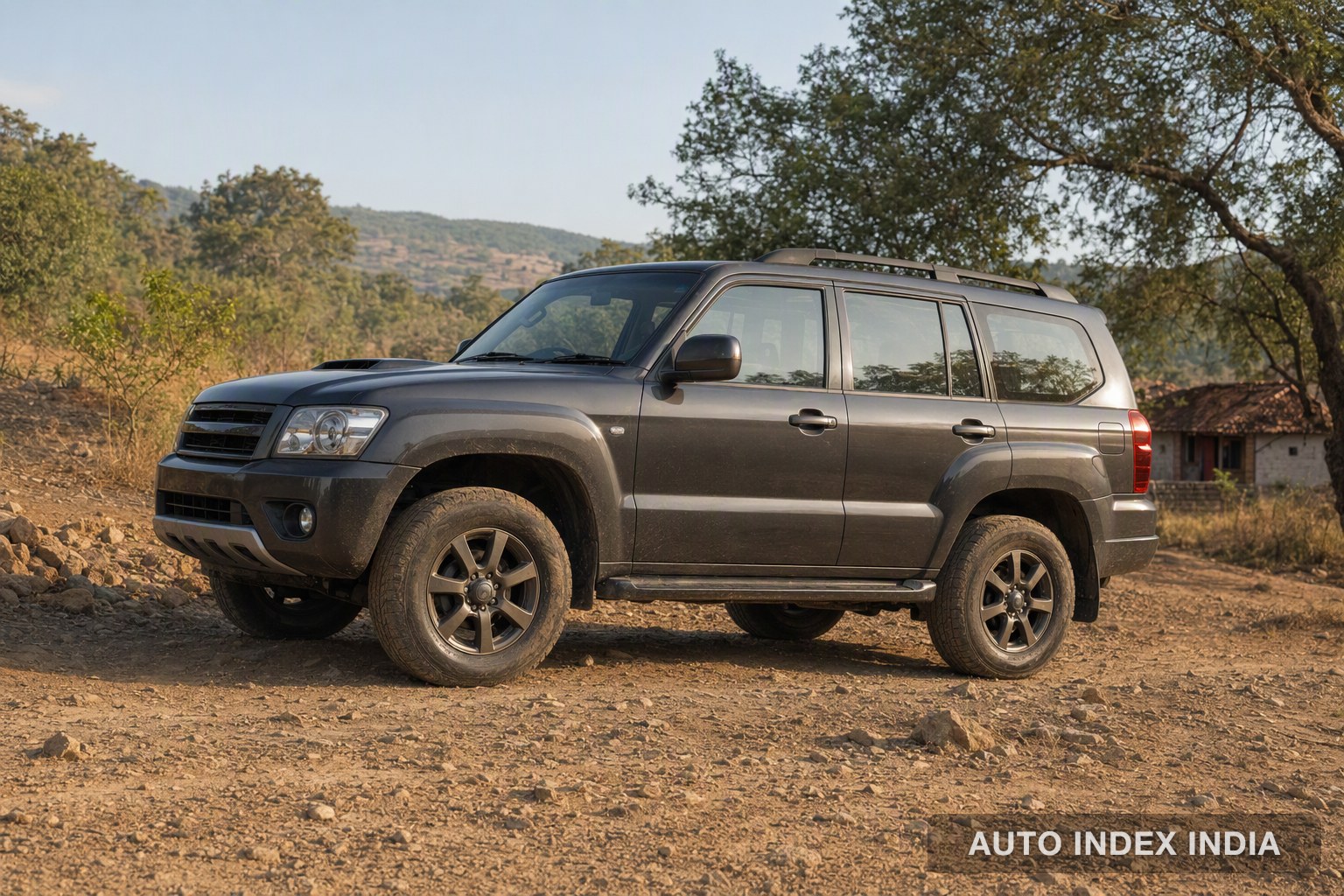
Best SUVs With a Ladder-Frame Chassis in India (2026)
A ladder frame resists twisting when a wheel lifts, tows without stressing the body and tolerates years of rough use. The costs are weight, more body roll and a firmer ride, especially on models with rigid axles. Construction type says nothing about crash safety on its own: this list runs from a 1-star Global NCAP adult result to a 5-star Bharat NCAP rating.
Eight mainstream SUVs on sale in India are built on a ladder frame, where the body sits on a separate steel chassis rather than forming a single shell with it. They span from the Mahindra Bolero at about ₹8.49 lakh to the MG Majestor at about ₹40.99 lakh. The Maruti Jimny, from ₹12.59 lakh, is the cheapest of them with four-wheel drive standard on every variant.
That construction still matters if your driving includes broken village roads, steep hill tracks, water crossings or towing, and it is why these vehicles tend to feel unshakable after years of hard use. Most SUVs sold here today use monocoque bodies instead, which keeps the genuine ladder-frame list fairly short.
Key takeaways
- A ladder frame resists twisting when one wheel lifts, handles towing without stressing the body, and takes years of rough use without developing rattles.
- The trade is weight, a higher centre of gravity and more body roll, plus a firmer ride over small bumps, especially on models with rigid axles.
- Maruti Jimny: the only Maruti built this way, and the cheapest here with four-wheel drive standard.
- Force Gurkha: the most off-road-focused, with dual mechanical differential locks and a snorkel.
- Crash-test results vary enormously, from a 1-star Global NCAP adult result on one entry to a 5-star Bharat NCAP on another, so construction type says nothing about crash safety on its own.
The eight compared
| Model | Starting price | Four-wheel drive from | 4x4 hardware | Seats |
|---|---|---|---|---|
| Mahindra Bolero | about ₹8.49 lakh | Not offered | Rear-wheel drive only | 7 |
| Mahindra Bolero Neo | about ₹8.99 lakh | Not offered | Locking rear differential on select variants | 7 |
| Mahindra Thar | about ₹10.32 lakh | about ₹15.60 lakh | Low range, electronic locking differential | 4 |
| Mahindra Thar Roxx | about ₹12.52 lakh | about ₹19.42 lakh | Low range, electronic locking differential | 5 |
| Maruti Jimny | ₹12.59 lakh | Standard | Low range, brake limited-slip differential | 4 |
| Mahindra Scorpio N | about ₹13.69 lakh | about ₹18.03 lakh | Low range, terrain modes | 6 or 7 |
| Force Gurkha | about ₹16.25 lakh | Standard | Low range, front and rear diff locks | 4 or 7 |
| Toyota Fortuner | about ₹34.76 lakh | about ₹39.35 lakh | Low range, rear diff lock | 7 |
| MG Majestor | about ₹40.99 lakh | about ₹44.99 lakh | Front, centre and rear diff locks | 6 or 7 |
| Where these numbers come from. The Jimny figures are read off Maruti's own current brochure and the NEXA price page. Mahindra, Force, Toyota and MG do not publish comparable brochure specification tables in the same form, so those figures are the best available published numbers, and Toyota publishes no ex-showroom prices in India at all. |
What a ladder frame actually does
In a body-on-frame vehicle, two long steel rails joined by cross members form the chassis. The engine, gearbox and suspension bolt to that frame, and the body mounts on top. A monocoque SUV has no separate frame, so the body shell carries all the loads itself.
In practice that brings three benefits. The frame resists twisting when a wheel is in the air, so doors and panels do not flex on uneven ground. It handles heavy loads and towing without stressing the body. And it tolerates years of rough use without developing rattles.
The costs are weight, a higher centre of gravity and more body roll in corners, plus a firmer ride over small bumps, which is most noticeable on the models still using rigid axles.
1. Maruti Jimny
Price: ₹12.59 lakh to ₹14.67 lakh. Four-wheel drive is standard on every variant.
The Jimny is the smallest and lightest vehicle here. Its short body and compact footprint suit narrow hill roads and forest trails where the larger vehicles on this list simply will not fit.
Chassis: ladder frame with three-link rigid axles and coil springs at both ends. Rigid axles keep the wheels in contact with the ground over uneven terrain.
Four-wheel drive: ALLGRIP PRO shifts from 2H to 4H on the move and adds a 4L low-range transfer gear. A brake limited-slip differential brakes a spinning wheel so torque reaches the one with grip.
Angles and clearance: 210 mm unladen, 36 degrees approach, 46 degrees departure, 24 degrees ramp breakover.
Engine: 1.5-litre K15B petrol with idle start-stop, 77.1 kW (104.8 PS) at 6,000 rpm and 134.2 Nm at 4,000 rpm, with a 5-speed manual or 4-speed automatic.
Mileage: 16.94 km/l on the manual, 16.39 km/l on the automatic.
Safety: 6 airbags standard, with stability programme, hill hold and hill descent control and ABS with EBD. No published Bharat NCAP or Global NCAP rating for the India-spec five-door.
2. Mahindra Bolero Neo
Price: about ₹8.99 lakh to ₹10.79 lakh. Rear-wheel drive only.
The Bolero Neo is among the most affordable vehicles here and one of only two seven-seaters under ₹11 lakh on this list. It suits buyers who want something tough and simple for rough roads and heavy daily use rather than serious off-roading.
Chassis: ladder frame with independent front suspension and a coil-sprung multi-link rear. Ground clearance about 180 mm.
Four-wheel drive: none offered. Select variants get a locking rear differential to send torque to the wheel with grip on mud or loose surfaces.
Engine: 1.5-litre diesel, about 100 PS and 260 Nm, with a 5-speed manual.
Safety: dual airbags and ABS with EBD standard. It scored 1 star for adult occupant protection in Global NCAP testing in 2024, the weakest result on this list.
3. Mahindra Thar
Price: about ₹10.32 lakh to ₹18.99 lakh, with four-wheel-drive variants from about ₹15.60 lakh.
The updated Thar remains the choice for buyers who want a three-door, open-trail vehicle with a choice of petrol and diesel engines.
Chassis: body-on-frame with independent double-wishbone front suspension and a solid rear axle with a Watt's link, which improves stability in corners.
Four-wheel drive: 4x4 variants get a low-range transfer case, an electronic locking differential and terrain modes for mud, sand and snow. The entry diesel is rear-wheel drive only.
Angles and clearance: about 226 mm ground clearance, about 41.2 degrees approach, about 36 degrees departure and about 650 mm wading depth.
Engines: a 1.5-litre diesel at about 119 PS and 300 Nm, a 2.2-litre diesel at about 152 PS and 330 Nm, and a 2.0-litre turbo-petrol at about 162 PS and 330 Nm.
Safety: stability control with rollover mitigation standard across the range. Lower trims get dual airbags while the top trim gets six.
4. Mahindra Thar Roxx
Price: about ₹12.52 lakh to ₹23.52 lakh, with 4x4 variants from about ₹19.42 lakh.
The Thar Roxx adds five doors, a longer wheelbase and a proper five-seat cabin to the Thar formula, making it the more practical choice for families who still want real off-road hardware.
Chassis: ladder frame with double-wishbone front suspension and a coil-sprung rigid rear axle with Watt's linkage. Frequency-dependent dampers soften the rigid axle's reaction to sharp bumps.
Four-wheel drive: offered with the diesel engine only, including low range, an electronic locking differential, terrain modes, a crawl function and a brake-assisted tight-turn function.
Angles and clearance: about 235 mm ground clearance, about 41.7 degrees approach, about 36.1 degrees departure, about 23.9 degrees breakover and about 650 mm wading depth.
Engines: a 2.0-litre turbo-petrol in rear-wheel drive only, and a 2.2-litre diesel at about 152 PS and 330 Nm rising to about 175 PS and 370 Nm depending on variant.
Safety: 6 airbags standard, with Level 2 ADAS on higher variants, and a 5-star Bharat NCAP rating scoring about 31.09 of 32 for adult and 45 of 49 for child occupant protection.
5. Mahindra Scorpio N
Price: about ₹13.69 lakh to ₹25.49 lakh, with 4x4 variants from about ₹18.03 lakh.
The Scorpio N is the only three-row, seven-seat ladder-frame SUV under ₹25 lakh here with a four-wheel-drive option, making it the pick for large families travelling on bad roads.
Chassis: body-on-frame with double-wishbone front suspension and a multi-link rear with Watt's linkage.
Four-wheel drive: diesel only. The 4XPLOR system adds low range, selectable terrain modes, and hill-hold and hill-descent control.
Engines: a 2.0-litre turbo-petrol at about 203 PS, and a 2.2-litre diesel at about 175 PS with 370 to 400 Nm depending on gearbox, plus a lower-output diesel on base variants.
Safety: 6 airbags and stability control, with Level 2 ADAS on top variants. In Global NCAP's 2022 test it scored 5 stars for adult and 3 for child occupant protection.
6. Force Gurkha
Price: about ₹16.25 lakh for the 3-door and about ₹17.58 lakh for the 5-door. Four-wheel drive is standard on both.
The Gurkha is the most off-road-focused vehicle here, with a snorkel, dual locking differentials and a five-door seven-seat version.
Chassis: ladder frame with multi-link coil-spring suspension at both axles.
Four-wheel drive: floor-mounted levers select high and low range. Mechanically actuated differential locks on both axles are the Gurkha's biggest advantage in deep ruts and on rock.
Angles and clearance: about 233 mm ground clearance, about 39 degrees approach, about 37 degrees departure and about 28 degrees breakover. The snorkel allows wading to about 700 mm.
Engine: 2.6-litre diesel, about 140 PS and 320 Nm, with a 5-speed manual only.
Safety: dual airbags, ABS and tyre pressure monitoring standard, the thinnest specification on this list.
7. Toyota Fortuner
Price: about ₹34.76 lakh to ₹50.46 lakh, with 4x4 from about ₹39.35 lakh. Toyota publishes no ex-showroom prices in India, so these are dealer-listed.
The Fortuner is the benchmark full-size ladder-frame SUV here, suited to buyers who want a seven-seater that tows, covers long highway distances and still copes with rough ground.
Chassis: body-on-frame with double-wishbone front suspension and a four-link coil-sprung rear.
Four-wheel drive: diesel 4x4 variants get high and low range, an electronic rear differential lock, active traction control and downhill assist control. Approach angle is about 29 degrees and departure about 25 degrees.
Engines: a 2.8-litre diesel at 150 kW (204 PS) with 420 Nm on the manual and 500 Nm on the automatic, and a 2.7-litre petrol in two-wheel drive only.
Safety: seven airbags, vehicle stability control, hill assist and traction control standard. No published India-spec Bharat NCAP or Global NCAP rating.
8. MG Majestor
Price: about ₹40.99 lakh for the two-wheel drive and about ₹44.99 lakh for the 4x4.
The Majestor is MG's flagship ladder-frame SUV and the longest and widest vehicle here, focused on luxury and space while keeping serious four-wheel-drive hardware.
Chassis: ladder frame, about 5,046 mm long on a 2,950 mm wheelbase, with about 219 mm ground clearance.
Four-wheel drive: the 4x4 variant gets triple differential locks, front, centre and rear, plus a crawl function that manages throttle and braking at low speed. Rated for about 810 mm wading.
Engine: 2.0-litre twin-turbo diesel, about 216 PS and 479 Nm, with an 8-speed automatic.
Safety: 6 airbags, Level 2 ADAS and a 360-degree camera standard.
Which one suits which use
- Weekend trails and narrow hill roads: the Jimny or the Thar, where compact size and short overhangs matter more than outright power.
- Families who still leave the tarmac: the Thar Roxx or Scorpio N diesel 4x4, which add doors and seats without giving up low range.
- The hardest terrain: the Force Gurkha, whose dual mechanical differential locks and snorkel are built for deep ruts and water.
- Towing and long highway runs: the Fortuner or Majestor, whose torque and long wheelbases make them stable at speed.
- A tight budget and daily rough roads: the Bolero or Bolero Neo, which handle heavy use without the cost of four-wheel drive.
Conclusion
A ladder frame suits roads and plans that are hard on a vehicle: hill travel, unpaved routes, water crossings, towing, or simply keeping a car for a very long time. The toughness comes with a firmer ride, more body roll and extra weight, and at the budget end some models offer only two airbags or skip an automatic gearbox and four-wheel drive entirely.
Construction type says nothing about crash safety on its own. This list runs from a 1-star Global NCAP adult result to a 5-star Bharat NCAP rating, so the individual vehicle's design and equipment decide that, not the frame underneath it.
FAQs
What is a ladder-frame chassis?
Two long steel rails joined by cross members form a separate frame. The engine, suspension and body all mount onto it. It is stronger under twisting and heavy loads than a monocoque body, where frame and body form a single shell.
Is a ladder-frame SUV safer than a monocoque one?
Not inherently. Crash safety depends on the specific vehicle's design and equipment. The vehicles here range from a 1-star Global NCAP adult rating to a 5-star Bharat NCAP result, so compare individual scores rather than construction type.
Which Maruti SUV has a ladder frame?
The Jimny, the only one. It pairs that frame with rigid axles at both ends and a four-wheel-drive system with low range standard on every variant.
What is the cheapest ladder-frame SUV in India?
The Mahindra Bolero at about ₹8.49 lakh, followed by the Bolero Neo at about ₹8.99 lakh. Both are rear-wheel drive. The Jimny at ₹12.59 lakh is the cheapest with four-wheel drive standard.
Do ladder-frame SUVs ride uncomfortably?
They generally ride more firmly than monocoque SUVs, especially those with rigid axles. Newer designs use advanced dampers and Watt's linkages to improve ride quality on rough roads.
Last verified: 2026-09-30