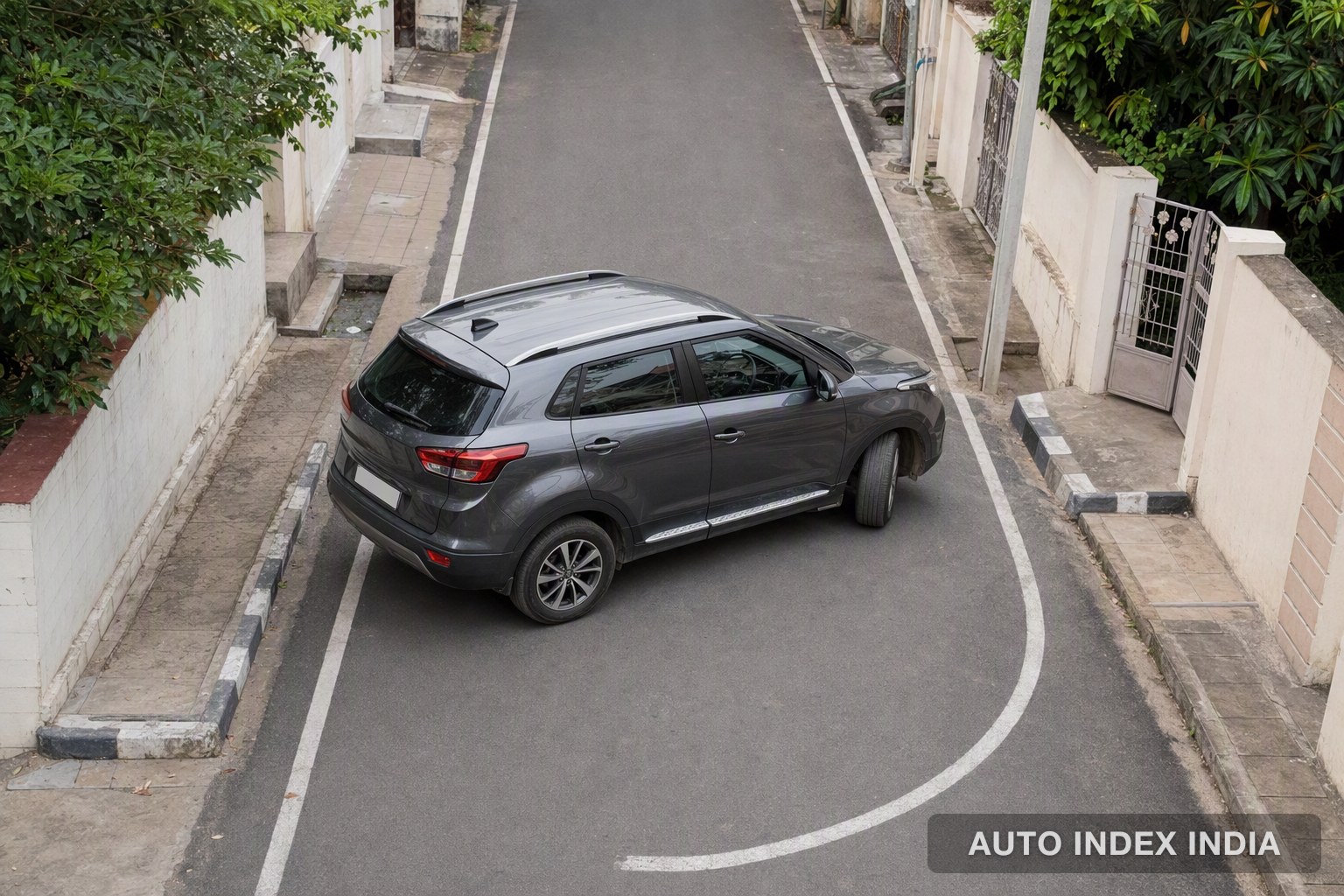
Which Mid-Size SUV Has the Tightest Turning Radius? (2026)
Turning radius is the spec that decides whether a mid-size SUV is easy or exhausting in a multi-storey car park or a narrow lane. The Volkswagen Taigun turns tightest at 5.05 metres, with the Honda Elevate at 5.2 m and the Kia Seltos at 5.3 m behind it. The Maruti Grand Vitara and Victoris, Hyundai Creta, Toyota Urban Cruiser Hyryder and Skoda Kushaq all quote 5.4 m, and the MG Astor is the widest-turning here at 5.6 m. Wheelbase explains much but not all of the spread, since steering lock and front track matter too. Maruti and Toyota print a turning radius in their own brochures for the Grand Vitara, Victoris and Hyryder; the other figures here are third-party.
The Volkswagen Taigun turns in the tightest circle of any mid-size SUV on sale in India, at 5.05 meters, with the Honda Elevate next at 5.2 meters and the Kia Seltos at 5.3 meters. Most of the segment sits at 5.4 meters, including the Maruti Suzuki Grand Vitara, the Maruti Suzuki Victoris, the Hyundai Creta, the Toyota Urban Cruiser Hyryder and the Skoda Kushaq. The MG Astor is the widest here at 5.6 meters. Turning radius rarely makes it into a test drive conversation, but it shapes daily driving more than most buyers realize. A tighter turning radius means easier U-turns on narrow roads, less maneuvering in cramped parking lots, and a generally more manageable car in dense city traffic, especially in a segment where every SUV is around 4.3 to 4.4 meters long.
Most buyers in this segment focus on engine output, feature lists, or safety ratings when comparing options. Turning radius rarely comes up until after the purchase, usually the first time a three-point turn on a narrow street takes an extra attempt. Since mid-size SUVs in India are close enough in overall length that size alone doesn't predict this spec, the actual numbers are worth checking directly rather than assuming.
This list compares mid-size SUVs in India specifically on turning radius. It's a spec that's easy to overlook next to engine output or feature counts, but it makes a real difference every time the car needs to make a tight U-turn or squeeze into a parking spot.
Mid-size SUV turning radius comparison
| Model | Turning radius | Wheelbase |
|---|---|---|
| Maruti Suzuki Grand Vitara | 5.4 m | 2,600 mm |
| Maruti Suzuki Victoris | 5.4 m | 2,600 mm |
| Volkswagen Taigun | 5.05 m | 2,651 mm |
| Honda Elevate | 5.2 m | 2,650 mm |
| Kia Seltos | 5.3 m | 2,610 mm |
| Hyundai Creta | 5.4 m | 2,610 mm |
| Toyota Urban Cruiser Hyryder | 5.4 m | 2,600 mm |
| Skoda Kushaq | 5.4 m | 2,651 mm |
| MG Astor | 5.6 m | 2,585 mm |
Maruti Suzuki figures are the ARAI-certified numbers printed in each model's own brochure, and the one Maruti figure of that kind used below is the Grand Vitara's 27.97 km/l hybrid mileage. Maruti prints a turning radius of 5.4 m and a wheelbase of 2,600 mm for both the Grand Vitara and the Victoris in their own brochures, and Toyota prints both figures for the Hyryder, so those three rows are manufacturer-published. Hyundai and MG print a wheelbase for the Creta (2,610 mm) and the Astor (2,585 mm) but no turning radius. Volkswagen, Honda, Kia and Skoda either block automated access or publish no comparable figure, so those rows are our own and are worth confirming with a dealer.
Both the table and the sections that follow are grouped Maruti-first rather than ordered tightest-to-widest, so read the turning radius column rather than the running order.
What is turning radius, and why does it matter?
Turning radius is the radius of the smallest circle a car can turn within at full steering lock, the kerb-to-kerb figure brochures quote. A smaller number means the car can turn more sharply within a tighter space, which translates directly into easier three-point turns, tighter parking maneuvers, and less back-and-forth when navigating a crowded street.
It's mostly determined by a car's wheelbase, front wheel steering angle, and overall length, which is why two SUVs of similar size can still post noticeably different figures depending on how their steering geometry is engineered.
Key takeaways
- The Volkswagen Taigun posts the tightest turning radius overall, at 5.05 meters, ahead of every SUV covered here.
- Maruti Suzuki's Grand Vitara and Victoris both post 5.4 meters, tied with several rivals, since all three Toyota-Suzuki alliance SUVs share the same underlying platform.
- A tighter turning radius doesn't always track with a smaller car: the Honda Elevate posts a tighter radius than several rivals despite being similar in overall length, pointing to differences in steering geometry rather than just size.
- Platform sharing usually means identical turning radius: the Grand Vitara, Victoris, and Toyota Urban Cruiser Hyryder all post the exact same 5.4-meter figure, so this spec won't be a deciding factor between them.
1. Maruti Suzuki Grand Vitara
Turning radius: 5.4 meters, tied with the Victoris, Creta, Hyryder, and Kushaq. This figure is printed in Maruti's own brochure.
The Grand Vitara shares its platform with the Toyota Urban Cruiser Hyryder under the Toyota-Suzuki alliance, which is why both post an identical turning radius. Maruti's own brochure states both a turning radius and a wheelbase figure directly, so this number rests on consistently corroborated third-party reporting rather than an official Maruti document.
- Its 27.97 km/l strong hybrid mileage, confirmed directly against the official brochure, remains a bigger differentiator for this SUV than turning radius, where it ties with several rivals.
- Buyers comparing its running costs against the Creta or Kushaq won't find turning radius to be the deciding factor, since all three land at 5.4 meters.
2. Maruti Suzuki Victoris
Turning radius: 5.4 meters, tied with the Grand Vitara, Creta, Hyryder, and Kushaq. This figure is printed in Maruti's own brochure.
The Victoris matches its Grand Vitara sibling exactly on this spec, a direct result of the shared platform between the two. As with the Grand Vitara, Maruti's Victoris brochure states these figures directly or wheelbase, so this figure comes from consistent third-party comparison data rather than an official source.
- Its underbody CNG tank design, a first for this segment, is a more distinctive point of difference than turning radius, where it doesn't stand out from its closest rivals.
- Buyers comparing its maintenance costs against the Taigun or Elevate should note those two actually turn tighter, even though the Victoris matches the majority of the segment.
3. Volkswagen Taigun
Turning radius: 5.05 meters, the tightest of any mid-size SUV in India.
The Taigun's steering geometry gives it a genuine edge in tight urban driving, a meaningful advantage for buyers who spend most of their time navigating narrow city streets rather than open highways.
- It shares its platform with the Skoda Kushaq, yet still posts a noticeably tighter turning circle, showing that even closely related cars can differ on this spec despite a similar wheelbase.
- A tighter radius here comes despite its length, not because of it. The Taigun is close in size to most rivals on this list rather than meaningfully shorter.
Full pricing and variant details are available on Volkswagen's official India site.
4. Honda Elevate
Turning radius: 5.2 meters.
The Elevate comes closer to the Taigun's tight turning circle than any other mainstream rival, a genuine point of difference in a segment where most SUVs cluster around 5.4 meters.
- Its 2,650 mm wheelbase is nearly identical to the Taigun's, yet the two SUVs still land within 0.15 meters of each other on turning radius, reinforcing that steering geometry matters as much as wheelbase length.
- This makes it a strong pick for buyers who prioritize easy city maneuvering over the marginal cabin space gained by rivals with a similar footprint.
5. Kia Seltos
Turning radius: 5.3 meters.
The Seltos sits between the tightest and the more common 5.4-meter cluster, a modest edge that's still noticeable in daily parking and U-turns compared to its closest rivals.
- Its recent generation refresh grew the car's overall dimensions, but its turning radius held steady rather than widening along with the body.
6. Hyundai Creta, Toyota Urban Cruiser Hyryder, and Skoda Kushaq
Turning radius: 5.4 meters, matching the Grand Vitara and Victoris.
- The Creta and Kushaq arrive at 5.4 meters independently, on entirely different platforms from Maruti's SUVs, suggesting this has become something of an industry default for the segment's typical wheelbase and length.
- The Hyryder matches the Grand Vitara and Victoris exactly, since all three share the same platform under the Toyota-Suzuki alliance.
7. MG Astor
Turning radius: 5.6 meters, the widest of any mid-size SUV in this comparison.
The Astor closes out this list with the least maneuverable turning circle, a real consideration for buyers who frequently navigate narrow lanes or tight parking structures.
- Its wheelbase, at 2,585 mm, is actually shorter than every other SUV on this list, yet it still posts the widest turning circle, underscoring that wheelbase length alone doesn't determine this spec.
Conclusion
Among Maruti Suzuki's own lineup, the Grand Vitara and Victoris are evenly matched on turning radius, so buyers choosing between the two should look elsewhere: running cost, features, or dealer network. Against the rest of the segment, the Volkswagen Taigun's 5.05-meter turning radius remains the tightest available, with the Honda Elevate a close second. Both are genuinely easier to maneuver in city traffic than the 5.4-meter cluster that includes both Maruti SUVs alongside the Creta, Hyryder, and Kushaq. For more on where the Grand Vitara and Victoris stand out instead, see our SUVs with the highest ground clearance and the full Maruti Suzuki lineup.
FAQs
Which mid-size SUV in India has the tightest turning radius?
The Volkswagen Taigun, at 5.05 meters, the tightest of any mid-size SUV covered here.
Do the Maruti Suzuki Grand Vitara and Victoris have the same turning radius?
Yes, both post 5.4 meters, a direct result of sharing the same platform under the Toyota-Suzuki alliance. Both figures are third-party, since neither brochure prints one.
Does a tighter turning radius mean a smaller car?
Not necessarily. The Honda Elevate posts a tighter turning radius than several rivals of similar overall length, and the MG Astor has the shortest wheelbase on this list but the widest turning circle, showing that steering geometry, not just size, plays a real role.
What causes two SUVs on the same platform to have different turning radii?
Generally, they don't. Cars sharing a platform typically share this spec too, as seen with the Grand Vitara, Victoris, and Toyota Urban Cruiser Hyryder, all at 5.4 meters. Those three figures are third-party rather than brochure-stated.
Is turning radius listed in every manufacturer's brochure?
Not always. Some brochures state it explicitly, while other figures come from independent testing or dealer-published spec sheets when a manufacturer doesn't list it directly. Maruti Suzuki is one of the manufacturers that does not print it.
Last verified: 2026-09-22
Sources
- Maruti Grand Vitara brochure: NEXA
- Maruti Grand Vitara price: NEXA
- Maruti Victoris brochure: Maruti Suzuki Arena
- Maruti Victoris price: Maruti Suzuki Arena
- Hyundai Creta brochure: Hyundai Motor India
- Kia Seltos brochure: Kia India
- Toyota Urban Cruiser Hyryder specifications: Toyota Kirloskar Motor
- MG Astor brochure: MG Motor India