Best 4-Seater Off-Road SUVs in India (2026)
Four seats is not the compromise on a car like this. It is the consequence of a short wheelbase, short overhangs and a rear axle close behind the rear seats, which is exactly what lets you turn one around on a narrow mountain track.
India sells three genuine four-seat off-roaders, and they are unusually easy to tell apart. The Maruti Suzuki Jimny from Rs 12,59,000 is the only one with five doors and the only one under Rs 15 lakh. The Mahindra Thar in 4WD form from about Rs 15.60 lakh brings roughly 50 percent more power. The Force Gurkha 3-door at about Rs 16.25 lakh has mechanical differential locks on both axles and a snorkel, and no automatic gearbox at all.
Four seats is not a compromise on a car like this. It is a consequence of the thing that makes it good: a short wheelbase, a short body, minimal overhangs and a rear axle that sits close behind the rear seats. Every one of those choices costs you a third row and buys you the ability to turn around on a narrow mountain track.
Four-seat off-roaders compared
| Model | 4WD from | Engine | 4WD hardware | Ground clearance | Length | Doors |
|---|---|---|---|---|---|---|
| Maruti Suzuki Jimny | Rs 12,59,000 | 1.5 petrol, 104.8 PS | Low range, Brake LSD, hill descent control | 210 mm | 3,985 mm | 5 |
| Mahindra Thar | About Rs 15.60 lakh | 2.0 turbo-petrol or 2.2 diesel | Low range, electronic locking differential, terrain modes | 232 mm | 3,995 mm | 3 |
| Force Gurkha 3-door | About Rs 16.25 lakh | 2.6 diesel, about 140 PS | Low range, front and rear diff locks, snorkel | 233 mm | 3,965 mm | 3 |
| Prices are ex-showroom Delhi as on 30 September 2026. The Jimny figures come from Maruti's own NEXA price list. Mahindra and Force do not publish consolidated ex-showroom tables, so those two are drawn from dealer and launch reporting and are indicative. |
What a four-seat off-roader needs to get right
Capability comes first on a car like this, but three of the four things that matter are about size rather than drivetrain.
- Low range. A reduction gear in the transfer case multiplies torque for steep climbs, rock steps and controlled descents. Without it, a 4x4 badge is not much use on technical ground.
- Traction aids. Brake-based limited-slip systems and locking differentials keep torque flowing to whichever wheel still has grip when one lifts or spins.
- Short body, short overhangs. These determine whether you can place the car on a narrow trail, turn it around, and get it over a crest without grounding either end.
- Angles and clearance. Approach, departure and breakover angles decide what you can drive over. Ground clearance decides what you can drive above.
Safety is the part that gets skipped in off-road comparisons and should not be, because a remote trail is the worst possible place to need an airbag. The three cars here differ sharply on it.
1. Maruti Suzuki Jimny
Price: Rs 12,59,000 to Rs 14,67,100. Four-wheel drive with low range is standard on every variant, and dual-tone paint adds Rs 15,400 to the Alpha trims.
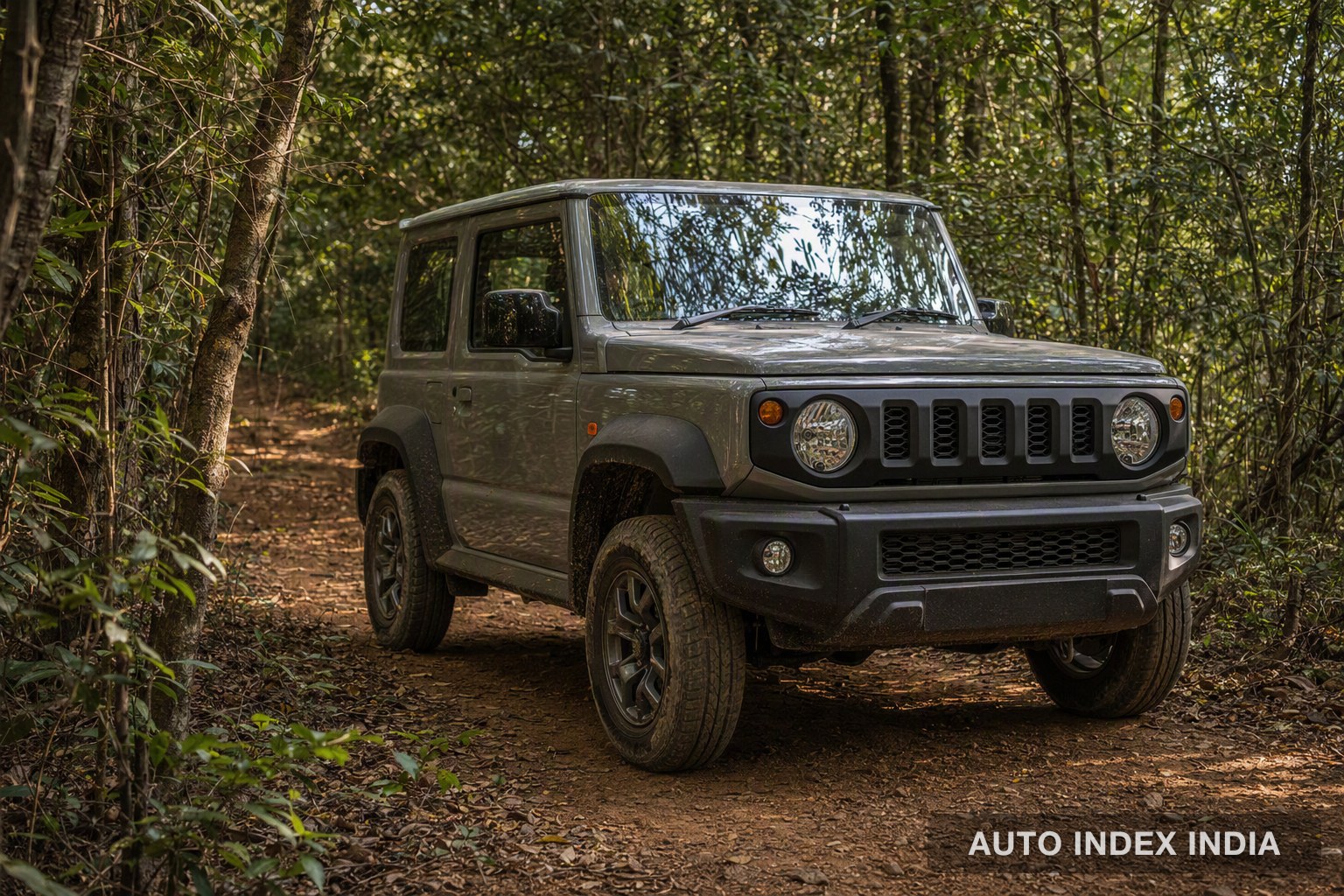
The Jimny is the accessible way into this category, and its five-door body is the single biggest practical difference on this list. Getting into the back of a Jimny means opening a door. Getting into the back of a Thar or a Gurkha means folding a front seat forward and climbing.
Off-road hardware. ALLGRIP PRO shifts from 2H to 4H on the move and adds a 4L low-range transfer gear. Brake LSD brakes a slipping wheel so torque crosses to the one with grip. Full-width rigid axles with coil springs sit at both ends. Ground clearance is 210 mm, with a 36-degree approach angle, a 46-degree departure angle and a 24-degree breakover angle. That departure angle is the best of the three by nine degrees.
Size and practicality. 3,985 mm long, 1,645 mm wide and 1,720 mm tall on a 2,590 mm wheelbase, with a 5.7 m turning radius. Boot space is 219 litres with the rear seatback in its first position, 211 litres in its second, and 332 litres with the rear seats folded. The fuel tank holds 40 litres, which is the Jimny's real limitation on a long route: at 16.94 km/l certified you are stopping more often than you would like.
Engine. The 1.5-litre K15B petrol makes 77.1 kW, stated by Maruti as 104.8 PS, at 6,000 rpm, with 134.2 Nm at 4,000 rpm and idle start-stop. A five-speed manual or a four-speed automatic, with 16.94 km/l and 16.39 km/l certified respectively.
Safety. Six airbags, ESP with hill hold and hill descent control, standard on every variant. This is where the Jimny pulls decisively ahead of both rivals.
2. Mahindra Thar
Price: 4WD variants from about Rs 15.60 lakh to about Rs 18.99 lakh. The wider range opens near Rs 10.32 lakh in rear-wheel-drive form, which is not a 4x4 and should not be compared with one.
The current three-door Thar, sold as the Thar OG, is the choice for a buyer who wants an off-roader that is also genuinely quick. It is the only car here with an automatic option on a diesel, and the only one with a petrol at all.
Off-road hardware. 4WD variants get a low-range transfer case, an electronic locking differential and Mud, Sand and Snow terrain modes. Ground clearance is 232 mm, with a 40-degree approach angle, a 36-degree departure angle, a 26.4-degree breakover angle and 650 mm of wading depth. The approach angle is the best of the three; the departure angle is the worst.
Size and practicality. 3,995 mm long on a 2,450 mm wheelbase, so it is 10 mm longer than the Jimny with 140 mm less between the axles, which is what gives it that strong breakover figure. As a three-door, rear-seat access and luggage space are both tighter than the Jimny's despite the Thar being the larger car overall.
Engine. A 2.0-litre turbo-petrol at 162 PS and 330 Nm, or a 2.2-litre diesel at 152 PS and 330 Nm, each with a six-speed manual or six-speed automatic. Either one has more than 50 percent more power than the Jimny and roughly two and a half times the torque.
Safety. ESP with rollover mitigation is standard. The airbag count is worth checking on whichever variant you are buying: lower trims get two, and six arrive only at the top ZXT trim. That is a wide spread on a car costing Rs 15 lakh and up.
3. Force Gurkha 3-door
Price: About Rs 16.25 lakh, with 4WD and low range standard.
The Gurkha is the least compromised off-roader and the most compromised car. It exists for people who regularly drive deep ruts, rock and water, and it makes no real attempt to be anything else.
Off-road hardware. Floor-mounted levers select 4x4 High and 4x4 Low. Mechanically actuated differential locks on both axles tie each axle's wheels together, which is what keeps it moving with a wheel entirely in the air. Neither rival has this. The Thar locks one axle electronically and the Jimny brakes individual wheels. Ground clearance is 233 mm, with a 39-degree approach angle, a 37-degree departure angle and a 28-degree breakover angle, the best breakover figure here. The roof-mounted snorkel takes wading depth to about 700 mm.
Size and practicality. 3,965 mm long on a 2,400 mm wheelbase, which makes it the shortest car here on both measures.
Engine. A 2.6-litre diesel that Force lists at about 140 PS and 320 Nm, with a five-speed manual and no automatic option.
Safety. Two airbags and a tyre-pressure monitoring system are standard. Against the Jimny's six airbags and ESP, this is the Gurkha's clearest weakness, and it is not a small one.
Which of the three
For a first off-roader, the Jimny. It is the cheapest, the easiest to place on a narrow track, the only one with five doors, and the only one with six airbags and hill descent control on every variant. Its 40-litre tank and 104.8 PS are the price of that.
For power and a usable automatic, the Thar 4WD. The petrol at 162 PS transforms what the car is like on the road to the trail, and the six-speed automatic makes it far easier to live with in traffic than the Gurkha will ever be. Check the airbag count on your variant before signing.
For the hardest routes, the Gurkha 3-door. Mechanical lockers on both axles and 700 mm of wading depth are hardware the other two do not have at any price near this. You give up an automatic gearbox, four airbags and any pretence of comfort.
For a daily driver that goes off-road at weekends, the Jimny automatic or the Thar automatic. The Gurkha's five-speed manual and its ride make it a difficult everyday proposition.
For more small off-roaders side by side, see the best compact 4x4 SUVs in India. If your budget can stretch, compare the best off-road SUVs under Rs 20 lakh and the SUVs with the best approach and departure angles.
Frequently asked questions
What is the cheapest four-seat SUV with 4WD in India?
The Maruti Suzuki Jimny Zeta PRO at Rs 12,59,000 ex-showroom, with 4WD and low range standard.
Is the Jimny really a four-seater?
Yes. Maruti's brochure lists seating capacity as four on every variant, despite the five-door body. The extra doors buy access, not seats.
Which of these has the best traction hardware?
The Force Gurkha 3-door, with mechanically actuated differential locks on both axles. The Thar uses an electronic locking differential on one axle, and the Jimny uses Brake LSD, which brakes individual wheels rather than locking them together.
Does the Thar come with 4WD and an automatic?
Yes, on both engines. The 2.0 turbo-petrol and the 2.2 diesel are each offered with a six-speed manual or a six-speed automatic in 4WD form.
Which has the most ground clearance?
The Gurkha at 233 mm, a millimetre ahead of the Thar at 232 mm, with the Jimny at 210 mm. More options appear among the SUVs with the highest ground clearance in India.
Are four-seat off-roaders practical for a family?
For a couple or a small family with light luggage, yes. With all four seats occupied the Jimny gives you 219 litres, which is roughly one large suitcase. A roof carrier stops being optional on longer trips.
Which is safest?
The Jimny, clearly. Six airbags, ESP, hill hold and hill descent control on every variant. The Thar's six airbags arrive only at the top trim, and the Gurkha has two.
Last verified: 2026-09-30