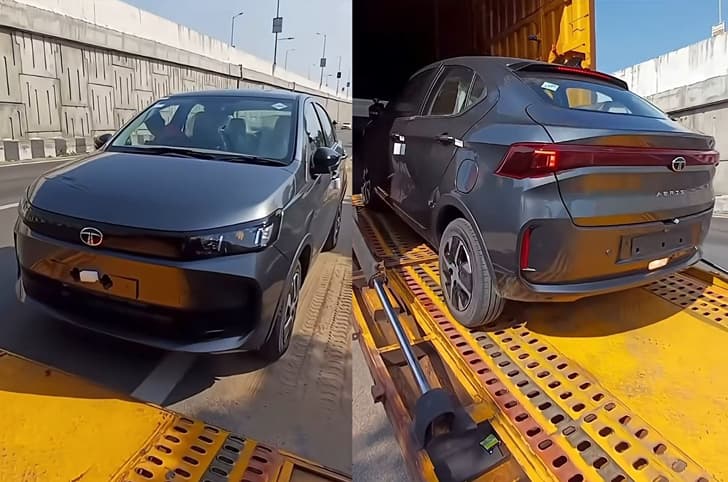

The Tata Aeris launches September 25, 2026, from ~₹6 lakh ex-showroom, replacing the Tigor with a Tiago-inspired redesign, iCNG powertrain, and a feature-rich cabin rivalling the Maruti Dzire.
The Tata Aeris is a substantially updated sub-4-metre notchback sedan that replaces the Tigor, launched on September 25, 2026, with an expected starting price of approximately ₹6.00 lakh (ex-showroom) for the petrol variant and an iCNG variant also available from launch day. It competes directly in the sub-4-metre compact sedan segment against the Maruti Dzire, Honda Amaze, and Hyundai Aura — a space where CNG running costs and feature-per-rupee value are the primary purchase drivers.
At-a-Glance Comparison: Tata Aeris vs Maruti Dzire vs Honda Amaze
| Specification | Tata Aeris (iCNG) | Maruti Dzire (CNG) | Honda Amaze (Petrol) |
|---|---|---|---|
| Expected Price (ex-showroom) | ~₹7.00–8.50 lakh (est.) | ₹7.89–9.39 lakh | ₹7.99–10.50 lakh |
| Engine | 1.2L NA, 3-cyl | 1.2L NA, 4-cyl | 1.2L NA, 4-cyl |
| CNG Output | 76hp / 97Nm | 77.5hp / 98.5Nm | Not available |
| Petrol Output | 86hp / 113Nm | 90hp / 113Nm | 90hp / 110Nm |
| ARAI Mileage (CNG) | ~TBA (Tigor iCNG: ~26.49 km/kg) | ~33.73 km/kg (ARAI) | N/A |
| Gearbox Options | 5-MT / 5-AMT | 5-MT / 6-AT | 5-MT / CVT |
| Airbags (standard) | 6 | 6 | 2 (base) |
| Touchscreen Size | 10.25-inch (expected) | 9-inch | 8-inch |
| Key Weakness | Unproven real-world CNG efficiency; AMT only (no torque-converter AT) | No AMT on CNG; AT only on petrol | No CNG option; pricier for features |
Prices are ex-showroom. Aeris pricing is expected/estimated at time of writing; Dzire and Amaze figures are current market prices. ARAI mileage figures are manufacturer claims.
What exactly is the Tata Aeris, and how does it differ from the Tigor?
While Tata Motors internally describes it as a new model, the Aeris is mechanically rooted in the Tigor's platform and powertrain — a nameplate in production since 2017 — making it closer in nature to a full facelift than an all-new vehicle. The company has reworked the sheet metal rather than simply swapping bumpers and lights, a level of investment that justifies the new nameplate.
The most visible changes appear up front. Autocar India's pre-launch feature confirms slim LED headlamps with a thin DRL strip, LED fog lamps (absent on the Tigor), and C-shaped design elements in the front bumper. The notchback roofline, shark-fin antenna, and roof spoiler with integrated stop lamp carry over from the Tigor, maintaining the silhouette that buyers in this segment recognise.
At the rear, the number plate has moved from the boot lid to the bumper — a subtle modern touch — and the tail-lamps adopt a sharper, connected design as revealed in Tata's design patent filings. The boot lid itself is sculpted differently, and the iCNG variant wears a prominent 'iCNG' badge alongside the Aeris lettering. A new purple colour option broadens the palette beyond what the Tigor offered.
What does the Aeris cabin look like, and how big an upgrade is it over the Tigor?
The interior makes the strongest case for a new nameplate. Based on leaked footage published by Autocar India, the cabin adopts a dual-tone theme with piano-black accents and a layered dashboard design borrowed from the updated Tiago. Two free-standing digital displays — a 10.25-inch touchscreen infotainment unit and a binnacle-less digital driver's display — dominate the fascia, replacing the Tigor's older, more conventional setup.
The steering wheel is Tata's new two-spoke design, already seen on the Tiago, and the centre console carries dual phone-storage trays and front cup holders. Rear passengers get individual headrests, three-point seatbelts, and an armrest — features that matter in a segment where the car often doubles as a family vehicle.
Expected feature highlights across variants include:
- Wireless Apple CarPlay and Android Auto
- Wireless charging pad
- Automatic climate control with rear AC vents
- 360-degree surround-view camera
- Connected car technology
- 6 airbags as standard across all variants
- ABS with EBD and ISOFIX anchors
The iCNG variant shown in leaked video — likely a mid-spec trim — already features powered ORVMs, steering-mounted controls, and a manually dimming IRVM, suggesting the base CNG specification is reasonably well-equipped. Higher trims are expected to add leatherette upholstery and a blind-view monitor, according to Autocar India's specifications preview.
The Maruti Dzire's top trim offers a sunroof — absent from the Aeris — and the Dzire's 6-speed automatic (torque-converter) on petrol variants delivers a smoother drive than the Aeris's 5-speed AMT. Buyers who prioritise a refined automatic gearbox over CNG savings should weigh this carefully.
What are the Aeris's engine and CNG powertrain options?
The Tata Aeris carries forward the Tigor's 1.2-litre, naturally aspirated, three-cylinder petrol engine. In petrol form, this unit produces 86hp and 113Nm of torque, paired with either a 5-speed manual or a 5-speed AMT.
The iCNG variant — most relevant to budget-conscious buyers — runs the same engine in bi-fuel mode, with output dropping to 76hp and 97Nm when running on CNG. This power reduction is standard across factory-fitted CNG cars and not unique to the Aeris; the Maruti Dzire CNG similarly produces around 77.5hp versus 90hp on petrol.
The Tigor iCNG, which the Aeris directly replaces, carried an ARAI-claimed CNG mileage of approximately 26.49 km/kg. The Aeris iCNG's official ARAI figure had not been published at the time of writing, but a comparable or marginally improved number is reasonable given the similar powertrain. For context, the Maruti Dzire CNG claims 33.73 km/kg (ARAI) — a meaningfully higher figure that reflects the Dzire's lighter kerb weight and more refined four-cylinder engine architecture. Real-world CNG mileage for both models typically falls 20–25% below ARAI claims in urban driving.
The AMT gearbox on the Aeris iCNG suits city commuters who want automatic convenience without the cost premium of a torque-converter. However, AMTs are known for their characteristic head-nod during low-speed gear changes, and the Aeris is unlikely to be an exception. Buyers who spend significant time in stop-and-go traffic should factor this in.
How does the Aeris's CNG running cost compare to the Dzire CNG and Maruti Swift?
Running cost is where CNG sedans make their strongest case, and the Aeris enters a segment where the Maruti Dzire has long been the benchmark. The Maruti Swift, while a hatchback rather than a sedan, is included here because many buyers in this price bracket consider both body styles interchangeably when CNG efficiency is the priority.
Using current CNG pump prices of approximately ₹75–80/kg in major Indian cities (prices vary by city and are subject to change):
Estimated running cost per 100 km (CNG, urban cycle, ~70% of ARAI):
- Tata Aeris iCNG: ~₹6.00/km (assuming ~18.5 km/kg real-world)
- Maruti Dzire CNG: ~₹4.80/km (assuming ~23.6 km/kg real-world, ARAI 33.73 km/kg)
- Maruti Swift CNG: ~₹5.20/km (ARAI ~32.85 km/kg; real-world ~23 km/kg)
These are estimates based on ARAI claims and standard real-world correction factors. Actual figures depend on driving conditions, city, and CNG pump prices at the time of refuelling.
The Dzire CNG's efficiency advantage is significant and stems from its four-cylinder engine, which inherently offers better NVH and combustion efficiency than the Aeris's three-cylinder unit. If pure running cost is the priority, the Dzire CNG remains the stronger choice. The Aeris's argument rests on a more modern interior, 6 airbags as standard (the Dzire base variant offers 2), and more aggressive pricing at the entry level.
The Maruti Swift, as a hatchback, does not offer a boot of comparable size to the Aeris or Dzire. Buyers who need the practicality of a notchback boot alongside CNG efficiency should stay within the sedan segment.
What is the Tata Aeris's expected price, and how does it stack up against rivals?
Tata Motors had not officially announced the Aeris's price at the time of writing (September 25, 2026 launch day), but Autocar India's pre-launch coverage pegs the expected range at ₹6.00–7.00 lakh (ex-showroom) for the base petrol variant. The outgoing Tigor was priced from ₹5.70 lakh to ₹9.10 lakh (ex-showroom), and the Aeris is expected to carry a modest premium over this given its feature upgrades.
Zee News's pre-launch report cited the Tigor's then-current range as ₹5.55 lakh to ₹8.84 lakh, providing a baseline for the Aeris's likely pricing trajectory.
For context:
- Maruti Dzire (petrol): ₹6.79–10.14 lakh (ex-showroom, approximate current range)
- Maruti Dzire (CNG): ₹7.89–9.39 lakh (ex-showroom, approximate)
- Honda Amaze: ₹7.99–10.50 lakh (ex-showroom, approximate)
- Hyundai Aura: ₹6.49–9.99 lakh (ex-showroom, approximate)
If Tata prices the Aeris iCNG below ₹8.50 lakh for its mid-spec variant, it will undercut the Dzire CNG meaningfully while offering more airbags and a larger touchscreen. That is the pricing sweet spot Tata is almost certainly targeting.
What safety features does the Aeris offer, and how does it compare to rivals?
Six airbags are confirmed as standard across all variants — a significant step up from the Tigor, which offered 6 airbags only on higher trims. The Honda Amaze offers only 2 airbags on its base variant, while the Maruti Dzire also offers 6 airbags but only from mid-spec trims upward.
Additional safety equipment confirmed or strongly expected on the Aeris includes:
- ABS with EBD (standard)
- Electronic Stability Control (ESC)
- ISOFIX child-seat anchors
- Hill-hold control (on AMT variants)
- 360-degree surround-view camera (higher trims)
The Aeris has not yet been submitted for Bharat NCAP testing at the time of writing. The Tigor, its predecessor, held a 4-star Bharat NCAP rating — a reasonable baseline expectation for the Aeris, though the updated structure and standard 6-airbag fitment could push it toward 5 stars. Buyers who prioritise crash-test ratings should wait for official Bharat NCAP results before committing. For reference on how safety ratings affect buying decisions in this segment, our guide on 5-star Bharat NCAP-rated cars in India provides useful context.
Should you wait for the Aeris or buy the Maruti Dzire now?
This is the question most buyers in this segment will be asking, and the honest answer depends on what you prioritise.
Buy the Maruti Dzire CNG now if:
- CNG mileage efficiency is your primary concern. The Dzire's ARAI claim of 33.73 km/kg is among the best in the segment, and its four-cylinder engine is smoother and more refined than the Aeris's three-cylinder unit.
- You want a proven, widely serviced product with an established resale value track record.
- You prefer a torque-converter automatic (available on the Dzire petrol) over an AMT.
Wait for or consider the Tata Aeris if:
- You want 6 airbags as standard from the base variant — a meaningful safety differentiator.
- A larger, more modern touchscreen (10.25-inch vs Dzire's 9-inch) and a digital driver's display matter to you.
- Tata's pricing comes in below the Dzire CNG at comparable trim levels, which is a real possibility.
- You value a more contemporary interior design and are comfortable with Tata's improving (but still maturing) service network.
The Aeris's weaknesses are real: its three-cylinder engine is inherently less refined than the Dzire's four-cylinder, its AMT is the only automatic option (no torque-converter), and its real-world CNG efficiency is likely to trail the Dzire. Tata's service network, while expanding, still lags Maruti Suzuki's in rural and semi-urban areas — a practical concern for buyers outside the top 30 cities.
What about the Tata Aeris EV — is it relevant for CNG buyers?
The Aeris EV is being launched simultaneously with the ICE version on September 25, 2026. It is expected to be offered with two battery options — a 19.2kWh pack priced from approximately ₹9.92 lakh (ex-showroom, Delhi) and a 24kWh pack from approximately ₹11.13 lakh — based on Autocar India's specifications listing.
This site covers petrol, diesel, CNG, and hybrid powertrains; the Aeris EV is mentioned here only as market context. For CNG buyers, the EV's pricing places it in a different budget bracket entirely, and it does not directly influence the ICE Aeris purchase decision. Tata may offer the Aeris EV with a Battery-as-a-Subscription (BaaS) scheme to lower upfront costs, as it has done with the Tiago EV — but even with BaaS, the monthly outgo structure differs from a CNG purchase.
What are the Aeris's key rivals, and where does each win?
The sub-4-metre sedan segment in India is defined as the category of notchback or three-box cars with an overall length under 4,000mm, qualifying for lower GST rates and excise benefits. The Aeris competes in this space against four main rivals:
Maruti Dzire: The segment leader by volume. Its four-cylinder engine, 33.73 km/kg CNG efficiency (ARAI), and Maruti's unmatched service network make it the default recommendation for most buyers. Its weakness is a less modern interior at equivalent price points and the absence of 6 standard airbags on base trims.
Honda Amaze: Defined by its refined 1.2-litre petrol engine and CVT automatic — the smoothest gearbox in the segment. It does not offer CNG, which is a significant gap for running-cost-sensitive buyers. Its interior quality is high, but it is priced at a premium.
Hyundai Aura: Offers both petrol and CNG options, with a claimed CNG efficiency of ~28.4 km/kg (ARAI). Its interior is modern and it offers a 1.0-litre turbo-petrol option for buyers who want performance. However, it lacks the feature density of the Aeris at equivalent pricing.
Tata Tigor (outgoing): The Aeris replaces this model. The Tigor iCNG claimed ~26.49 km/kg (ARAI). The Aeris improves on the Tigor in design, features, and safety equipment, but carries the same powertrain.
For buyers who spend significant time on highways and want the best combination of efficiency and refinement, the Dzire CNG remains the segment benchmark. For urban buyers who prioritise safety equipment and a modern cabin at a competitive price, the Aeris makes a compelling case — provided Tata's pricing is aggressive at launch.
If you're also evaluating automatic options in this budget, our guide on best automatic cars under ₹15 lakh in India covers the broader space, and our best AMT hatchbacks guide is useful if you're open to hatchbacks alongside sedans.
What should buyers watch for after the official launch?
Several details remain unconfirmed at the time of writing and will be critical to the Aeris's real-world value:
- Official ARAI CNG mileage figure. The Tigor iCNG's 26.49 km/kg is the baseline; any improvement will strengthen the Aeris's case against the Dzire.
- Variant-wise pricing. The entry price of ~₹6 lakh is expected for the base petrol. The iCNG mid-spec variant's price — likely the volume seller — will determine how aggressively Tata is pricing against the Dzire CNG.
- Bharat NCAP submission timeline. Six standard airbags are a strong foundation, but an official crash-test rating will be decisive for safety-conscious buyers.
- AMT availability on iCNG. The leaked footage confirms a manual iCNG variant; whether the AMT is offered on CNG (as it is on the Tigor iCNG) needs official confirmation.
- Warranty and service package. Tata has been competitive on warranty terms in recent years; any extended warranty or service plan bundled at launch will affect the total cost of ownership calculation.
The Tata Aeris enters a segment that Maruti Suzuki has dominated for years, and it does so with a genuinely updated product rather than a cosmetic refresh. Whether it can meaningfully dent the Dzire's volume leadership will depend on pricing discipline and real-world CNG efficiency — two factors that will become clear in the weeks following launch.
Sources
- Tata Aeris leaked in full ahead of launch | Autocar India
- All you need to know about Tata Aeris ahead of launch tomorrow | Autocar India
- Tata Aeris EV – Expected Price, Launch Date & Specs | Autocar India
- Tata Aeris set to launch on September 25: What to expect | Zee News
- Tata Aeris Leaked in Full Ahead of Official Launch: Everything You Need to Know | CarOnPhone
- Tata Motors – Official Site