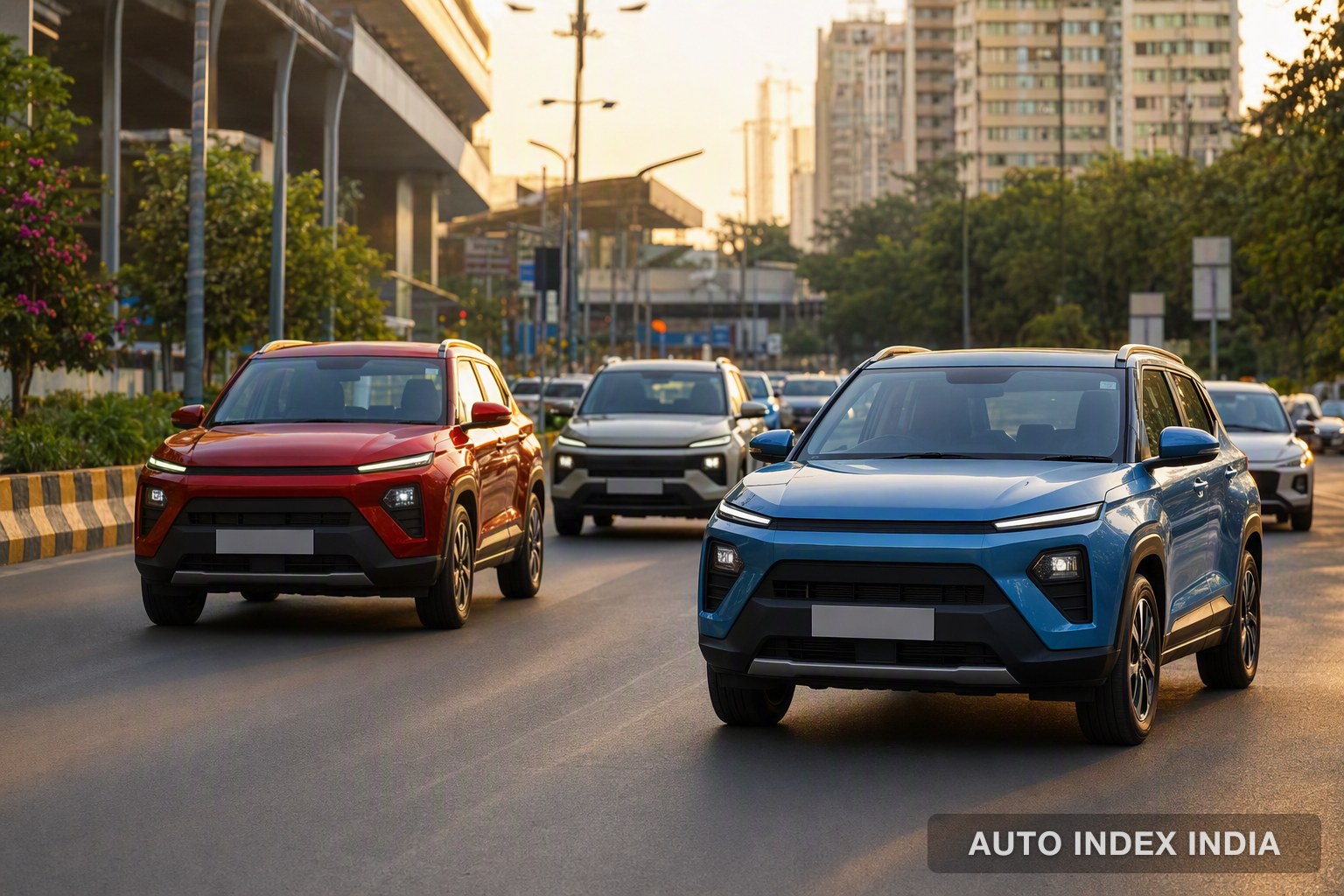

Tata Punch topped India's compact SUV segment in August 2026 with 21,320 units; Maruti Fronx ranked second at 18,730 units and Tata Nexon third at 18,431 units, in a segment that grew 40.88% year-on-year to 1,21,391 units.
India's sub-4-metre SUV segment covers compact sport utility vehicles under 4,000 mm in overall length. That length threshold, combined with an engine-size cap, puts these vehicles in a lower GST slab than longer SUVs, which is why this is the most price-competitive and highest-volume SUV class in the country. In August 2026, the segment recorded combined wholesale dispatches of 1,21,391 units, a 40.88% year-on-year surge from 86,169 units in August 2025. The Tata Punch held the top spot for the month, the Maruti Fronx came in second, and the Tata Nexon completed the podium.
The table below compares the six models that matter most to a buyer choosing in this segment right now, Punch, Fronx, Nexon, Venue, Sonet and XUV 3XO, on the numbers that actually drive purchase decisions.
| Model | Aug 2026 Sales | YoY Growth | Starting Price (ex-showroom) | Key Engine Options | ARAI Mileage (best claim) |
|---|---|---|---|---|---|
| Tata Punch | 21,320 units | +99.18% | ₹5.65 lakh | 1.2L NA petrol, 1.2L turbo petrol, CNG | 20.09 km/l (petrol); 26.99 km/kg (CNG) |
| Maruti Fronx | 18,730 units | +50.78% | ₹6.85 lakh | 1.2L petrol, 1.2L CNG, 1.0L turbo petrol (mild hybrid) | 21.79 km/l (1.2 petrol); 28.51 km/kg (CNG) |
| Tata Nexon | 18,431 units | +31.61% | ₹7.37 lakh | 1.2L turbo petrol, 1.5L diesel, CNG | 17.44 km/l (petrol); 23.23 km/l (diesel) |
| Hyundai Venue | 11,365 units | +40.15% | ₹8.00 lakh | 1.2L petrol, 1.0L turbo petrol, 1.5L diesel | 20.99 km/l (diesel MT) |
| Kia Sonet | 9,048 units | +16.88% | ₹7.34 lakh | 1.2L petrol, 1.0L turbo petrol, 1.5L diesel | 24.1 km/l (diesel) |
| Mahindra XUV 3XO | 8,302 units | +50.37% | ₹7.79 lakh | 1.2L turbo petrol, 1.5L diesel | 20.1 km/l (diesel) |
| Starting ex-showroom prices from manufacturer websites and brochures (Punch and Nexon per Autocar India), September 2026. Mileage figures are ARAI-certified manufacturer claims and will differ from real-world usage. |
How did each model perform in August 2026?
The Tata Punch / Punch EV combined for 21,320 units in August 2026, nearly doubling its August 2025 tally of 10,704 units, a 99.18% year-on-year gain. That gives it a 17.56% share of the entire sub-4-metre segment for the month. Month-on-month, sales held steady versus July's 21,313 units, suggesting the model has found a stable demand floor at around 21,000 units per month. Tata's mid-cycle update introduced a new turbo-petrol engine and improvements to ride and handling, and Punch EV sales are counted in the combined figure.
The Maruti Fronx ranked second with 18,730 units, up 50.78% from 12,422 units in August 2025. A 3.82% month-on-month slip from 19,473 units in July is worth noting for buyers tracking inventory availability and waiting periods. The Fronx's year-on-year trajectory remains solid: it ranked eighth overall among all passenger vehicles in India in the first half of 2026 with 95,441 units, sitting just behind the Baleno in Maruti's own lineup.
The Tata Nexon / Nexon EV came in third with 18,431 units, up 31.61% year-on-year and 5.49% month-on-month. The Nexon's full-year performance is formidable: it was India's bestselling SUV in FY2026 with 2,16,054 units, reclaiming the top spot after dropping to sixth in FY2025. August's numbers show the Nexon holding ground even as the Punch surges.
Further down, Maruti Brezza ranked fourth with 15,288 units, up 12.25% year-on-year and a sharp 26.82% month-on-month from 12,055 units in July, the strongest sequential recovery in the top five. Hyundai Venue posted 11,365 units, up 40.15% year-on-year and 2.43% month-on-month. Kia Sonet followed with 9,048 units, up 16.88% year-on-year. Mahindra XUV 3XO recorded 8,302 units, a healthy 50.37% year-on-year gain, though it fell 11.95% from 9,429 units in July.
Hyundai Exter posted 8,157 units, up 61.17% year-on-year and 19.78% month-on-month, one of the stronger sequential gains in the segment. Kia Syros recorded the highest percentage year-on-year growth of any model, jumping 465.58% from just 308 units in August 2025 to 1,742 units, aided by the arrival of its EV variant. Nissan Magnite managed 1,495 units (+8.02% year-on-year), while Maruti Jimny slipped 2.82% to 586 units and Renault Kiger posted the steepest decline at 474 units, down 47.91% year-on-year.
Why is the Maruti Fronx selling so strongly, and what are its real weaknesses?
The Maruti Fronx is a coupe-styled compact SUV built on the Baleno's platform and sold through Maruti's Nexa premium retail channel. Its appeal rests on Maruti's large service network, the 1.2-litre petrol's ARAI claim of 21.79 km/l (28.51 km/kg with factory CNG), and a coupe-like design that sets it apart from the more conventional Brezza. In August 2026, those factors translated into 18,730 units, enough to outsell every rival except the Punch.
The 1.2-litre petrol is the volume engine and posts the highest petrol ARAI claim in this comparison. The 1.0-litre turbo-petrol, which uses Maruti's Smart Hybrid mild-hybrid system, adds performance at a higher price. Buyers who want a diesel will not find one here: Maruti does not offer a diesel Fronx, which is a real gap for high-mileage drivers or buyers in markets where diesel economics still make sense.
The Baleno-derived platform keeps the Fronx car-like to drive. It rides well in town, but despite 190 mm of ground clearance it is not built for rough surfaces the way the Nexon or XUV 3XO are. Boot space of around 308 litres trails the Nexon's 382 litres. Maruti's service costs are low, but the Fronx's top variants command a premium that is hard to justify against the Nexon's broader powertrain menu.
The Fronx's FY2026 annual tally of 1,72,363 units placed it sixth in the overall SUV rankings, behind the Nexon (2,16,054), Creta (2,01,921), Punch (1,83,980), Brezza (1,80,104) and Scorpio (1,78,800). August 2026 was a strong month for it on a year-on-year basis.
How does the Tata Punch justify its segment leadership?
The Punch's position at the top of the August 2026 chart reflects sustained momentum. In H1 2026, the Punch sold 1,19,303 units to rank second overall among all passenger vehicles in India, separated from the top-placed Dzire by just 6,901 units. Its near-doubling of year-on-year sales in August comes from the updated ICE version with its new turbo-petrol engine and sustained demand for the Punch EV, though the ICE Punch is the relevant product for this comparison.
The ICE Punch is priced from ₹5.65 lakh to ₹10.60 lakh, the lowest entry point in this comparison by a meaningful margin. Its 5-star Bharat NCAP safety rating, segment-competitive ride quality, and CNG availability (with an ARAI claim of 26.99 km/kg) appeal to price-sensitive and efficiency-conscious buyers alike. The turbo-petrol variant provides performance headroom that the naturally aspirated 1.2-litre base engine cannot match.
The Punch does have genuine weaknesses. Interior quality, while improved in the update, still trails the Venue and Sonet on perceived premium feel. The naturally aspirated base engine can feel strained on highways. And bundling the Punch EV into reported figures means the ICE-only volume is somewhat lower than headline numbers suggest, which is relevant context when comparing like-for-like with petrol-only rivals.
What does the Nexon offer that the Fronx and Punch cannot match?
The Tata Nexon is the segment's most powertrain-diverse compact SUV, offering petrol, diesel, CNG and electric options under one nameplate. That breadth is a genuine differentiator. The ICE Nexon is priced between ₹7.37 lakh and ₹14.32 lakh, spanning a wide range that allows it to compete at both the entry and premium ends of the segment simultaneously.
The diesel Nexon's ARAI claim of 23.23 km/l is competitive, and the 1.5-litre diesel engine's real-world torque makes it practical for long-distance buyers. The 1.2-litre turbo petrol is offered with a 7-speed DCT automatic. ADAS was introduced on the top-spec Nexon during FY2026, a feature neither the Punch nor the Fronx offers across their range.
The Nexon's shortcomings are notable. Fit and finish has historically drawn criticism, and Autocar India noted explicitly in its FY2026 rankings that it "is not on par with some rivals." Service costs at Tata dealerships are generally higher than at Maruti outlets, and the Nexon's top-spec pricing at ₹14.32 lakh places it in a different conversation from where most buyers in this segment shop.
How do the Venue, Sonet and XUV 3XO stack up?
The Hyundai Venue's 11,365 units in August 2026 represent a 40.15% year-on-year gain, and the model benefits from Hyundai's strong brand perception for interior quality and feature content. The new-generation Venue, launched in November 2025, adds Level 2 ADAS and a 5-star Bharat NCAP rating. Offering a 1.0-litre turbo petrol, a 1.2-litre naturally aspirated petrol and a 1.5-litre diesel, the Venue appeals particularly to efficiency-focused buyers through its diesel option. The Venue's interior is widely regarded as the most premium-feeling in the sub-4-metre class, and its connected car features rank among the most comprehensive. Pricing is a weakness at the top of the range, where upper variants can feel expensive relative to the Nexon's feature-per-rupee ratio.
The Kia Sonet, at 9,048 units with 16.88% year-on-year growth, shares its platform and many features with the Venue but targets buyers who want a sportier design and a broader automatic transmission menu (iMT, DCT and torque converter options). Its diesel variant posts an ARAI claim of 24.1 km/l, the highest diesel efficiency figure in this comparison. The Sonet sits in a narrow band between the Venue (which has stronger brand pull) and the Nexon (which offers more powertrain variety), making its value proposition harder to articulate clearly.
The Mahindra XUV 3XO's 8,302 units reflect a 50.37% year-on-year improvement, though the 11.95% month-on-month dip from July's 9,429 units points to some volatility. The XUV 3XO is the most feature-rich model in the segment at its price point: panoramic sunroof, ADAS, and a 10.25-inch dual-screen setup are all available. Its 1.2-litre turbo petrol and 1.5-litre diesel engines are well-regarded. After-sales service network depth relative to Maruti and Hyundai remains a weakness, and some buyers report longer waiting periods for popular variants.
What does the OEM-level picture tell buyers about brand momentum?
Tata emerged as the clear segment leader in August 2026 with 39,751 units across Punch and Nexon combined, commanding a 32.75% market share, up 60.88% year-on-year. That two-model dominance is unusual: most OEMs rely on a single volume driver in this segment.
Maruti ranked second with 34,604 units across Fronx, Brezza and Jimny, holding a 28.51% share with 29.87% year-on-year growth. Maruti's multi-model presence, with the Fronx in Nexa and the Brezza in Arena, gives it coverage across different buyer profiles and income segments. Hyundai took third place with 19,522 units and a 16.08% share, up 48.23% year-on-year, driven by both the Venue and Exter.
Kia held an 8.89% share with 10,790 units (Sonet + Syros combined), while Mahindra's 6.84% share reflects the XUV 3XO's still-growing footprint. Renault was the only OEM to post a year-on-year decline in the segment, with the Kiger's 47.91% drop to 474 units pointing to a model struggling to find relevance in an increasingly competitive field.
SUVs as a category accounted for 56% of India's total passenger vehicle market in FY2026, with 26.3 lakh units sold. The sub-4-metre segment is the engine of that growth, and August 2026's 1,21,391-unit month is one of the strongest the segment has ever recorded.
Which model should a buyer shortlist, and on what criteria?
Choosing between these six models depends entirely on what the buyer values most, because no single model wins across all dimensions.
Start with entry price and safety ratings, and the Tata Punch stands alone at ₹5.65 lakh with a 5-star Bharat NCAP rating. No rival in this comparison matches that combination at the base level. The CNG variant adds long-run fuel cost efficiency with an ARAI claim of 26.99 km/kg. The trade-off is a more basic interior at lower trims and a naturally aspirated base engine that feels underpowered on expressways.
Prioritize fuel efficiency on petrol, and the Maruti Fronx's 1.2-litre engine leads among petrol options with its 21.79 km/l ARAI claim, while its factory CNG version claims 28.51 km/kg. Maruti's service network is the largest in India, keeping maintenance costs predictable. The Fronx has no diesel option, its 308-litre boot is smaller than the Nexon's, and its car-based platform is less suited to rough roads.
Value powertrain breadth, whether diesel, CNG, petrol turbo or automatic, and the Tata Nexon is the only model covering all four. Its FY2026 tally of 2,16,054 units as India's bestselling SUV reflects sustained demand across buyer types. Fit and finish trails the Venue and Sonet, and service costs exceed Maruti's.
Seek interior quality and feature content at a given price point, and the Hyundai Venue and Kia Sonet are the benchmarks. The Venue's interior is widely regarded as the most premium in the sub-4-metre class; the Sonet adds a sportier design and the highest diesel ARAI claim in the comparison at 24.1 km/l. Both command a premium over the Punch and Fronx at comparable trim levels.
Want features-per-rupee, and the Mahindra XUV 3XO offers a panoramic sunroof, ADAS and a dual-screen setup at prices undercutting similarly equipped Venue and Sonet variants. A thinner service network and some month-to-month sales volatility that can affect resale value perception are the trade-offs.
What are the trends to watch in the months ahead?
Several developments will shape this segment's rankings through the rest of 2026. The Maruti Brezza is the one to watch inside Maruti's own range. Its 26.82% month-on-month recovery in August 2026 could pull some upper-trim demand away from the Fronx, since both target buyers in the same price band.
The Kia Syros trajectory deserves close attention. Its 465.58% year-on-year growth to 1,742 units is partly a low-base effect from its August 2025 launch phase, but the EV variant's arrival is clearly adding volume. Should Syros sustain 2,000+ units per month, it will start meaningfully pressuring the Sonet's position within Kia's own lineup.
Renault's Kiger situation is the segment's clearest cautionary tale. A 47.91% year-on-year drop to 474 units in a segment that grew 40.88% overall means the Kiger is losing share at an accelerating rate. Without significant product intervention, it risks becoming irrelevant in a segment it once competed credibly in.
For the Fronx specifically, the month-on-month dip of 3.82% in August, while the segment as a whole grew 4.15%, is a minor flag. It is too early to call it a trend, but if the Brezza's recovery holds, some buyers at the upper end of the Fronx range may cross-shop it. Maruti's strength lies in its multiple models to absorb that demand internally, so the OEM-level share is unlikely to suffer even if individual model rankings shift.
The segment's 40.88% year-on-year growth rate in August 2026 is exceptional by any measure. SUVs already command 56% of India's passenger vehicle market, and the sub-4-metre class is where first-time SUV buyers and upgrading hatchback owners converge. That structural demand means the top three, Punch, Fronx and Nexon, are likely to remain the volume leaders for the foreseeable future, even as newer entrants like the Syros and a refreshed Brezza reshape the mid-table.
Sources
- Sub 4m SUV Sales Aug 2026 – Punch, Fronx, Nexon, Brezza, Venue, Sonet, XUV 3XO, Exter, Kylaq, Syros
- Tata Nexon tops SUV sales in FY2026 – Autocar India
- Best-selling cars in H1 2026: Maruti secures nine models in top 15 – Autocar India
- With 26.3 lakh units, SUVs continue to rule Indian car market with 56% share in FY26 – The Hindu BusinessLine
- Best-selling Tata Cars July 2026 – Spinny
- Maruti Fronx – Official Nexa Page
- Tata Punch (official)
- Hyundai Venue (official)
- Kia Sonet specifications (official)