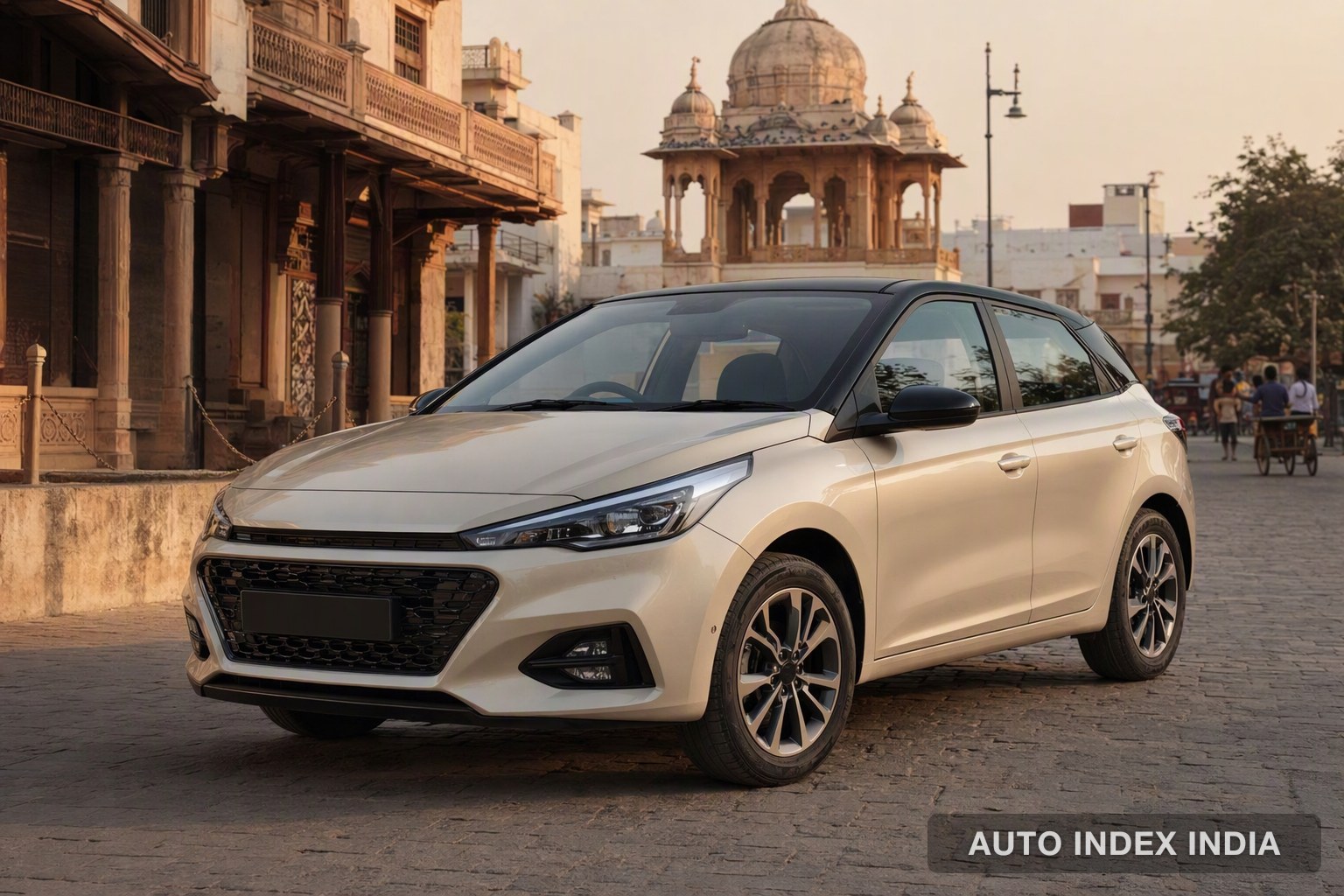
5 Most Stylish Hatchbacks Under Rs 10 Lakh in India (2026)
Design language rather than colour count separates a genuinely stylish hatchback from one that simply offers a lot of paint. The car with the boldest front end here has no dual-tone option at all, and the one with the most distinctive shape rides on the smallest wheels. No car on this list wins on every dimension, so the choice comes down to which element matters most.
Five hatchbacks under ₹10 lakh have genuine design intent rather than styling by spreadsheet. The Hyundai i20 is the only one whose dual-tone treatment carries into the cabin. The Citroen C3 has the most distinctive shape. And the Maruti Baleno, which makes the boldest single design statement here with its NEXWave grille, is the only car on the list with no dual-tone exterior option at all.
Sharper grilles, contrast roofs that used to belong to cars twice the price, diamond-cut alloys and cabins designed rather than merely assembled are all available at this budget now.
This list looks at five hatchbacks purely through design: exterior language, colour and dual-tone options, wheels and cabin aesthetics. Mechanical figures are covered for each, but the ranking logic is which car looks like more than its price suggests.
Key takeaways
- Maruti Baleno: the boldest single design element here and a genuinely upscale dual-tone cabin, but no dual-tone exterior paint at any trim.
- Tata Altroz: built on the same design language as Tata's larger SUVs, with a dual-tone exterior on higher trims and the largest wheels here at 16 inches.
- Hyundai i20: the only one where the dual-tone theme continues inside, with red cabin accents on those variants.
- Tata Tiago: a 2026 facelift brought a genuinely refreshed exterior, three new colours and an all-digital cabin.
- Citroen C3: the most distinctive silhouette here, SUV-inspired rather than conventional hatchback, though on the smallest wheels of the group.
The five compared
| Model | Price | Dual-tone exterior | Wheels | Cabin highlight |
|---|---|---|---|---|
| Maruti Baleno | ₹5.99L to ₹9.99L | None offered | Alloys on Alpha trims | Dual-tone cabin with piano black inserts |
| Tata Altroz | about ₹6.00L to ₹10.75L | On higher trims | 16-inch, the largest here | Sculpted dashboard |
| Hyundai i20 | about ₹6.00L to ₹10.68L | Two colours with black roof | Diamond-cut alloys on Asta | Red interior accents on dual-tone cars |
| Tata Tiago | about ₹4.77L to ₹7.91L | None offered | Alloys from Pure Plus | 10.25-inch screen, all-digital cluster |
| Citroen C3 | about ₹4.99L to ₹10.21L | Two combinations, black roof | 15-inch, the smallest here | SUV-inspired dashboard and stance |
| Where these numbers come from. The Baleno figures are read off Maruti's own current brochure, which prints the engine output and both mileage figures directly, with prices from the NEXA price page. Tata, Hyundai and Citroen do not publish comparable brochure specification tables in the same form, so those figures are the best available published numbers. |
What actually makes a hatchback look expensive
Styling here comes down to a few concrete things rather than a vague sense of looking nice.
Design language is the shape and character lines a brand commits to across its range, which is why a car sharing its design DNA with pricier siblings tends to read as more expensive than its badge.
Colour and dual-tone options matter because a contrasting roof is the simplest way a hatchback punches above its bracket, and how many colours a car offers at all says something about how seriously the styling was taken.
Wheel design and size affect stance more than almost any other single element, which is why they are treated here as a design data point rather than a specification.
Cabin aesthetics matter because that is the view an owner actually lives with, long after the exterior stops getting a second look.
1. Maruti Baleno
Price: ₹5.99 lakh to ₹9.99 lakh.
The Baleno's facelift commits to one confident statement rather than spreading itself across a wide palette. The NEXWave grille gives it the widest, most assertive front here, and the cabin backs it up rather than reverting to budget-hatchback plastics.
Design: NEXWave grille with a chrome strip across the full width; LED projector headlamps with LED daytime running lights and three-point matrix tail lamps; chrome fender garnish and shark-fin antenna; dual-tone cabin with piano black inserts, sculpted wrap-around front seats and leatherette upholstery higher up; seven exterior colours.
Features: Head-Up Display and 360 View Camera on the Alpha(O), wireless charging with active cooling, ventilated front seats, 17.78 cm touchscreen with wireless smartphone mirroring.
Engine: 1.2-litre three-cylinder petrol, 61 kW (82.93 PS) and 112.4 Nm.
Mileage: 23.80 km/l on the manual and 24.77 km/l on the AMT.
Boot space: 318 litres.
Where it falls short: the Baleno is the only car here with no dual-tone exterior scheme at any trim, a real gap in a segment where a contrasting roof has become the easiest way to stand out.
2. Tata Altroz
Price: about ₹6.00 lakh to ₹10.75 lakh across petrol, diesel and CNG.
The Altroz was designed from the ground up on the same language Tata uses on its larger SUVs, which is much of why it has long been described as the segment's design benchmark. It is also the only car here offered with a diesel engine, which reinforces its more grown-up positioning.
Design: shared design language with Tata's larger models; dual-tone exterior on select higher trims; five monotone colours; 16-inch alloys on higher trims, the largest wheels here.
Features: 10.25-inch touchscreen with a 360-degree camera higher up, a dual-clutch automatic option and a diesel engine, both uncommon in this segment.
Engine: about 86.7 PS and 113 Nm from the 1.2-litre naturally aspirated petrol.
Mileage: about 19.33 km/l on the petrol manual.
Boot space: about 345 litres, the largest here.
Where it falls short: the dual-tone option and the dual-clutch trims push the Altroz to the edge of, and in one case past, ₹10 lakh, so the most visually complete version is not always available within this budget.
3. Hyundai i20
Price: about ₹6.00 lakh to ₹10.68 lakh.
The i20 is widely read as the most premium-looking hatchback in its class, and it is one of very few cars at this price where the dual-tone treatment goes past the roof and into the cabin itself. Its sharper lines and more grown-up proportions are a deliberate step on from its own predecessor.
Design: dual-tone exterior in two colours, each with a black roof; those variants carry the theme inside with red cabin accents; diamond-cut alloys on the top Asta trim; five exterior colours in total.
Features: sunroof on higher trims, wireless smartphone mirroring, cruise control and rear AC vents higher up.
Engine: about 83.14 PS and 114.7 Nm on the manual, about 88.21 PS on the automatic, from the 1.2-litre petrol.
Boot space: about 311 litres.
Where it falls short: the dual-tone treatment, its strongest styling argument, is limited to two of its five colours, and the most complete combinations sit close to or past ₹10 lakh.
4. Tata Tiago
Price: about ₹4.77 lakh to ₹7.91 lakh following its 2026 facelift.
The Tiago's refresh is a genuine design update rather than a badge-and-sticker exercise, bringing a more youthful exterior, three new colours and a cabin that finally looks current.
Design: refreshed front end as part of the 2026 facelift; three new colours introduced with it; six colours in total, though the full palette is reserved for Pure Plus and above; a redesigned cabin with a 10.25-inch touchscreen, fully digital cluster and paddle shifters on AMT variants.
Features: wireless smartphone integration and charging, automatic climate control with rear vents, cruise control higher up.
Engine: about 85 PS and 113 Nm from the 1.2-litre petrol.
Boot space: about 242 litres, the smallest here.
Where it falls short: no dual-tone exterior at any trim, and the boldest new colours are reserved for Pure Plus and above rather than the cheaper variants that make up most of its range.
5. Citroen C3
Price: about ₹4.99 lakh to ₹10.21 lakh.
The C3 does not try to look like a conventional hatchback at all. Its SUV-inspired stance, raised ride height and boxier proportions set it apart from everything else here, and its dual-tone combinations lean into that rather than following the segment playbook.
Design: SUV-inspired proportions, a deliberate departure from the hatchback silhouette; two dual-tone combinations with a black roof; five monotone colours; 15-inch wheels.
Features: a 315-litre boot, a 6-speed automatic on the top turbo trim, and higher ground clearance than most rivals here.
Engine: about 80.46 PS and 115 Nm on the naturally aspirated 1.2-litre; about 108.62 PS and 205 Nm on the turbo.
Boot space: about 315 litres.
Where it falls short: the 15-inch wheels are the smallest here, which mutes the visual impact of an otherwise distinctive stance, and the dual-tone choice is limited to two combinations.
Conclusion
Design language, not colour count, separates a genuinely stylish hatchback from one that simply offers a lot of paint. The car with the boldest single statement here has no dual-tone exterior at all, and the one with the most distinctive shape rides on the smallest wheels. No car on this list wins on every dimension.
For a buyer who wants design DNA shared with genuinely larger, pricier models, the Altroz makes the clearest case. For one who wants the dual-tone theme to continue inside the car, the i20 does that better than anything else here. And for a buyer who simply does not want a hatchback that looks like every other hatchback, the C3 is the obvious answer.
FAQs
Which hatchback under ₹10 lakh has the most dual-tone options?
The Tata Altroz and Hyundai i20 both offer dual-tone paint on select trims. The i20 is the only one carrying the theme into the cabin, with red interior accents on those variants.
Which of these has no dual-tone exterior at all?
The Maruti Baleno and Tata Tiago. Both offer distinctive design elsewhere, the Baleno through its grille and cabin and the Tiago through its 2026 colour palette.
Which has the most striking shape?
The Citroen C3, with an SUV-inspired stance, raised ride height and boxier proportions that set it apart from every other silhouette here.
Does wheel size actually change how a hatchback looks?
Yes, wheel size and design have an outsized effect on stance. The Altroz's 16-inch alloys are the largest here and the C3's 15-inch wheels the smallest, which is one reason the C3's distinctive shape does not always translate into an equally strong stance.
Which has the largest boot of these five?
The Tata Altroz at about 345 litres, ahead of the Citroen C3 at about 315 and the Maruti Baleno at 318.
Last verified: 2026-09-30