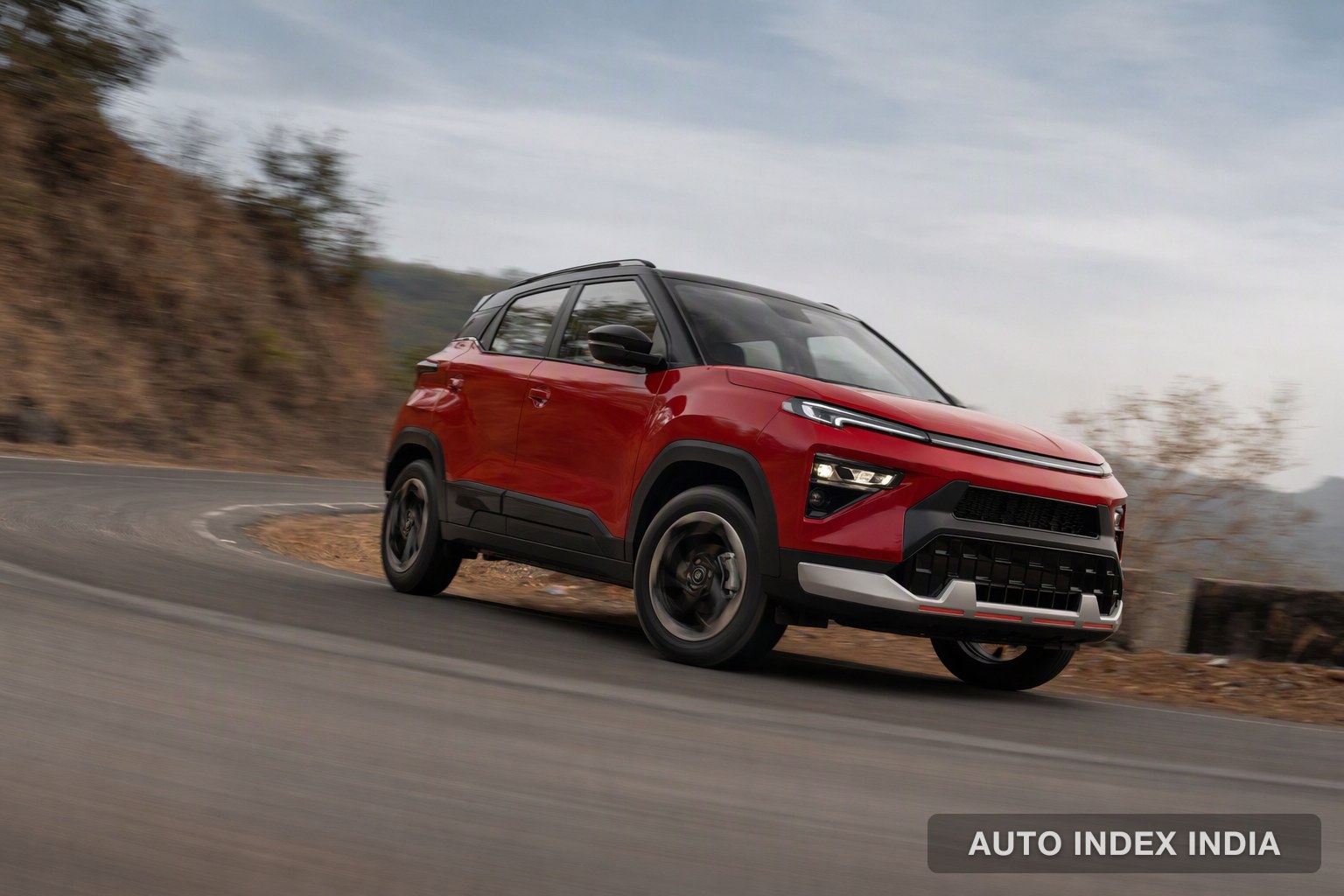
5 Sportiest Compact SUVs Under Rs 12 Lakh in India (2026)
A turbo badge alone does not make a car sporty. What matters is the gearbox, whether a Sport mode genuinely changes throttle mapping, and whether the styling backs it up. The cheapest car here carries the same 118 PS tune as trims costing Rs 2 lakh more, giving up only alloy wheels and ADAS. The Fronx is the only one with a manufacturer's own acceleration figure, though it has no confirmed India-spec crash rating.
Five compact SUVs under ₹12 lakh make a genuine case on driving enjoyment rather than mileage or boot space, and all five use a turbocharged engine. The Maruti Fronx Alpha AT is the only one with a factory-claimed acceleration figure, 5.3 seconds to 60 km/h. The Hyundai Venue N Line and Kia Sonet HTX Turbo DCT tie for the highest output at about 118 bhp, and the Tata Nexon Pure+ is the cheapest way to that same power tier at about ₹9.72 lakh.
A turbo badge alone does not make a car sporty. What matters is whether the power arrives with a gearbox built to use it, a drive mode that genuinely changes throttle response rather than relabelling the same tune, and styling that backs the claim up. Every price below is for the specific trim discussed, not the model's range, because the highest-output trims of several of these cars cost more than ₹12 lakh.
Key takeaways
- Maruti Fronx (Alpha AT): the only car here with an official factory acceleration claim, and a 6-speed torque-converter automatic with paddle shifters.
- Hyundai Venue N Line (N6 DCT): the most deliberately sport-tuned car here, a distinct sub-brand with its own exhaust, gearbox calibration and styling.
- Kia Sonet (HTX Turbo DCT): matches the Venue N Line's output and adds a sunroof and Level 1 ADAS, but has no confirmed India-spec crash rating.
- Tata Nexon (Pure+ PS): the cheapest route to the full 118 PS tune, with a genuine Sport drive mode and a 5-star Global NCAP rating.
- Nissan Magnite (Tekna Plus Turbo CVT): the least powerful here, but backed by a 5-star Global NCAP result earned after six airbags and stability control became standard.
The five compared
| Model (trim) | Engine and output | Gearbox | Price |
|---|---|---|---|
| Tata Nexon (Pure+ PS) | 1.2 turbo, 118 PS / 170 Nm | 6-speed MT | about ₹9.72 lakh |
| Nissan Magnite (Tekna Plus Turbo CVT) | 1.0 turbo, 99 PS / 152 Nm | CVT | about ₹10.99 lakh |
| Hyundai Venue N Line (N6 DCT) | 1.0 turbo GDi, 118 bhp / 172 Nm | 7-speed DCT | about ₹11.56 lakh |
| Kia Sonet (HTX Turbo DCT) | 1.0 turbo GDi, 118 bhp / 172 Nm | 7-speed DCT | about ₹11.75 lakh |
| Maruti Fronx (Alpha AT) | 1.0 Turbo Boosterjet, 100.06 PS / 147.6 Nm | 6-speed AT | about ₹11.89 lakh |
| Where these numbers come from. The Fronx output, mileage and trim availability are read off Maruti's own current brochure, with the price from the NEXA price page. Tata, Nissan, Hyundai and Kia do not publish comparable brochure specification tables, so those figures are the best available published numbers. |
What actually makes one of these feel quick
A turbocharged engine is the starting point, since it is what separates a genuinely brisk compact SUV from one that only looks the part. But output alone does not decide it.
A dual-clutch or torque-converter automatic with paddle shifters lets a driver hold a gear rather than having the car upshift for economy. A dedicated Sport mode that alters throttle mapping does more for the feel of a car than another 10 PS. And styling cues, twin-tip exhausts, contrast trim, unique wheels, matter as a finishing touch rather than a substitute for the mechanical case.
On that basis the ranking here is not simply by horsepower, which is why the most powerful cars are not automatically at the top.
1. Maruti Fronx, Alpha AT
Price: about ₹11.89 lakh for the Alpha automatic, or about ₹12.03 lakh in dual tone. The Alpha manual is about ₹10.61 lakh.
The Fronx is the only car here with an official factory acceleration claim: Maruti's brochure quotes 5.3 seconds from 0 to 60 km/h for the 1.0-litre Turbo Boosterjet. That is a different metric from the 0 to 100 figures usually quoted, so it is not directly comparable to rivals, but it is at least a manufacturer's own number rather than a road test.
Engine: 1.0-litre Turbo Boosterjet with Smart Hybrid assistance, 100.06 PS at 5,500 rpm and 147.6 Nm from 2,000 to 4,500 rpm.
Sporting equipment: 6-speed torque-converter automatic with paddle shifters, precision-cut alloy wheels, connected LED tail lamp, 22.86 cm SmartPlay Pro+ touchscreen with wireless smartphone mirroring.
Mileage: 20.01 km/l on the automatic, 21.5 km/l on the manual.
Safety: 6 airbags standard with ESP and hill-hold assist. There is no Bharat NCAP or Global NCAP result for the India-spec Fronx. A Japan-market car scored 4 stars under Japan NCAP and an Australasian-market car scored 1 star, and the two disagree sharply, so neither describes the Indian car.
Where it falls short: no ADAS at any Fronx trim, no sunroof at any price, no confirmed India-spec crash rating, and at 308 litres the boot is on the small side for the segment.
2. Hyundai Venue N Line, N6 DCT
Price: about ₹11.56 lakh.
The Venue N Line is the most deliberately built-for-purpose car here. It is not the standard Venue with a turbo engine but a separate sub-brand with its own exhaust, gearbox calibration and styling. The N6 is the entry to the dual-clutch automatic and stays under the ceiling, while the range-topping N10 DCT climbs well past it.
Engine: 1.0-litre Kappa turbo GDi three-cylinder, about 118 bhp at 6,000 rpm and 172 Nm from 1,500 to 4,000 rpm, with a 7-speed dual-clutch automatic.
Sporting equipment: twin-tip exhaust, paddle shifters, selectable drive modes, N Line styling with red accents and unique wheels.
Mileage: about 20 km/l.
Safety: 6 airbags standard with a 5-star Bharat NCAP rating.
Where it falls short: the fuller ADAS suite and several cabin features sit on the N10 DCT well above ₹12 lakh, so this trim's technology list is leaner than the nameplate suggests.
3. Kia Sonet, HTX Turbo DCT
Price: about ₹11.75 lakh.
The Sonet's range-topping GTX+ pairs this engine with a dual-clutch automatic at a price well past this ceiling. The HTX Turbo DCT carries the identical engine and gearbox one trim down, without the GTX+ extras, and clears ₹12 lakh.
Engine: 1.0-litre turbo-petrol, about 118 bhp at 6,000 rpm and 172 Nm from 1,500 to 4,000 rpm, with a 7-speed dual-clutch automatic.
Sporting equipment: single-pane sunroof, 8-inch touchscreen with wireless smartphone mirroring, Level 1 ADAS covering forward collision and lane departure warnings.
Mileage: about 18.4 km/l.
Safety: 6 airbags and stability control standard. There is no confirmed Bharat NCAP or Global NCAP rating for the India-spec Sonet. A South Africa-built export version scored 1 star under Global NCAP, but that is a different market's specification and build and should not be read as the Indian car's rating.
Where it falls short: no independently confirmed crash-test result for the car sold here, and the fuller-featured GTX+ costs more than this list's ceiling.
4. Tata Nexon, Pure+ (PS)
Price: about ₹9.72 lakh, the cheapest car here by a clear margin.
The Nexon's most powerful trims with the full feature set run past ₹12 lakh once alloys, ADAS or the cosmetic packages are added. The Pure+ is not a detuned entry variant, though: it carries the identical 118 PS turbo engine as those pricier trims, which makes it the cheapest route into this list's full power tier.
Engine: 1.2-litre three-cylinder turbo-petrol, about 118 PS at 5,500 rpm and 170 Nm from 1,750 to 4,000 rpm. The 260 Nm figure often quoted for the Nexon belongs to its 1.5-litre diesel, which makes about 115 PS.
Sporting equipment: selectable Eco, City and Sport drive modes, voice-assisted panoramic sunroof, automatic climate control.
Mileage: about 17.44 km/l.
Safety: 6 airbags standard with a 5-star Global NCAP rating.
Where it falls short: no ADAS at this trim, and it rides on steel wheels with covers rather than alloys, unlike every other car here.
5. Nissan Magnite, Tekna Plus Turbo CVT
Price: about ₹10.99 lakh.
The Magnite is the most affordable automatic here, and that shows most in outright output. It earns its place as a genuine turbo automatic with real sporting touches rather than on pace.
Engine: 1.0-litre turbo-petrol three-cylinder, about 99 PS at 5,000 rpm and 152 Nm from 2,200 to 4,400 rpm, with a CVT.
Sporting equipment: 360-degree camera, 16-inch alloys, LED daytime running lights and projector headlamps.
Mileage: about 17.9 km/l.
Safety: 6 airbags and stability control standard, with a 5-star Global NCAP rating earned after Nissan made six airbags and stability control standard across the range, upgrading an earlier 2-star result.
Where it falls short: the least powerful car here, and this trim skips both a sunroof and ADAS, which most rivals offer at a similar or lower price.
Conclusion
The two strongest cases for sportiness are the car with a factory acceleration claim and a paddle-shift automatic, and the one built as a dedicated performance sub-variant rather than a turbo engine dropped into a regular trim. The car matching that output and adding ADAS is let down by one gap: no confirmed India-spec crash rating.
The value pick is clear. The cheapest car here carries the same 118 PS tune as trims costing ₹2 lakh more, with a genuine Sport mode and a proven 5-star result, giving up only alloy wheels and ADAS to get there. The most affordable automatic trades away power, a sunroof and ADAS in exchange for its price.
FAQs
Which is the quickest compact SUV under ₹12 lakh?
The Maruti Fronx is the only one with an official factory figure, 5.3 seconds from 0 to 60 km/h. The Venue N Line and Sonet both make more peak power at about 118 bhp against the Fronx's 100.06 PS, but neither manufacturer publishes an acceleration time for these trims.
Does the Maruti Fronx have a crash-test rating?
Not for the India-spec car. Neither Bharat NCAP nor Global NCAP has published a result for it. A Japan-market Fronx scored 4 stars under Japan NCAP and an Australasian-market car scored 1 star, and neither describes the Indian model.
What is the Kia Sonet's NCAP rating?
The India-spec Sonet has no confirmed Bharat NCAP or Global NCAP rating. A South Africa-built export version scored 1 star under Global NCAP, on a different specification from the car sold here.
Which car here has the best crash-test rating?
The Hyundai Venue N Line holds a 5-star Bharat NCAP rating, and the Tata Nexon and Nissan Magnite both hold 5-star Global NCAP results.
What is the cheapest genuinely quick compact SUV under ₹12 lakh?
The Tata Nexon Pure+ at about ₹9.72 lakh, the cheapest trim carrying the full 118 PS turbo engine and a Sport drive mode.
Last verified: 2026-09-29