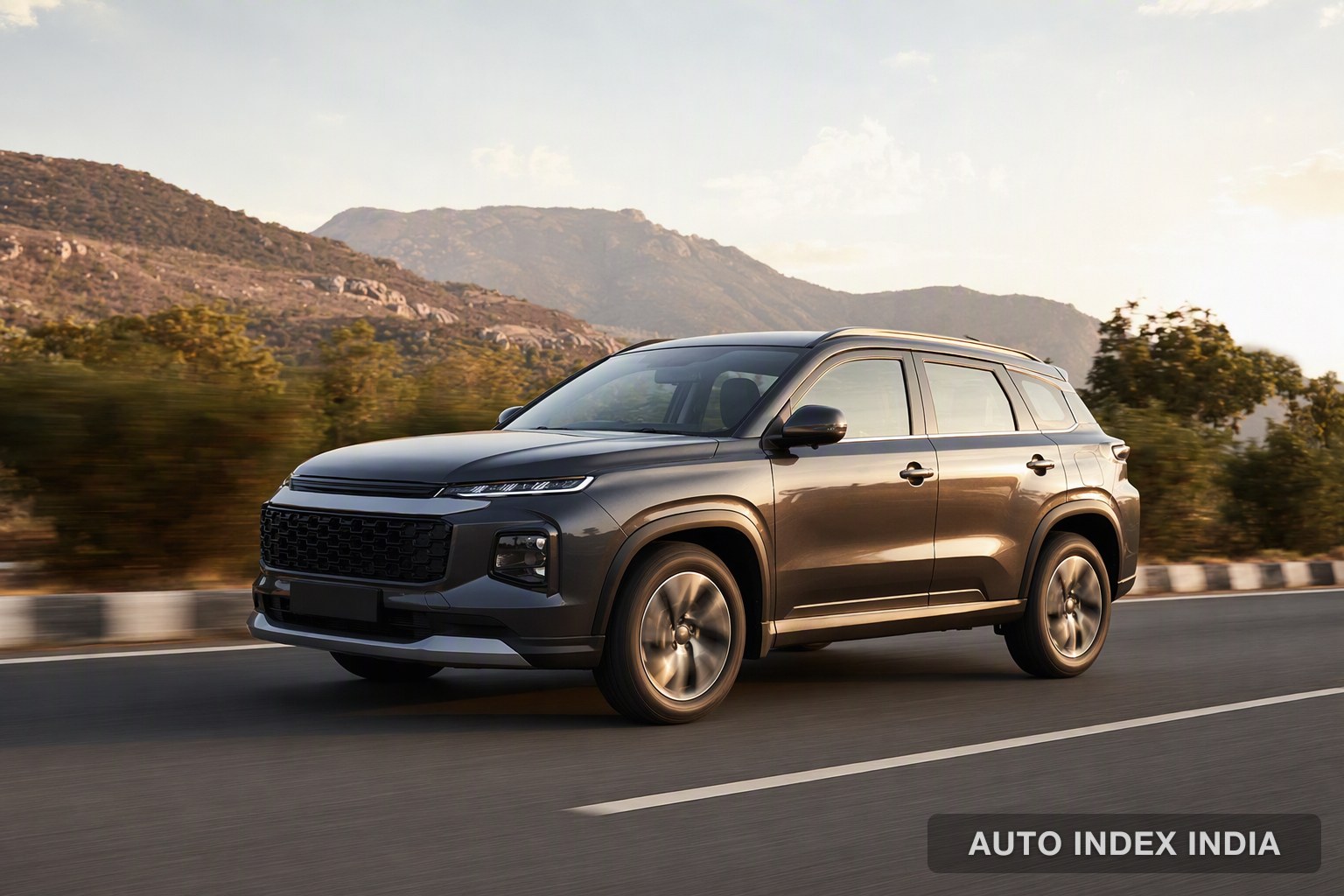
6 Most Fuel-Efficient Mid-Size SUVs in India (2026)
Strong hybrids hold a clear advantage over diesel and petrol in this segment, and the two closely related Maruti platform-mates are separated by just 0.68 km/l. On both diesels here the manual gearbox beats the automatic, the opposite of the petrol CVT at the bottom of the list. The trade-offs sit around the mileage rather than in it: one hybrid has no confirmed crash rating, and the non-hybrid with the best safety credential does not match the hybrids on running cost.
The most fuel-efficient mid-size SUV in India is the Maruti Victoris Strong Hybrid at 28.65 km/l. The Grand Vitara and Toyota Hyryder tie at 27.97 km/l on the same jointly developed system. Below the hybrids, the best non-hybrid figure belongs to the Hyundai Creta diesel manual at about 21.8 km/l, and the spread across this list runs to nearly 12 km/l.
Efficiency in this segment now spans strong hybrids that run partly on electricity, diesels that still post solid numbers, and a petrol automatic at the bottom. That range is wide enough to change what a car costs to run over several years.
This ranks six mid-size SUVs purely by certified mileage, using whichever trim and transmission delivers the best figure.
How the figures are measured
Every number is the manufacturer's ARAI-certified mileage, the official Indian test-cycle figure printed on the car's efficiency label. These are measured under controlled conditions and run higher than real-world use, but they are the only standardised basis for comparing across brands and powertrains.
Where a model offers the same engine with several transmissions, the higher certified figure is used. The trim named against each entry is chosen for its mileage rather than its price or equipment, so it may not be the version most buyers actually purchase.
Key takeaways
- Maruti Victoris, 28.65 km/l: the best figure in the segment, on the cheapest trim carrying its hybrid powertrain.
- Grand Vitara and Hyryder tie at 27.97 km/l, sharing the same system, so price and badge separate them rather than efficiency.
- Hyundai Creta, about 21.8 km/l: the best non-hybrid here, and the only diesel on this list clearing 20 km/l.
- On both diesels here the manual beats the automatic, the opposite of the pattern on the petrol CVT at the bottom of the list.
- Honda Elevate, about 16.92 km/l: the least efficient, and the only one with neither a diesel nor a hybrid option.
Six mid-size SUVs ranked
| Model (trim) | Mileage | Price | Powertrain | Transmission |
|---|---|---|---|---|
| Maruti Victoris (VXi Strong Hybrid) | 28.65 km/l | ₹16.43 lakh | Strong Hybrid | e-CVT |
| Maruti Grand Vitara (Delta+ Strong Hybrid) | 27.97 km/l | about ₹16.68 lakh | Strong Hybrid | e-CVT |
| Toyota Hyryder (Hybrid) | 27.97 km/l | about ₹19.99 lakh | Strong Hybrid | e-CVT |
| Hyundai Creta (E diesel) | about 21.8 km/l | about ₹12.61 lakh | Diesel | 6-speed MT |
| Kia Seltos (HTE diesel) | about 19.4 km/l | about ₹12.94 lakh | Diesel | 6-speed MT |
| Honda Elevate (V CVT) | about 16.92 km/l | about ₹13.43 lakh | Petrol | CVT |
| Where these numbers come from. The Victoris and Grand Vitara figures are read off Maruti's own current brochures and the Hyryder's off Toyota's specification sheet, with the Victoris price from the Arena price page. Toyota publishes no ex-showroom prices in India. Hyundai, Kia and Honda do not publish comparable brochure specification tables broken out by trim, so those figures are the best available published numbers. Maruti publishes no boot volume for the Victoris or Grand Vitara. |
1. Maruti Victoris, 28.65 km/l
Price: ₹16.43 lakh for the VXi Strong Hybrid, the cheapest trim carrying the powertrain.
The Victoris posts the best certified figure of any mid-size SUV sold here, and does it without requiring a loaded trim. Its hybrid pairs a 1.5-litre petrol engine with an electric motor and a lithium-ion battery, letting the car run on electricity alone at low speeds and in stop-start traffic, which is where most of its advantage over a conventional petrol or diesel actually comes from.
How it gets there: the engine works with a 59 kW electric motor and a 177.6-volt battery, switching between electric, petrol and combined operation automatically. Drive modes cover Eco, Normal and Power. Combined system output is 85 kW (115.56 PS), with the engine alone making 92.45 PS and 122 Nm and the motor contributing 141 Nm, all managed through an e-CVT with no fixed gear steps.
Safety: 6 airbags standard with stability control. 5-star Bharat NCAP at 31.66 of 32 for adult occupant protection and 43 of 49 for child, plus a separate 5-star Global NCAP result.
Where it falls short: Maruti publishes no boot volume for the Victoris in any variant, and the hybrid's advantage narrows on sustained highway running where the motor contributes less. No ADAS is offered on the Strong Hybrid at any price.
2. Maruti Grand Vitara, 27.97 km/l
Price: about ₹16.68 lakh for the Delta+ Strong Hybrid.
The Grand Vitara shares its hybrid system with the Victoris and the Hyryder, all three built on the same platform under a joint Suzuki and Toyota programme. Its certified figure sits fractionally below the Victoris despite the close mechanical relationship.
How it gets there: the 1.5-litre hybrid engine produces 68 kW (92.45 PS) at 5,500 rpm on its own, working with a 59 kW motor for a combined 85 kW (115.56 PS). Like the Victoris it can run on electricity alone at low speed, switching modes automatically.
Safety: 6 airbags standard with stability programme and hill-hold assist. No confirmed Bharat NCAP or Global NCAP rating.
Where it falls short: no confirmed crash-test rating despite years on sale, and no ADAS on any trim in any fuel. Maruti publishes no boot volume for it, so any figure quoted for the hybrid's reduced luggage space is reported rather than official.
3. Toyota Urban Cruiser Hyryder, 27.97 km/l
Price: about ₹19.99 lakh, dealer-listed since Toyota publishes no ex-showroom prices in India.
The Hyryder matches the Grand Vitara exactly because the two share a platform, an engine and a production line. The main difference is price: the hybrid grade costs meaningfully more than the Grand Vitara's cheapest hybrid trim for the same mechanical efficiency.
How it gets there: a 1.5-litre Atkinson-cycle petrol engine making 68 kW (92.45 PS) and 122 Nm on its own works with an electric motor through an e-CVT for a combined 85 kW (115.56 PS), prioritising electric drive at low speeds exactly as its Maruti siblings do.
Safety: 6 airbags. The last published result is a 4-star adult and 3-star child Global NCAP rating from 2022, under an older protocol that predates the current six-airbag specification.
Where it falls short: priced well above its platform-mate for the same mileage and largely the same package, with no current crash-test rating and no ADAS on any variant.
4. Hyundai Creta, about 21.8 km/l
Price: about ₹12.61 lakh for the E diesel manual.
The Creta is the most efficient non-hybrid here, and its diesel returns better certified mileage on the manual than on the automatic. A torque-converter automatic does not automatically mean better efficiency on a diesel. It is also the only diesel here clearing 20 km/l.
How it gets there: a 1.5-litre diesel with a 6-speed manual or automatic. The manual's advantage is common across diesel SUVs in this class, since a torque converter's fluid coupling carries a small loss the manual's direct mechanical link does not.
Mileage: about 21.8 km/l on the manual against about 19.1 km/l on the automatic.
Safety: 6 airbags standard. No Bharat NCAP rating for the current generation. A 2022 Global NCAP test gave the previous generation 3 stars in a two-airbag specification, which does not describe this car.
Where it falls short: no confirmed crash-test rating for the current generation, and the mileage-leading manual trim skips features available higher up the range.
5. Kia Seltos, about 19.4 km/l
Price: about ₹12.94 lakh for the HTE diesel manual.
The Seltos posts the second-best non-hybrid figure, just behind the Creta, and like the Creta its manual beats its own automatic. Unlike the Creta, it carries an officially confirmed crash-test rating, which none of the other non-hybrid entries here can match.
How it gets there: a 1.5-litre diesel with a 6-speed manual or automatic, following the same pattern as the Creta on gearbox efficiency.
Mileage: about 19.4 km/l on the manual against about 17.8 km/l on the automatic.
Boot space: 447 litres, among the largest here.
Safety: 6 airbags, stability control and hill assist standard even at this base diesel trim, with a 5-star Bharat NCAP rating.
Where it falls short: the automatic gives up roughly 1.6 km/l against the manual, so a buyer who specifically wants a diesel automatic will not see the figure leading this entry.
6. Honda Elevate, about 16.92 km/l
Price: about ₹13.43 lakh for the V CVT.
The Elevate is the least efficient car here and the only one with neither a diesel nor a hybrid option, running exclusively on a naturally aspirated petrol engine. That is a straightforward trade: lower running-cost potential in exchange for a simpler drivetrain with no particulate filter or hybrid battery.
How it gets there: a 1.5-litre i-VTEC petrol with a 6-speed manual or a CVT. Unlike the diesels above, the CVT is the more efficient of the two here, since its stepless ratios hold the engine nearer its efficient range more of the time than fixed gears allow.
Mileage: about 16.92 km/l on the CVT against about 15.31 km/l on the manual.
Boot space: about 458 litres, the largest on this list.
Safety: 6 airbags standard. No Bharat NCAP or Global NCAP result for the India-spec Elevate. A 5-star Japan NCAP rating exists for a related Japan-market model, which is a different vehicle tested under a different protocol and does not carry over.
Where it falls short: the lowest mileage here by a clear margin, and no confirmed India-spec crash rating.
Conclusion
Buyers who want the lowest running cost will find the strong hybrids well ahead of anything on diesel or petrol alone. The two closely related Maruti platform-mates are separated by just 0.68 km/l. Buyers not ready to pay the hybrid premium still have a diesel clearing 20 km/l, well ahead of any petrol-only SUV in this class.
The trade-offs worth weighing sit around the mileage rather than in it. One hybrid here carries no confirmed crash rating despite strong efficiency, and the non-hybrid with the best safety credential does not match the hybrids on running cost. The petrol-only entry trades the lowest mileage for the simplest drivetrain on the list.
FAQs
Which mid-size SUV has the best fuel economy in India?
The Maruti Victoris Strong Hybrid at 28.65 km/l, the highest certified figure in the segment.
Is the Grand Vitara or the Hyryder more efficient?
Neither. Both are certified at 27.97 km/l, because they share the same Strong Hybrid system on the same platform.
Which is the most efficient diesel mid-size SUV?
The Hyundai Creta at about 21.8 km/l on the manual, ahead of the Kia Seltos at about 19.4 km/l on the equivalent diesel manual.
Does a diesel automatic beat a diesel manual on mileage?
Not on either diesel here. Both return lower certified figures on the automatic, the opposite of the Honda Elevate's petrol CVT, which beats its own manual.
Which of these has no diesel or hybrid option?
The Honda Elevate, sold only with a naturally aspirated petrol engine, which is why it returns the lowest figure here.
Last verified: 2026-09-29
Sources
- Maruti Victoris brochure: Maruti Suzuki Arena
- Maruti Victoris price: Maruti Suzuki Arena
- Maruti Grand Vitara brochure: NEXA
- Maruti Grand Vitara price: NEXA
- Toyota Urban Cruiser Hyryder specifications: Toyota Bharat
- Five star Victoris: Global NCAP
- Bharat NCAP star ratings
- Hyundai Creta: Hyundai India
- Kia Seltos: Kia India
- Honda Elevate: Honda Cars India