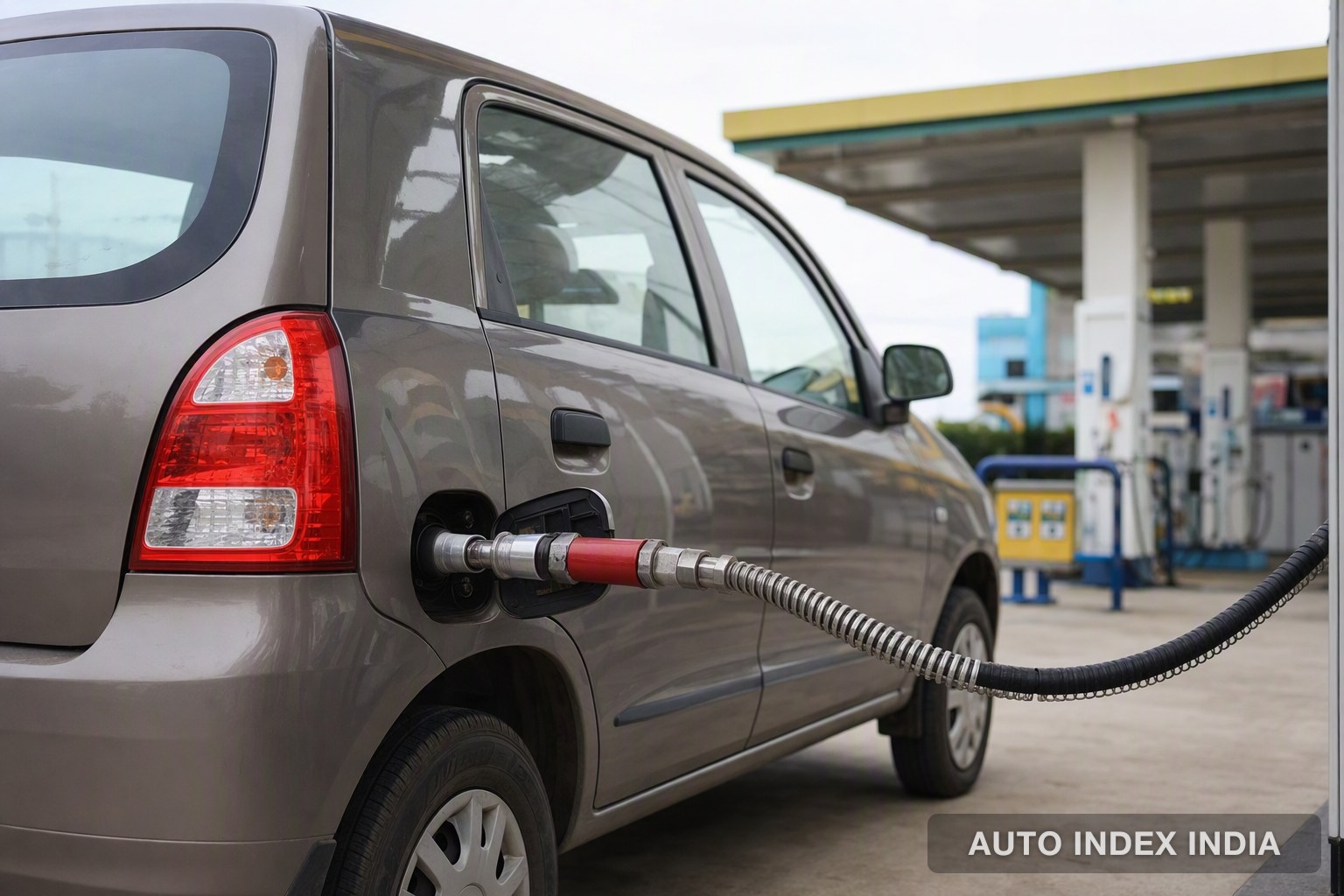
Hatchbacks With the Lowest Running Cost Per Km in India (2026)
Ranked on fuel cost per kilometre, factory CNG beats petrol comfortably in every case here. The Maruti Suzuki Celerio leads at roughly ₹2.47 per km on 34.43 km/kg, followed by the Baleno at about ₹2.53 (33.61 km/kg), the WagonR (33.47 km/kg) and Alto K10 (33.40 km/kg) at about ₹2.54, the Swift at ₹2.59 (32.85 km/kg) and the S-Presso (32.73 km/kg). The Toyota Glanza, Hyundai Grand i10 Nios, Tata Tiago and Tata Altroz complete the list. The Maruti CNG cars cluster tightly because they share closely related hardware, so the real differences come down to purchase price, boot space and how much of the range offers CNG at all.
The Maruti Suzuki Celerio CNG is the cheapest hatchback to run in India right now, at roughly ₹2.47 per kilometre on its ARAI-certified 34.43 km/kg. The Baleno CNG follows at ₹2.53 per km (33.61 km/kg), then the WagonR and Alto K10 at ₹2.54 (33.47 and 33.40 km/kg), the Swift at ₹2.59 (32.85 km/kg) and the S-Presso at ₹2.60 (32.73 km/kg). The first non-Maruti car on the list is the Toyota Glanza at ₹2.78 per km, and the most expensive of the ten, the Tata Altroz CNG, still only costs about ₹3.27 per km.
Most people buying a hatchback focus on price, looks, and a feature checklist. Running cost gets a passing glance, treated as a rough guess based on the fuel type printed on the brochure. That's a mistake. Two hatchbacks priced within a lakh of each other can end up costing meaningfully different amounts to actually drive, once engine size and fuel type are factored in properly.
The gap grows the more a car gets used. A daily commuter or a family putting real distance on their car every month will feel the difference between a hatchback that costs ₹2.50 per km to run and one that costs ₹4.00, in a way an occasional weekend driver simply won't.
This list ranks hatchbacks in India by estimated running cost per kilometer.
| Rank | Model | Fuel type | ARAI mileage | Estimated running cost/km* |
|---|---|---|---|---|
| 1 | Maruti Suzuki Celerio | CNG | 34.43 km/kg | ₹2.47 |
| 2 | Maruti Suzuki Baleno | CNG | 33.61 km/kg | ₹2.53 |
| 3 | Maruti Suzuki WagonR | CNG | 33.47 km/kg | ₹2.54 |
| 4 | Maruti Suzuki Alto K10 | CNG | 33.40 km/kg | ₹2.54 |
| 5 | Maruti Suzuki Swift | CNG | 32.85 km/kg | ₹2.59 |
| 6 | Maruti Suzuki S-Presso | CNG | 32.73 km/kg | ₹2.60 |
| 7 | Toyota Glanza | CNG | 30.61 km/kg | ₹2.78 |
| 8 | Hyundai Grand i10 Nios | CNG | ~27 km/kg (approx.) | ₹3.15 |
| 9 | Tata Tiago | CNG | 26.49 km/kg (approx.) | ₹3.21 |
| 10 | Tata Altroz | CNG | ~26 km/kg (approx.) | ₹3.27 |
*Estimated at ₹100/litre petrol, ₹85/kg CNG.
Maruti Suzuki and Toyota figures are the ARAI-certified numbers printed in each model's own brochure. Hyundai does not print ARAI mileage in its brochures at all, and Tata blocks automated access to its published specifications, so the Grand i10 Nios, Tiago and Altroz numbers here are our own and are worth confirming with a dealer before you buy on them.
Key takeaways
- Lowest running cost overall: the Maruti Suzuki Celerio CNG comes out cheapest at roughly ₹2.47 per km, on the back of a 34.43 km/kg ARAI figure from its 998cc K10C engine. The Baleno CNG is close behind at ₹2.53 per km.
- The top six are all Maruti, and that's genuinely earned: it isn't engine size alone doing the work, though. Maruti's CNG-specific tuning across both the 998cc K10C and the newer Z-Series 1.2 is what puts six of its hatchbacks ahead of everything else, and the 1197cc Baleno actually beats three of the smaller-engined cars on this list.
- Real competitors do make this list, just further down: the Toyota Glanza, Hyundai Grand i10 Nios, Tata Tiago, and Tata Altroz all appear here on their own merits, trailing the Maruti lineup by a real but modest margin.
- CNG beats petrol by a wide margin across every model: every Maruti hatchback here costs 30 to 40% less to run on CNG than on petrol. That gap holds true regardless of which specific model gets picked.
- The cheapest hatchback to buy isn't the cheapest to run: the S-Presso undercuts the Alto K10 on price, ₹3.49 lakh against ₹3.69 lakh, yet finishes sixth on running cost where the Alto K10 finishes fourth. Purchase price and running cost don't always move together.
What counts as running cost here
Running cost per km is calculated as fuel price divided by certified mileage, using ₹100 per litre for petrol and ₹85 per kg for CNG. ARAI, the government-recognized agency responsible for certifying fuel efficiency figures in India, tests every car under standardized lab conditions, which is why its numbers are used as the basis for comparison here rather than manufacturer marketing claims or user-reported figures, both of which vary far more from car to car and driver to driver. Where a manufacturer doesn't publish an ARAI figure, as Hyundai doesn't, the number used below is an approximation and is marked as one.
Actual fuel prices differ by state and fluctuate over time, so the running cost figures below should be read as a way to compare cars against each other, not as an exact monthly fuel bill.
Hatchbacks with the lowest running cost per km
1. Maruti Suzuki Celerio
Price: ₹4.70 lakh to ₹6.75 lakh ex-showroom.
The Celerio's 998cc K10C engine and light HEARTECT platform combine to give it the lowest running cost of any hatchback on this list.
Engine: 998cc K10C petrol, producing 68.5 PS and 91.1 Nm.
Mileage: 34.43 km/kg on CNG, ARAI certified; 24.97 to 26.00 km/l on petrol.
Estimated running cost: ₹2.47 per km on CNG, ₹3.85 to ₹4.00 per km on petrol.
Transmission options: 5-speed manual or Auto Gear Shift (AGS).
Warranty: 3 years or 1,00,000 km, standard.
2. Maruti Suzuki Baleno
Price: ₹5.99 lakh to ₹9.99 lakh ex-showroom, per Maruti's official brochure.
The Baleno is the surprise of this list. Its 1197cc engine is larger than the 998cc units in the Celerio, WagonR, Alto K10 and S-Presso, yet the move to Maruti's Z-Series has left it posting the second-best CNG figure here and beating three of those smaller cars outright. Engine size clearly isn't the whole story.
Engine: 1197cc Z-Series petrol, producing 82.93 PS (61 kW) and 112.4 Nm. Note that the Baleno has moved to the Z-Series and no longer shares the Glanza's engine.
Mileage: 23.80 to 24.77 km/l on petrol, 33.61 km/kg on CNG.
Estimated running cost: ₹2.53 per km on CNG, ₹4.04 to ₹4.20 per km on petrol.
Transmission options: 5-speed manual or AGS.
Warranty: 3 years or 1,00,000 km.
3. Maruti Suzuki WagonR
Price: From ₹4.98 lakh ex-showroom.
The WagonR ties closely with the Alto K10 on CNG running cost while offering the largest boot on this list at 335 litres, a useful trade-off for buyers who need both efficiency and cargo space.
Engine: 998cc or 1197cc petrol, with CNG offered on the 998cc variant.
Mileage: 24.35 km/l (1.0 manual) to 25.19 km/l (1.0 AGS) on petrol, 33.47 km/kg on CNG.
Estimated running cost: ₹2.54 per km on CNG, ₹3.97 to ₹4.11 per km on petrol.
Transmission options: 5-speed manual or AGS.
Warranty: 3 years or 1,00,000 km, standard.
4. Maruti Suzuki Alto K10
Price: From ₹3.69 lakh ex-showroom, which also makes it the cheapest Maruti hatchback that gets six airbags as standard.
The Alto K10 comes within a fraction of the WagonR's running cost while undercutting it on purchase price, making it a strong value pick for budget-focused buyers.
Engine: 998cc K10C petrol, producing 68.5 PS and 91.1 Nm.
Mileage: 24.39 km/l (manual) to 24.90 km/l (AGS) on petrol, 33.40 km/kg on CNG.
Estimated running cost: ₹2.54 per km on CNG, ₹4.02 to ₹4.10 per km on petrol.
Transmission options: 5-speed manual or AGS.
Warranty: 3 years or 1,00,000 km, standard.
5. Maruti Suzuki Swift
Price: From ₹5.83 lakh ex-showroom (LXi MT), rising to ₹8.51 lakh for the range-topping ZXi CNG.
The Swift's 1197cc engine is among the largest here, matching the Baleno's, and unlike the Baleno it doesn't convert that into a mileage advantage. At 32.85 km/kg it lands behind the Celerio and Baleno and just behind the 998cc WagonR and Alto K10, which puts it fifth rather than anywhere near the top.
Engine: 1197cc Z-series petrol, producing 81.58 PS (60 kW) and 111.7 Nm.
Mileage: 24.80 km/l (manual) to 25.75 km/l (AMT) on petrol, 32.85 km/kg on CNG.
Estimated running cost: ₹2.59 per km on CNG, ₹3.88 to ₹4.03 per km on petrol.
Transmission options: 5-speed manual or 5-speed AMT.
Warranty: 3 years or 1,00,000 km, whichever is earlier.
6. Maruti Suzuki S-Presso
Price: From ₹3.49 lakh ex-showroom, the most affordable car on this list to buy.
The S-Presso's tall-boy body doesn't cost it much on running cost, landing within a few paise of the WagonR and Alto K10 despite being priced lower than either.
Engine: 998cc K10C petrol, producing 68.5 PS and 91.1 Nm.
Mileage: 24.12 to 25.30 km/l on petrol depending on trim, 32.73 km/kg on CNG.
Estimated running cost: ₹2.60 per km on CNG, ₹3.95 per km on petrol (at the 25.30 km/l figure), ₹4.15 at the 24.12 km/l figure.
Transmission options: 5-speed manual or AGS.
Warranty: 3 years or 1,00,000 km, standard.
7. Toyota Glanza
Price: Broadly mirrors the Baleno's ₹5.99 lakh to ₹9.99 lakh range, a legacy of the two cars having shared a platform.
The Glanza is the rebadged Baleno built under Toyota-Suzuki's platform-sharing arrangement, but the two are no longer mechanically identical. The Baleno has moved to Maruti's Z-Series while the Glanza stays on the older 1.2 DualJet, so the Glanza's 30.61 km/kg on CNG now sits three full km/kg behind the Baleno's 33.61, and the running cost gap follows.
Engine: 1197cc, 4-cylinder petrol, producing 89.73 PS (66 kW) on petrol and 77.5 PS on CNG.
Mileage: Up to 22.94 km/l on petrol, 30.61 km/kg on CNG.
Estimated running cost: ₹2.78 per km on CNG, ₹4.36 per km on petrol.
Transmission options: 5-speed manual or AGS.
Warranty: Standard Toyota warranty terms apply.
8. Hyundai Grand i10 Nios
Price: ₹7.16 lakh (Magna CNG) to ₹8.46 lakh (Asta CNG) ex-showroom.
The Grand i10 Nios is the first genuine non-Maruti, non-Toyota competitor on this list. Its larger 1.2-litre, 4-cylinder engine can't match the smaller Maruti units on mileage, but it's a real, distinct option for buyers who prefer Hyundai's dealer network or cabin refinement.
Engine: 1197cc, 4-cylinder petrol, producing roughly 69 PS and 95 Nm on CNG, 83 PS and 114 Nm on petrol.
Mileage: Around 27 km/kg on CNG. Hyundai doesn't print ARAI mileage in its brochures, so treat this as an approximation rather than a certified figure.
Estimated running cost: ₹3.15 per km on CNG, on that approximate mileage.
Transmission options: 5-speed manual only on CNG; petrol variants also offer AMT.
Warranty: Standard Hyundai warranty terms apply.
9. Tata Tiago
Price: ₹6.60 lakh to ₹8.35 lakh ex-showroom (manual), up to ₹8.90 lakh on AMT variants.
The Tiago uses Tata's twin-cylinder CNG tank design, which preserves more boot space than a conventional single-tank setup. That's a genuine practical advantage, even though it doesn't close the mileage gap to the Maruti lineup.
Engine: 1199cc, 3-cylinder Revotron petrol, producing 73.4 PS on CNG.
Mileage: 26.49 km/kg (manual) to 28.06 km/kg (AMT). Tata blocks automated access to its published specifications, so these are unverified figures rather than confirmed ARAI ones.
Estimated running cost: ₹3.21 per km on CNG (manual), on the unverified mileage above.
Transmission options: 5-speed manual or 5-speed AMT, both available with CNG.
Warranty: Standard Tata warranty terms apply.
10. Tata Altroz
Price: Falls within the Altroz's broader ₹6.30 lakh to ₹10.51 lakh range; CNG trims sit in the mid-range.
The Altroz was the first hatchback in India to get Tata's twin-cylinder CNG technology, a genuine engineering first that improves usable boot space over older single-tank designs, even though it closes out this list on pure running cost.
Engine: 1199cc, 3-cylinder petrol, CNG-specific output not independently confirmed here.
Mileage: Around 26 km/kg on CNG, again unverified rather than confirmed, for the same reason as the Tiago.
Estimated running cost: ₹3.27 per km on CNG.
Transmission options: 5-speed manual.
Warranty: Standard Tata warranty terms apply.
Conclusion
Running cost is easy to overlook next to price and features, but it adds up fast over years of ownership, especially for anyone driving a meaningful distance each month. CNG comes out well ahead of petrol across the board here, regardless of which hatchback gets picked, so it's worth treating as a separate decision from the model itself. Beyond that, the differences between individual cars are real but modest, a matter of a few paise per kilometer rather than a dramatic gap. Purchase price, boot space, brand preference, and dealer network are just as reasonable a basis for the final choice as running cost alone.
FAQs
Which hatchback in India has the lowest running cost?
The Maruti Suzuki Celerio has the lowest estimated running cost on this list, at roughly ₹2.47 per km on its CNG variant, assuming a CNG price of ₹85/kg. The Baleno CNG is next at ₹2.53 per km.
Why are Maruti hatchbacks so dominant on this list?
Maruti tunes its CNG variants harder than its rivals do, and it does it across two different engines: the 998cc K10C in the Celerio, WagonR, Alto K10 and S-Presso, and the newer Z-Series 1.2 in the Baleno. Engine size alone doesn't explain the result, since the 1197cc Baleno posts 33.61 km/kg and beats three of the 998cc cars here.
Do any non-Maruti hatchbacks make this list?
Yes. The Toyota Glanza, Hyundai Grand i10 Nios, Tata Tiago, and Tata Altroz all appear here, each trailing the Maruti lineup on running cost.
Is CNG always cheaper to run than petrol?
Among the hatchbacks on this list, yes. Every Maruti model here costs 30% or more less per km on CNG than on petrol, based on the ARAI figures in Maruti's own brochures.
Which non-Maruti CNG hatchback has an advantage besides running cost?
The Tata Tiago and Tata Altroz both use twin-cylinder CNG tank technology, which preserves more usable boot space than a single-tank design, a genuine practical benefit even though it doesn't beat the Maruti lineup on running cost.
Last verified: 2026-09-20
Sources
- Maruti Celerio price: Maruti Suzuki Arena
- Maruti Baleno brochure: NEXA
- Maruti Baleno price: NEXA
- Maruti WagonR price: Maruti Suzuki Arena
- Maruti Alto K10 price: Maruti Suzuki Arena
- Maruti Swift brochure: Maruti Suzuki Arena
- Maruti S-Presso: Maruti Suzuki Arena
- Toyota Glanza brochure: Toyota Kirloskar Motor
- Hyundai Grand i10 Nios brochure: Hyundai Motor India
- Tata Motors brochures: Tata Motors