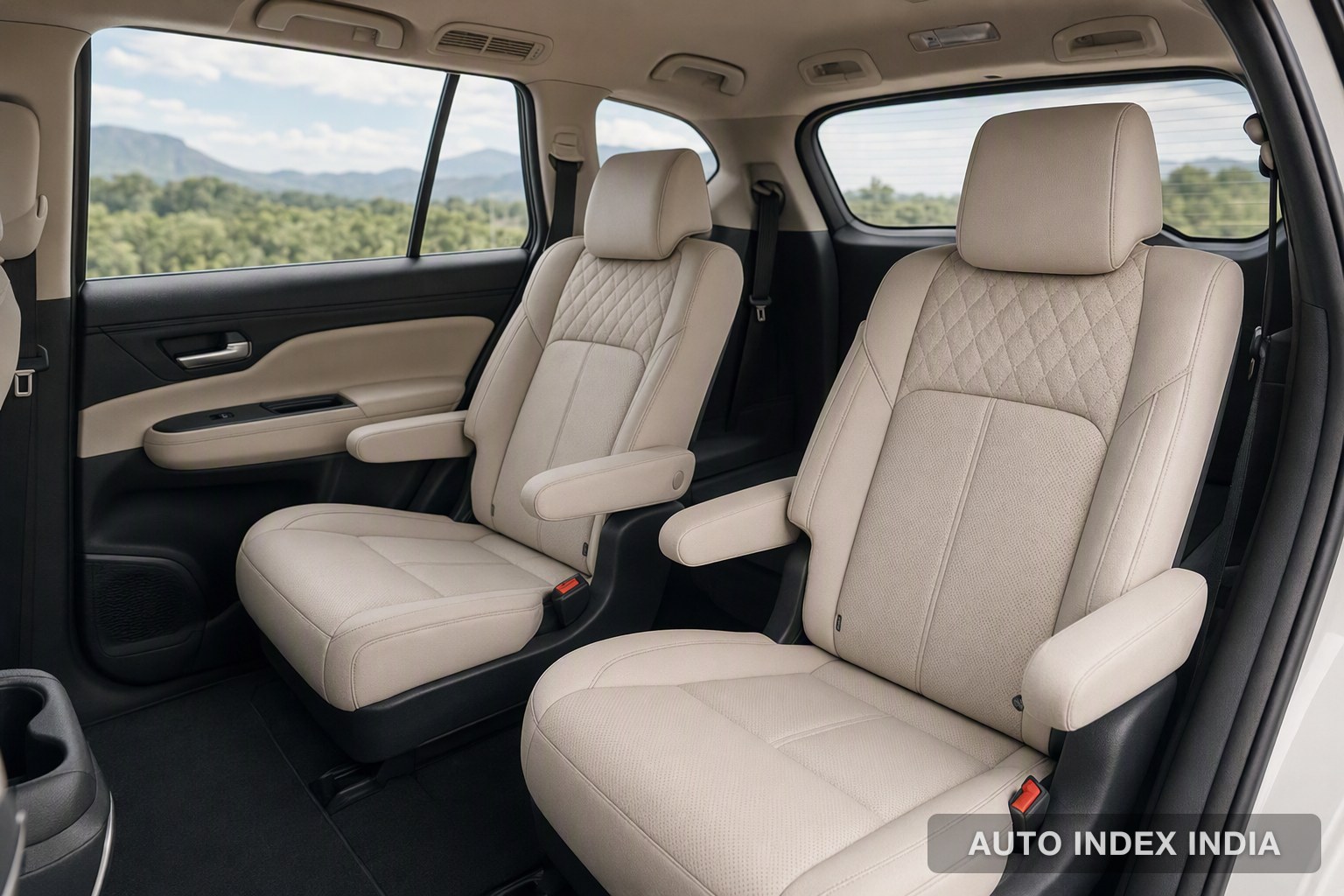
Best 6-Seater MPVs With Captain Seats Under Rs 20 Lakh in India (2026)
Captain seats are common; a true six-seat layout is not. Most Indian MPVs at this price are built to seat seven or eight, and captain seats are offered as an alternative second row inside a seven-seater rather than as a six-seat model.
Under Rs 20 lakh in India, the genuine six-seater MPV with captain seats comes down to two cars: the Maruti Suzuki XL6, from Rs 11.62 lakh, and the Kia Carens Clavis EV, from about Rs 17.99 lakh. Everything else worth considering at this money is a seven-seater that happens to offer captain seats in the middle row. The XL6 is the stronger case of the two on paper, because its brochure lists a seating capacity of six on both the petrol and the CNG variant and puts captain seats on every trim with no exceptions.
That is a thinner field than the search results suggest, and it is worth being straight about why. Captain seats, meaning two individually reclining seats in row two instead of a shared bench, are common enough. A true six-seat layout, where row three seats two rather than three, is not. Most Indian MPVs in this price band are built to seat seven or eight because that is what buyers ask for, and captain seats get offered as an alternative row-two arrangement inside a seven-seat car rather than as a six-seat model of their own.
Six-seater and captain-seat MPVs under Rs 20 lakh at a glance
| Model | Layout | Price | Powertrain | Certified efficiency |
|---|---|---|---|---|
| Maruti Suzuki XL6 | True six-seater, captain seats on every trim | Rs 11.62 lakh to Rs 14.68 lakh | 1.5 K15C petrol or CNG | 20.90 km/l manual, 20.27 km/l automatic, 26.23 km/kg CNG |
| Kia Carens Clavis EV | Six-seat captain layout on HTX and above | From about Rs 17.99 lakh | 42 kWh electric | 404 km claimed range |
| Toyota Innova Crysta | Seven or eight seats, captain seats in the seven-seat form | Not published by Toyota | 2.4 diesel, 150 PS | Not published by Toyota |
Prices are ex-showroom Delhi as on 30 September 2026. The XL6 range comes from Maruti's own NEXA price list. Kia does not publish a consolidated ex-showroom table for the Clavis EV, so that figure is drawn from launch reporting and should be treated as indicative. Toyota does not publish ex-showroom prices for the Innova Crysta in India at all, which is why this table leaves that cell blank rather than guessing.
What actually counts as a six-seater with captain seats
A true six-seater has two individually adjustable, reclining captain seats in row two and a two-seat row three, for six in total. A seven-seater with captain seats keeps the same row two but seats three across row three. In daily use the difference is smaller than the spec sheet implies, because the part you notice, the individual seat with its own armrest and recline, is identical in both. The difference shows up when you need the seventh seat, or when you want the wider walkthrough that a two-seat rear bench allows.
Both configurations are covered below and labelled clearly, because pretending the true six-seater field is bigger than it is would not help anyone shopping.
1. Maruti Suzuki XL6
The XL6 exists because of its captain seats. Maruti's brochure lists the row as "2nd Row Plush Captain Seats with One-Touch Recline and Slide" with no variant exception next to it, which means every XL6, petrol or CNG, manual or automatic, has them. Seating capacity reads six in both the petrol and CNG columns. Row three splits 50:50 and reclines, and folds flat when you need the space.
Engine. The 1.5-litre K15C Smart Hybrid makes 75.8 kW, which Maruti states as 103.05 PS, at 6,000 rpm, with 139 Nm at 4,300 rpm from 1,462 cc. The CNG variant is set up differently: 74 kW and 137.1 Nm in petrol mode, dropping to 64.6 kW, or 87.8 PS, and 121.5 Nm at 4,200 rpm when running on gas.
Efficiency. Maruti certifies 20.90 km/l for the manual and 20.27 km/l for the automatic on petrol, and 26.23 km/kg on CNG. Note those numbers if you have seen 20.97 quoted elsewhere, because the brochure figure is 20.90.
Fuel tank. 45 litres on petrol. The CNG variant keeps the 45-litre petrol tank and adds a 60-litre water-equivalent CNG cylinder, so it genuinely has two usable ranges rather than a compromised one.
Dimensions. 4,485 mm long, 1,775 mm wide, 1,745 mm tall, on a 2,740 mm wheelbase, with a 5.2 m turning radius. That last figure is the one that matters in a city, and it is tighter than most seven-seaters this size manage.
Gearboxes. A 5-speed manual or a 6-speed automatic on petrol. CNG is manual only.
What it does not have. No sunroof and no head-up display at any trim, despite both turning up regularly in write-ups of this car. The largest screen in the range is the 17.78 cm SmartPlay Pro. Cruise control is standard from the base Zeta trim upward, which is genuinely unusual at this price. Maruti's brochure publishes no boot volume, so the 209-litre figure you will see quoted is a measured or reported number rather than a Maruti one.
Safety. No Bharat NCAP or Global NCAP result exists for the XL6. Six airbags are standard and the 360-degree camera arrives on Alpha.
2. Kia Carens Clavis EV
The Clavis EV is the only way to get a six-seat captain-seat layout from Kia now, because the petrol, diesel and CNG Carens and Carens Clavis no longer offer that configuration at all. If a Kia six-seater is specifically what you want, this is the car, and that is a meaningful constraint rather than a footnote.
Kia's own specs page lists the row as "2nd Row Captain Seats with Sliding, Reclining and Tumble [6 Seater]" and offers it across most of the trim range, from HTX(E) upward. The tumble function matters more than it sounds: it is what lets you reach row three without folding a seat forward and climbing over it. Kia lists two battery packs, and the standard-range car uses the 42 kWh one with a claimed range of 404 km. The motor is reported at about 134.6 PS with 255 Nm, though Kia does not publish those figures on its India specs page. DC fast charging takes it from 10 to 80 percent in roughly 39 minutes.
Kia has not published a boot figure for the six-seat configuration specifically, and no Bharat NCAP or Global NCAP result exists for the Clavis EV yet. Warranty follows Kia's standard India terms, with separate battery coverage of the kind every EV carries.
3. Toyota Innova Crysta
The Crysta is a seven-or-eight-seater rather than a true six-seater, and its spec sheet makes the arrangement clear: seating capacity reads "7 / 8 Seater" on the G, GX, GX+ and VX grades and "7 Seater" on the ZX. So the captain-seat layout is the seven-seat option, available across the range, and the ZX is captain-seat only.
Every grade runs the same 2,393 cc diesel at 110 kW, which Toyota states as 150 PS, with 343 Nm, and every grade uses a 5-speed manual. ECO and Power drive modes are standard throughout. Toyota does not print an ARAI efficiency figure on the spec sheet, so anything you see quoted for this car comes from elsewhere.
On safety, there is no Bharat NCAP or Global NCAP result. The Crysta holds a five-star ASEAN NCAP rating from a 2020 assessment, which is a different body running a different protocol on a different market's car, and is not comparable to either Indian rating.
Toyota's reason to be on this list is not its specification. It is that the Crysta is the captain-seat MPV with the deepest service network and the most settled resale behaviour, and for a lot of buyers that outweighs a spec sheet.
Which one to buy
If you want a genuine six-seater and you want it to cost as little as possible, the XL6 is the answer and it is not close. It is the cheapest car here by around Rs 6 lakh, its captain seats are standard rather than a top-trim reward, and the CNG option gives it a running cost no electric or diesel rival on this list can match on a per-kilometre basis once you account for purchase price.
If you want the same six-seat layout and you are ready to go electric, the Clavis EV is the only alternative, and the 404 km claimed range on the standard battery is enough for city and regional use. Be clear-eyed that you are paying about Rs 6 lakh more than the XL6 for it.
If you need the seventh seat and want the most proven car, the Crysta is the one, at the cost of accepting a five-speed manual as your only gearbox and no published efficiency figure.
Frequently asked questions
Is the Maruti XL6 a true six-seater with captain seats?
Yes. The brochure lists a seating capacity of six on both petrol and CNG and puts the captain seat row on every variant with no exception, so there is no XL6 without them.
Does Kia still sell a petrol or diesel Carens with six seats?
No. The petrol, diesel and CNG Carens and Carens Clavis are seven-seaters now. The six-seat captain-seat layout is exclusive to the Carens Clavis EV.
Is the Toyota Innova Crysta a six-seater or a seven-seater?
A seven-seater. Its captain-seat configuration puts individual seats in row two and a three-seat bench in row three. The spec sheet lists it as a seven or eight seater on most grades and a seven-seater only on the ZX.
Which car here has the best confirmed crash rating?
None of them has a Bharat NCAP or Global NCAP result. If a confirmed Indian crash rating is your priority in a captain-seat MPV, you have to look above Rs 20 lakh.
What is the real efficiency difference between the XL6 petrol and CNG?
Maruti certifies 20.90 km/l for the petrol manual and 26.23 km/kg for the CNG. Because CNG costs less per kilogram than petrol does per litre in most Indian cities, the running-cost gap is wider than those two numbers alone suggest.
Last verified: 2026-09-30